Pearson Edexcel · GCSE · History
Course version: 1HI0 · Version from Sept 2016
Key topic 1: The development of the civil rights movement, 1954–60 - 1 The…
Full specification wording
Option 33: Key topic 1: The development of the civil rights movement, 1954–60 - 1 The position of Black Americans in the early 1950s: The work of civil rights organisations, including the NAACP and CORE.
In the early 1950s, civil rights organisations used distinct strategies to challenge racial inequality.
Checked against the Pearson Edexcel 1HI0 specification (opens in a new tab) on .
- Point 2 of 2
Study notes
From the checked teaching notes for this specification point.
The idea
In the early 1950s, civil rights organisations used distinct strategies to challenge racial inequality. The National Association for the Advancement of Colored People (NAACP) focused on legal battles to dismantle segregation. Led by Thurgood Marshall, they fought Jim Crow in the courts, culminating in the 1954 Brown v. Board of Education ruling against segregated schools. Conversely, the Congress of Racial Equality (CORE) pioneered non-violent direct action. Influenced by Gandhi, CORE organised early sit-ins and the 1947 Journey of Reconciliation to test desegregation on transport. Together, these organisations laid the crucial legal and tactical groundwork for the mass protests of the later civil rights movement.
What earns the marks
- The NAACP's strategy of using the judicial system to challenge the constitutionality of segregation laws.
- The NAACP's role in providing legal representation for Black Americans facing discrimination or false accusations.
- CORE's foundational role in introducing non-violent direct action tactics, such as sit-ins and boycotts, to the movement.
- CORE's early campaigns, such as the 1947 Journey of Reconciliation, which tested Supreme Court rulings on desegregated interstate travel.
Common mistakes and how to put them right
Confusing the tactics of the NAACP and CORE.
Put it right: Clearly distinguish that the NAACP focused on litigation and legal challenges, whereas CORE focused on non-violent direct action.
Assuming these organisations only started working in the 1950s.
Put it right: Acknowledge that both the NAACP (founded 1909) and CORE (founded 1942) had been laying the groundwork for civil rights long before the 1950s.
Stating that Martin Luther King Jr. founded the NAACP or CORE.
Put it right: Note that MLK was associated with the SCLC, while the NAACP and CORE had different leadership such as Thurgood Marshall and James Farmer.
Exam tips
- Contrast the legal approach of the NAACP with the direct action approach of CORE to demonstrate a deep understanding of civil rights strategies.
- Mention Thurgood Marshall when discussing the NAACP's legal victories to add specific historical detail.
- Use the 1954 Brown v. Board of Education decision as the prime example of the NAACP's successful legal strategy.
Try the lesson
The start of the Option 33: Key topic 1: The development of the civil rights movement, 1954–60 - 1 The position of Black Americans in the early 1950s: The work of civil rights organisations, including the NAACP and CORE. lesson, made from checked teaching notes for this specification point.
Have a go first
What was the primary strategy used by the National Association for the Advancement of Colored People (NAACP) in the early 1950s to challenge segregation?
Listen
In the early 1950s, civil rights organisations used distinct strategies to challenge racial inequality. The National Association for the Advancement of Colored People (NAACP) focused on legal battles to dismantle segregation. Led by Thurgood Marshall, they fought Jim Crow in the courts, culminating in the 1954 Brown v. Board of Education ruling against segregated schools. Conversely, the Congress of Racial Equality (CORE) pioneered non-violent direct action. Influenced by Gandhi, CORE organised early sit-ins and the 1947 Journey of Reconciliation to test desegregation on transport. Together, these organisations laid the crucial legal and tactical groundwork for the mass protests of the later civil rights movement. A strong answer earns marks for these points. The NAACP's strategy of using the judicial system to challenge the constitutionality of segregation laws. The NAACP's role in providing legal representation for Black Americans facing discrimination or false accusations. CORE's foundational role in introducing non-violent direct action tactics, such as sit-ins and boycotts, to the movement. CORE's early campaigns, such as the 1947 Journey of Reconciliation, which tested Supreme Court rulings on desegregated interstate travel. A common slip: Confusing the tactics of the NAACP and CORE. Instead, Clearly distinguish that the NAACP focused on litigation and legal challenges, whereas CORE focused on non-violent direct action. Exam tip: Contrast the legal approach of the NAACP with the direct action approach of CORE to demonstrate a deep understanding of civil rights strategies.
See it
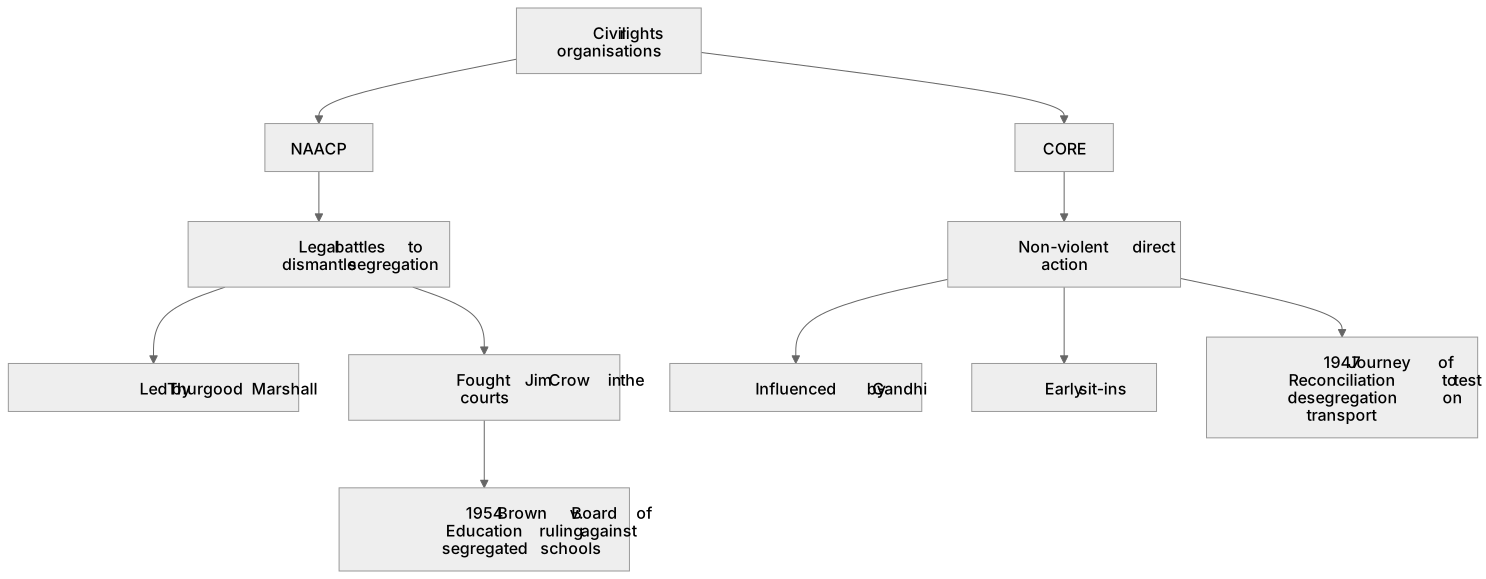
Label the diagram
Some boxes have lost their names. Pick the right name for each number.
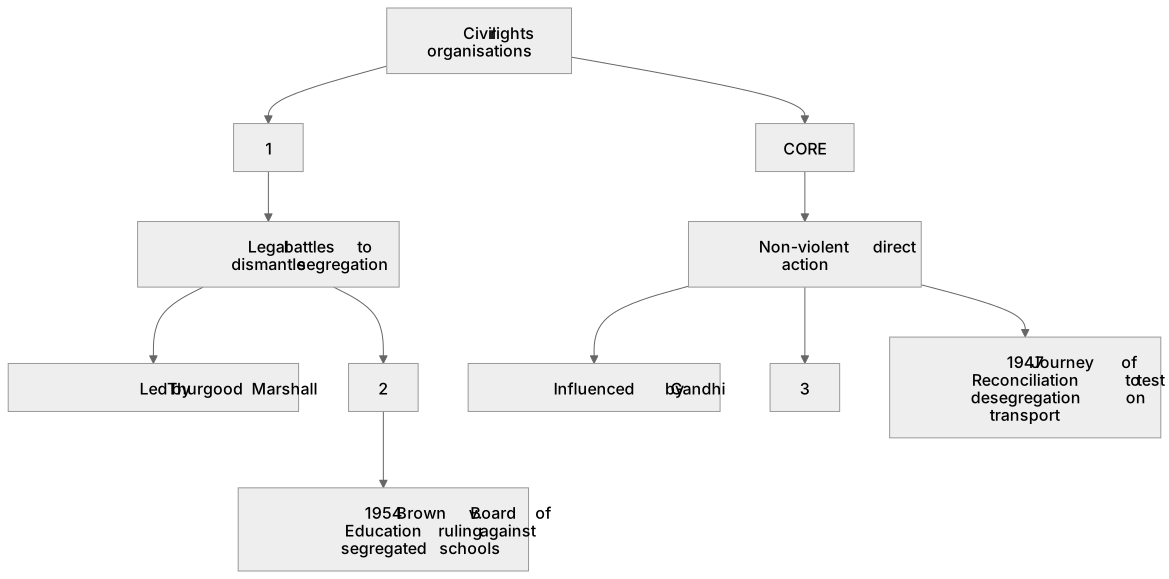
1Box 1
2Box 2
3Box 3
There is more to this lesson
The full lesson goes on to check your understanding and help you earn the marks. Create a free account to carry on, with your progress saved.
A week of Premium from your first lesson · Then the free plan continues · No card, no charge
Test your understanding of Option 33: Key topic 1: The development of the civil rights movement, 1954–60 - 1 The position of Black Americans in the early 1950s: The work of civil rights organisations, including the NAACP and CORE.
Active recall beats re-reading. Take an instant quiz now to test what you’ve learned and lock it into long-term memory.
A week of Premium from your first lesson · Then the free plan continues · No card, no charge