Pearson Edexcel · GCSE · History
Course version: 1HI0 · Version from Sept 2016
Key topic 1: The development of the civil rights movement, 1954–60 - 2…
Full specification wording
Option 33: Key topic 1: The development of the civil rights movement, 1954–60 - 2 Developments in education: Reasons for, key features and significance of the Brown v. Topeka case (1954).
The Brown v.
Checked against the Pearson Edexcel 1HI0 specification (opens in a new tab) on .
- Point 1 of 2
- 4 key terms
Study notes
From the checked teaching notes for this specification point.
The idea
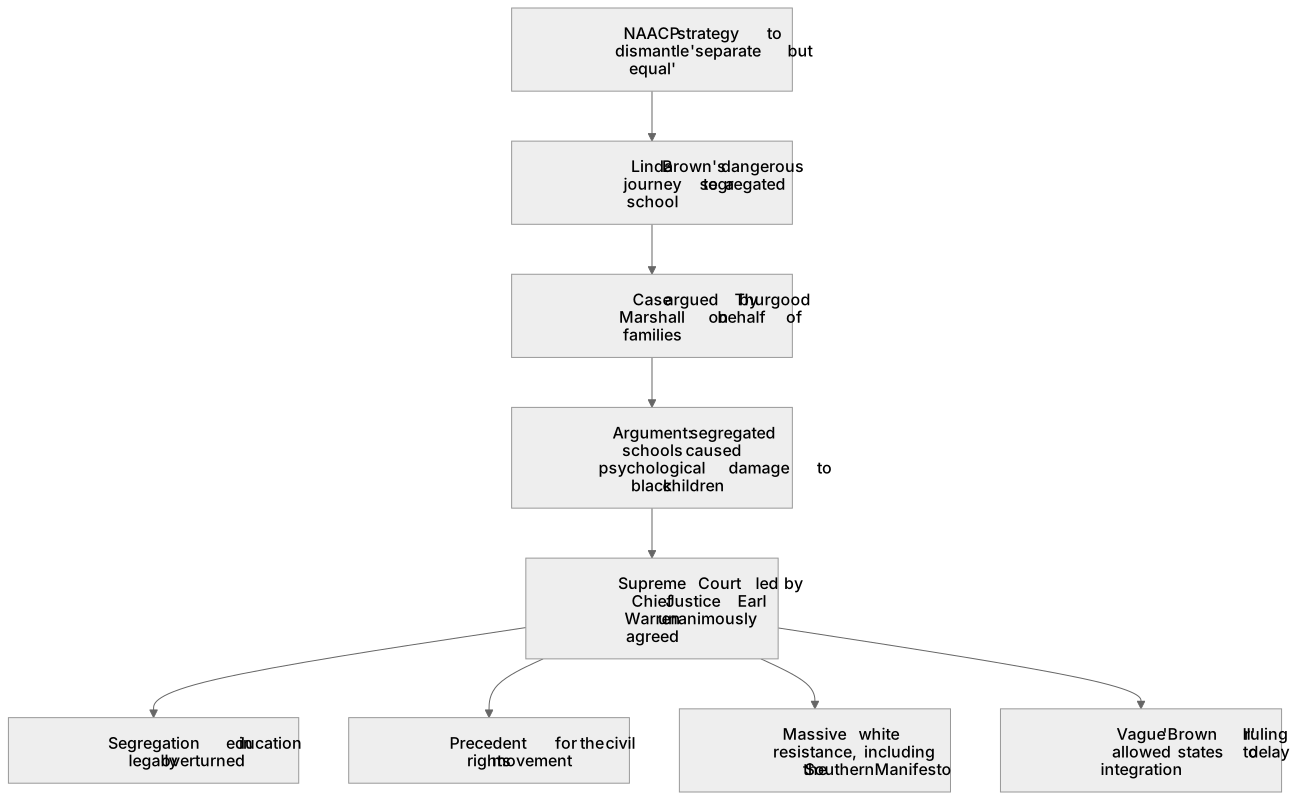
The Brown v. Topeka case (1954) was driven by the NAACP's strategy to dismantle the 'separate but equal' doctrine established by Plessy v. Ferguson. The immediate reason was Linda Brown's dangerous journey to a segregated school when a white school was much closer. A key feature of the case was Thurgood Marshall's argument that segregated schools caused psychological damage to black children, making them inherently unequal. The Supreme Court, led by Chief Justice Earl Warren, unanimously agreed. The significance of this ruling was profound: it legally overturned segregation in education and provided a crucial precedent for the civil rights movement. However, it also sparked massive white resistance, including the Southern Manifesto, and the vague 'Brown II' ruling allowed states to delay integration.
What earns the marks
- Explain the role of the NAACP in using the courts to challenge the 'separate but equal' precedent.
- Describe the psychological evidence presented by Thurgood Marshall regarding the impact of segregation on black children.
- Analyse the immediate significance of the unanimous Supreme Court decision in overturning Plessy v. Ferguson.
- Evaluate the limitations of the ruling, specifically the vague 'all deliberate speed' directive in Brown II.
Common mistakes and how to put them right
Stating that Brown v. Topeka immediately desegregated all schools in the USA.
Put it right: Explain that the ruling only applied to education and many Southern states actively resisted or delayed integration.
Confusing the Brown case with the Montgomery Bus Boycott.
Put it right: Ensure Brown v. Topeka is explicitly linked to education and the NAACP's legal strategy, not transport.
Claiming Linda Brown argued the case herself.
Put it right: Clarify that the NAACP and lawyer Thurgood Marshall argued the case on behalf of several families, including the Browns.
Exam tips
- Use the phrase 'separate but equal' when discussing the legal precedent that the Brown case successfully overturned.
- Mention the 'Southern Manifesto' as concrete evidence of the political resistance to the Supreme Court's ruling.
- When evaluating significance, contrast the legal victory with the practical delays caused by the 'Brown II' ruling.
Try the lesson
The start of the Option 33: Key topic 1: The development of the civil rights movement, 1954–60 - 2 Developments in education: Reasons for, key features and significance of the Brown v. Topeka case (1954). lesson, made from checked teaching notes for this specification point.
Have a go first
What was the main legal principle overturned by the Supreme Court in the Brown v. Topeka ruling of 1954?
Listen
The Brown v. Topeka case (1954) was driven by the NAACP's strategy to dismantle the 'separate but equal' doctrine established by Plessy v. Ferguson. The immediate reason was Linda Brown's dangerous journey to a segregated school when a white school was much closer. A key feature of the case was Thurgood Marshall's argument that segregated schools caused psychological damage to black children, making them inherently unequal. The Supreme Court, led by Chief Justice Earl Warren, unanimously agreed. The significance of this ruling was profound: it legally overturned segregation in education and provided a crucial precedent for the civil rights movement. However, it also sparked massive white resistance, including the Southern Manifesto, and the vague 'Brown II' ruling allowed states to delay integration. A strong answer earns marks for these points. Explain the role of the NAACP in using the courts to challenge the 'separate but equal' precedent. Describe the psychological evidence presented by Thurgood Marshall regarding the impact of segregation on black children. Analyse the immediate significance of the unanimous Supreme Court decision in overturning Plessy v. Ferguson. Evaluate the limitations of the ruling, specifically the vague 'all deliberate speed' directive in Brown II. A common slip: Stating that Brown v. Topeka immediately desegregated all schools in the USA. Instead, Explain that the ruling only applied to education and many Southern states actively resisted or delayed integration. Exam tip: Use the phrase 'separate but equal' when discussing the legal precedent that the Brown case successfully overturned.
See it
Key words
Say what each word means before you turn the card.
Legal challenges
Try answering aloud or in your head before turning the card.
Segregation
Try answering aloud or in your head before turning the card.
White resistance
Try answering aloud or in your head before turning the card.
Separate but equal
Try answering aloud or in your head before turning the card.
See every definition
- Legal challenges
- The NAACP's strategy of using the courts to challenge the 'separate but equal' precedent, with the Brown v. Topeka case driven by this approach.
- Segregation
- The practice legally overturned in education by the unanimous Supreme Court ruling, which provided a crucial precedent for the civil rights movement.
- White resistance
- Massive opposition sparked by the ruling, including the Southern Manifesto, while the vague 'Brown II' ruling allowed states to delay integration.
- Separate but equal
- The doctrine established by Plessy v. Ferguson, which the NAACP's strategy sought to dismantle and which the Brown ruling legally overturned in education.
Label the diagram
Some boxes have lost their names. Pick the right name for each number.
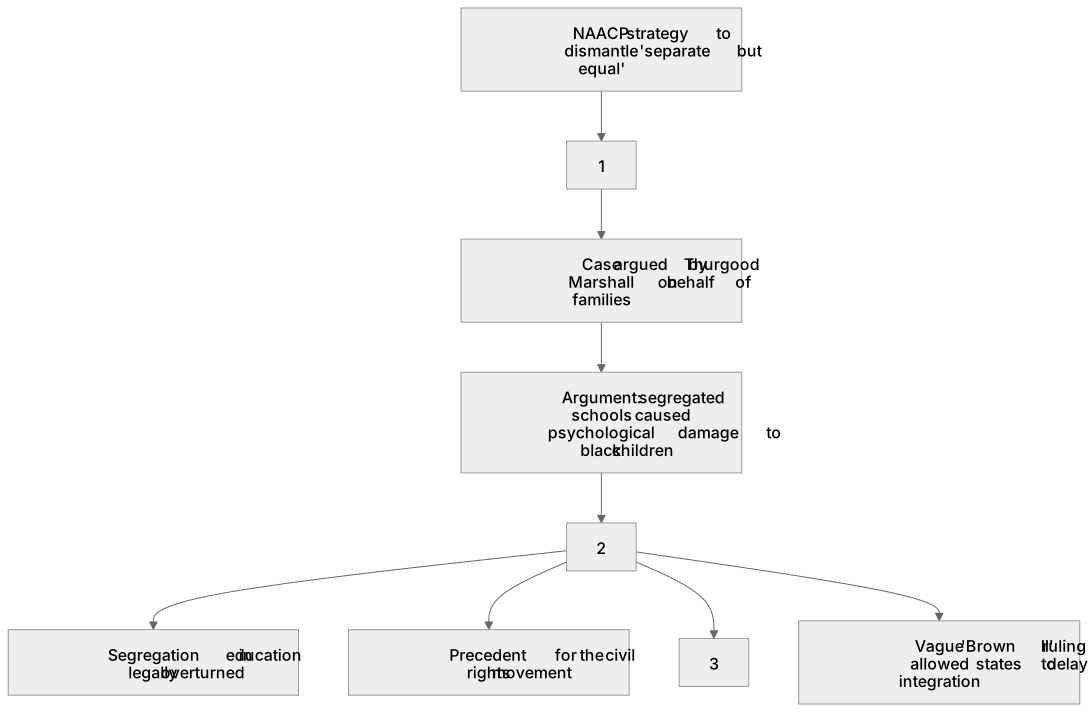
1Box 1
2Box 2
3Box 3
There is more to this lesson
The full lesson goes on to check your understanding and help you earn the marks. Create a free account to carry on, with your progress saved.
A week of Premium from your first lesson · Then the free plan continues · No card, no charge
Test your understanding of Option 33: Key topic 1: The development of the civil rights movement, 1954–60 - 2 Developments in education: Reasons for, key features and significance of the Brown v. Topeka case (1954).
Active recall beats re-reading. Take an instant quiz now to test what you’ve learned and lock it into long-term memory.
A week of Premium from your first lesson · Then the free plan continues · No card, no charge