Pearson Edexcel · GCSE · History
Course version: 1HI0 · Version from Sept 2016
Key topic 1: The development of the civil rights movement, 1954–60 - 2…
Full specification wording
Option 33: Key topic 1: The development of the civil rights movement, 1954–60 - 2 Developments in education: Reasons for, key features and significance of the events at Little Rock High School (1957).
The events at Little Rock High School in 1957 stemmed from the local school board's plan to gradually comply with the Brown v.
Checked against the Pearson Edexcel 1HI0 specification (opens in a new tab) on .
- Point 2 of 2
- 4 key terms
Study notes
From the checked teaching notes for this specification point.
The idea
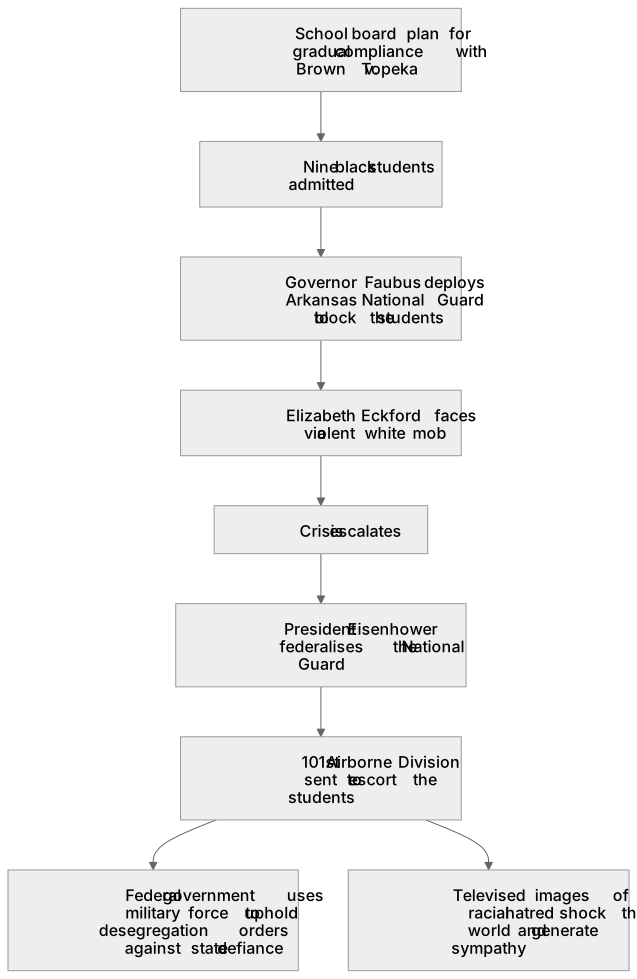
The events at Little Rock High School in 1957 stemmed from the local school board's plan to gradually comply with the Brown v. Topeka ruling by admitting nine black students. A key feature was Governor Faubus deploying the Arkansas National Guard to block the students, leaving Elizabeth Eckford to face a violent white mob. The crisis escalated until President Eisenhower intervened, federalising the National Guard and sending the 101st Airborne Division to escort the students. The significance of Little Rock lies in demonstrating that the federal government would use military force to uphold federal court desegregation orders against state defiance. Furthermore, televised images of racial hatred shocked the world and generated sympathy.
What earns the marks
- Identify the gradual integration plan of the Little Rock school board as the reason for the events.
- Describe the actions of Governor Orval Faubus in using the National Guard to block the Little Rock Nine.
- Explain the significance of President Eisenhower's decision to federalise the National Guard and deploy the 101st Airborne Division.
- Analyse the impact of media coverage of the events on national and international opinion regarding US civil rights.
Common mistakes and how to put them right
Stating that President Eisenhower intervened immediately because he strongly supported civil rights.
Put it right: Explain that Eisenhower was reluctant to intervene but was forced to act to uphold federal law and the authority of the Supreme Court.
Believing the Little Rock Nine were the only black students in Arkansas.
Put it right: Clarify that they were specifically chosen to be the first to integrate Central High School as part of a gradual integration plan, not a test case.
Assuming the integration of Little Rock High School ended racism in the school.
Put it right: Note that the students faced severe bullying inside the school and Faubus closed the schools the following year.
Exam tips
- Highlight the conflict between state government (Faubus) and federal government (Eisenhower) as a key feature of the crisis.
- Use Elizabeth Eckford's experience as a specific example of the hostility faced by the Little Rock Nine.
- Discuss the role of television and photojournalism in making Little Rock a turning point in public awareness.
Try the lesson
The start of the Option 33: Key topic 1: The development of the civil rights movement, 1954–60 - 2 Developments in education: Reasons for, key features and significance of the events at Little Rock High School (1957). lesson, made from checked teaching notes for this specification point.
Have a go first
What action did President Eisenhower take in response to the events at Little Rock High School in 1957?
Listen
The events at Little Rock High School in 1957 stemmed from the local school board's plan to gradually comply with the Brown v. Topeka ruling by admitting nine black students. A key feature was Governor Faubus deploying the Arkansas National Guard to block the students, leaving Elizabeth Eckford to face a violent white mob. The crisis escalated until President Eisenhower intervened, federalising the National Guard and sending the 101st Airborne Division to escort the students. The significance of Little Rock lies in demonstrating that the federal government would use military force to uphold federal court desegregation orders against state defiance. Furthermore, televised images of racial hatred shocked the world and generated sympathy. A strong answer earns marks for these points. Identify the gradual integration plan of the Little Rock school board as the reason for the events. Describe the actions of Governor Orval Faubus in using the National Guard to block the Little Rock Nine. Explain the significance of President Eisenhower's decision to federalise the National Guard and deploy the 101st Airborne Division. Analyse the impact of media coverage of the events on national and international opinion regarding US civil rights. A common slip: Stating that President Eisenhower intervened immediately because he strongly supported civil rights. Instead, Explain that Eisenhower was reluctant to intervene but was forced to act to uphold federal law and the authority of the Supreme Court. Exam tip: Highlight the conflict between state government (Faubus) and federal government (Eisenhower) as a key feature of the crisis.
See it
Key words
Say what each word means before you turn the card.
Federal intervention
Try answering aloud or in your head before turning the card.
Media impact
Try answering aloud or in your head before turning the card.
State resistance
Try answering aloud or in your head before turning the card.
Youth involvement
Try answering aloud or in your head before turning the card.
See every definition
- Federal intervention
- President Eisenhower federalised the National Guard and sent the 101st Airborne Division to escort the students, showing the federal government would use military force to uphold federal court desegregation orders against state defiance.
- Media impact
- Televised images of racial hatred shocked the world and generated sympathy, making Little Rock a turning point in public awareness.
- State resistance
- Governor Faubus deployed the Arkansas National Guard to block the students, leaving Elizabeth Eckford to face a violent white mob.
- Youth involvement
- Nine black students were admitted under the local school board's plan to gradually comply with the Brown v. Topeka ruling.
Label the diagram
Some boxes have lost their names. Pick the right name for each number.
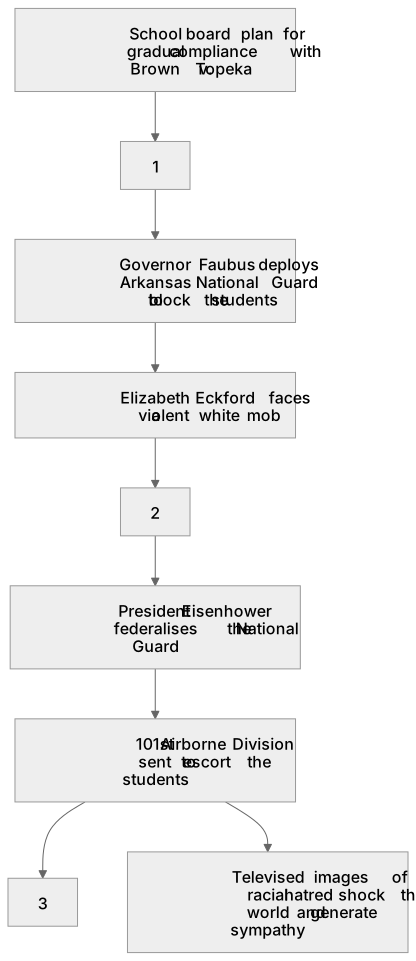
1Box 1
2Box 2
3Box 3
There is more to this lesson
The full lesson goes on to check your understanding and help you earn the marks. Create a free account to carry on, with your progress saved.
A week of Premium from your first lesson · Then the free plan continues · No card, no charge
Test your understanding of Option 33: Key topic 1: The development of the civil rights movement, 1954–60 - 2 Developments in education: Reasons for, key features and significance of the events at Little Rock High School (1957).
Active recall beats re-reading. Take an instant quiz now to test what you’ve learned and lock it into long-term memory.
A week of Premium from your first lesson · Then the free plan continues · No card, no charge