Pearson Edexcel · GCSE · History
Course version: 1HI0 · Version from Sept 2016
Key topic 2: Protest, progress and radicalism, 1960–75 - 4 The civil…
Full specification wording
Option 33: Key topic 2: Protest, progress and radicalism, 1960–75 - 4 The civil rights movement, 1965–75: King’s campaign in the North. The assassination of Martin Luther King and its impact.
In 1966, Martin Luther King Jr. shifted focus to the North, launching the Chicago Freedom Movement to tackle de facto segregation in housing and employment.
Checked against the Pearson Edexcel 1HI0 specification (opens in a new tab) on .
- Point 2 of 3
Study notes
From the checked teaching notes for this specification point.
The idea
In 1966, Martin Luther King Jr. shifted focus to the North, launching the Chicago Freedom Movement to tackle de facto segregation in housing and employment. Unlike the South, Northern racism was systemic rather than legal, making non-violent tactics less effective against entrenched poverty and hostile white residents. The campaign achieved limited success, highlighting the difficulty of addressing economic inequality. King’s assassination on 4 April 1968 in Memphis sparked immediate nationwide riots in over 100 cities, reflecting deep anger. Its impact included the hasty passage of the 1968 Civil Rights Act (Fair Housing Act), but it also marked a definitive shift towards Black Power and the decline of unified, non-violent protest.
What earns the marks
- Identify the aims of King's Northern campaign, specifically targeting housing and economic inequality in Chicago.
- Explain why non-violent tactics struggled in the North due to de facto segregation and lack of clear legal targets.
- Describe the immediate impact of King's assassination, including widespread urban riots across the USA.
- Evaluate the longer-term impact of the assassination, such as the passage of the 1968 Civil Rights Act and the acceleration of the Black Power movement.
Common mistakes and how to put them right
Claiming King's Northern campaign was highly successful.
Put it right: It achieved very limited tangible results compared to his Southern campaigns.
Confusing the 1964 and 1968 Civil Rights Acts.
Put it right: The 1968 Act, passed after King's death, specifically focused on fair housing.
Stating that the civil rights movement ended with King's death.
Put it right: The movement continued but fractured, with a greater emphasis on radicalism and Black Power.
Exam tips
- Use the Chicago campaign to contrast the challenges of fighting de facto economic segregation in the North with de jure legal segregation in the South.
- When discussing the impact of King's assassination, ensure you balance short-term effects (riots) with long-term legislative and movement changes.
- Link the failure of the Northern campaign to the growing appeal of Black Power among young, urban African Americans.
Try the lesson
The start of the Option 33: Key topic 2: Protest, progress and radicalism, 1960–75 - 4 The civil rights movement, 1965–75: King’s campaign in the North. The assassination of Martin Luther King and its impact. lesson, made from checked teaching notes for this specification point.
Have a go first
Which city was the primary focus of Martin Luther King's 1966 campaign in the North to address housing and economic inequalities?
Listen
In 1966, Martin Luther King Jr. shifted focus to the North, launching the Chicago Freedom Movement to tackle de facto segregation in housing and employment. Unlike the South, Northern racism was systemic rather than legal, making non-violent tactics less effective against entrenched poverty and hostile white residents. The campaign achieved limited success, highlighting the difficulty of addressing economic inequality. King’s assassination on 4 April 1968 in Memphis sparked immediate nationwide riots in over 100 cities, reflecting deep anger. Its impact included the hasty passage of the 1968 Civil Rights Act (Fair Housing Act), but it also marked a definitive shift towards Black Power and the decline of unified, non-violent protest. A strong answer earns marks for these points. Identify the aims of King's Northern campaign, specifically targeting housing and economic inequality in Chicago. Explain why non-violent tactics struggled in the North due to de facto segregation and lack of clear legal targets. Describe the immediate impact of King's assassination, including widespread urban riots across the USA. Evaluate the longer-term impact of the assassination, such as the passage of the 1968 Civil Rights Act and the acceleration of the Black Power movement. A common slip: Claiming King's Northern campaign was highly successful. Instead, it achieved very limited tangible results compared to his Southern campaigns. Exam tip: Use the Chicago campaign to contrast the challenges of fighting de facto economic segregation in the North with de jure legal segregation in the South.
See it
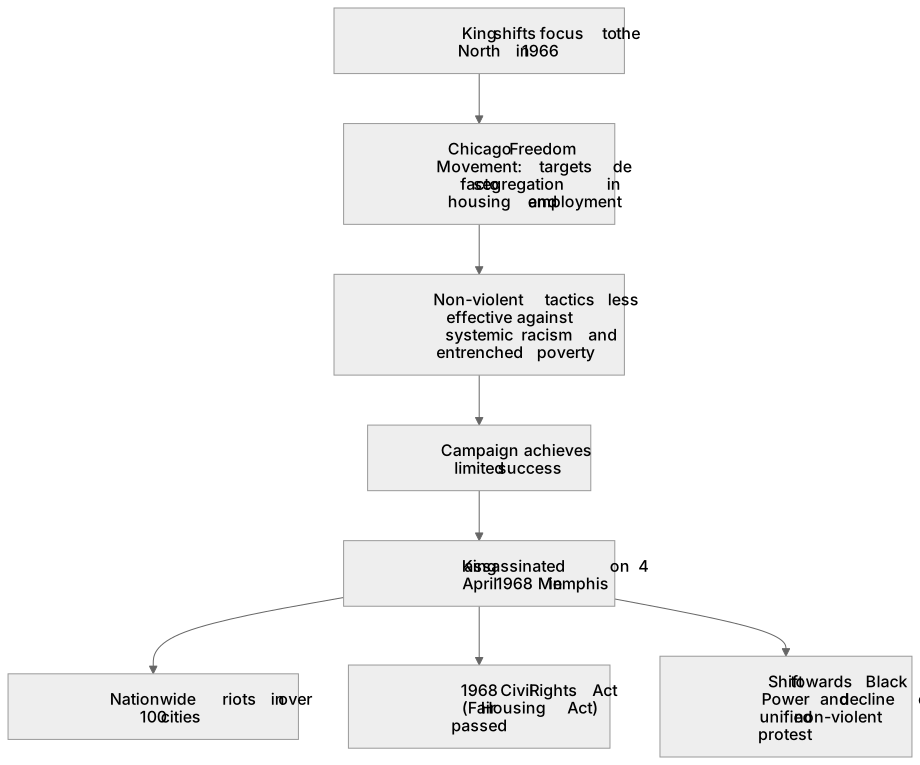
Label the diagram
Some boxes have lost their names. Pick the right name for each number.
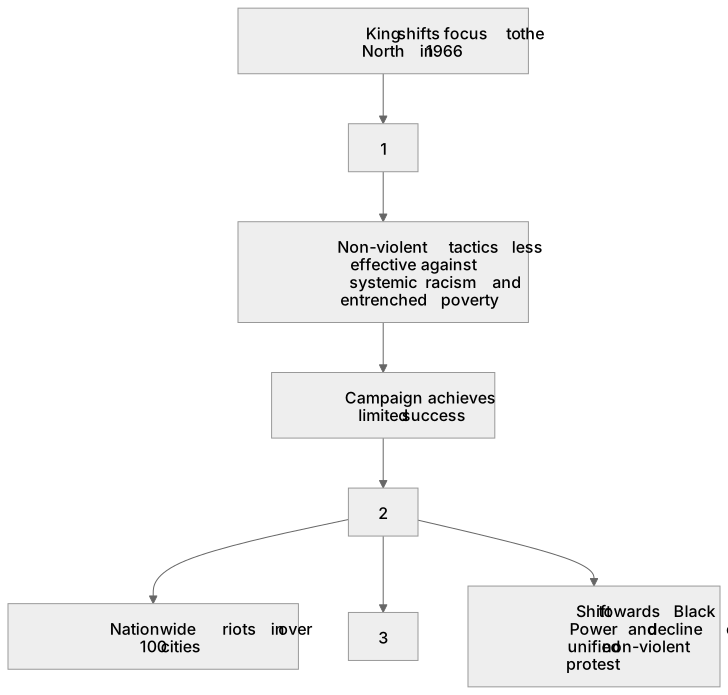
1Box 1
2Box 2
3Box 3
There is more to this lesson
The full lesson goes on to check your understanding and help you earn the marks. Create a free account to carry on, with your progress saved.
A week of Premium from your first lesson · Then the free plan continues · No card, no charge
Test your understanding of Option 33: Key topic 2: Protest, progress and radicalism, 1960–75 - 4 The civil rights movement, 1965–75: King’s campaign in the North. The assassination of Martin Luther King and its impact.
Active recall beats re-reading. Take an instant quiz now to test what you’ve learned and lock it into long-term memory.
A week of Premium from your first lesson · Then the free plan continues · No card, no charge