Pearson Edexcel · GCSE · History
Course version: 1HI0 · Version from Sept 2016
Key topic 2: Protest, progress and radicalism, 1960–75 - 4 The civil…
Full specification wording
Option 33: Key topic 2: Protest, progress and radicalism, 1960–75 - 4 The civil rights movement, 1965–75: The riots of 1965–67 and the Kerner Report (1968).
Between 1965 and 1967, severe race riots erupted in major US cities, most notably the Watts riot in Los Angeles (1965) and the Detroit riot (1967).
Checked against the Pearson Edexcel 1HI0 specification (opens in a new tab) on .
- Point 1 of 3
- 4 key terms
Study notes
From the checked teaching notes for this specification point.
The idea
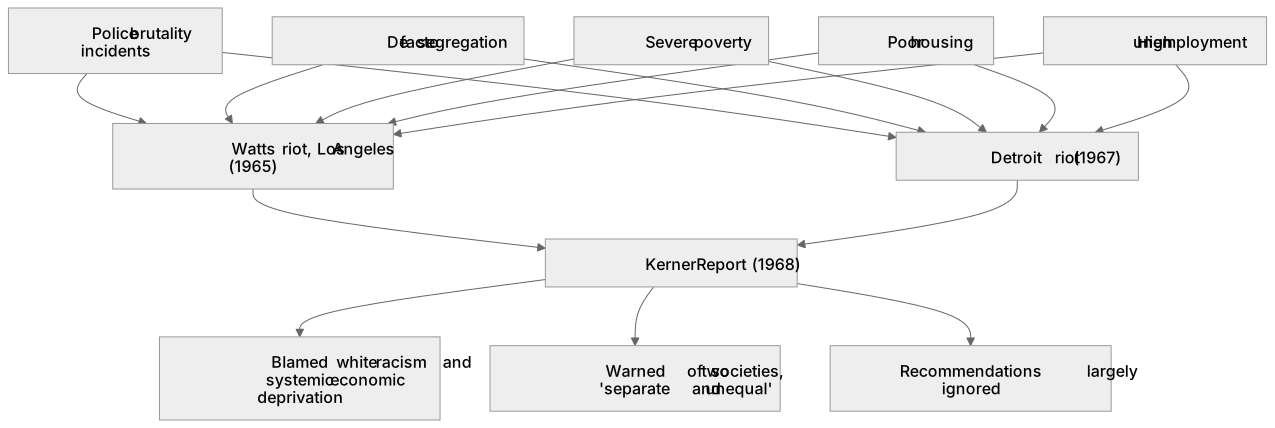
Between 1965 and 1967, severe race riots erupted in major US cities, most notably the Watts riot in Los Angeles (1965) and the Detroit riot (1967). These uprisings were sparked by incidents of police brutality but were fundamentally rooted in deep-seated anger over de facto segregation, severe poverty, poor housing, and high unemployment in northern and western ghettos. In response, President Johnson commissioned the Kerner Report (1968) to investigate the causes. The report famously concluded that America was moving towards two societies, 'one black, one white—separate and unequal', blaming white racism and systemic economic deprivation for the riots, though its recommendations for massive social investment were largely ignored.
What earns the marks
- Identify the Watts (1965) and Detroit (1967) riots as major examples of urban unrest driven by poor living conditions and police tensions.
- Explain that the riots demonstrated the failure of the 1964 Civil Rights Act and 1965 Voting Rights Act to solve economic and social issues in the North and West.
- Describe the purpose of the 1968 Kerner Report as a government commission to investigate the underlying causes of the urban riots.
- Detail the Kerner Report's findings, specifically its conclusion that white racism and systemic poverty were to blame, and its warning of a permanently divided society.
Common mistakes and how to put them right
Stating the riots were caused by Martin Luther King's assassination.
Put it right by noting the 1965-67 riots predated his 1968 death and were caused by long-term ghetto conditions.
Claiming the Kerner Report blamed African Americans for the violence.
Put it right by explaining the report explicitly blamed 'white racism' and systemic economic inequality.
Assuming the government fully implemented the Kerner Report's recommendations.
Put it right by noting that President Johnson largely ignored the costly recommendations due to the financial drain of the Vietnam War.
Exam tips
- Use the phrase 'de facto segregation' to explain the underlying conditions in the North and West that led to the riots.
- Quote the Kerner Report's conclusion ('two societies, one black, one white—separate and unequal') to demonstrate precise knowledge.
- Contrast the focus of the riots (economic and social equality) with earlier civil rights campaigns (legal and political equality).
Try the lesson
The start of the Option 33: Key topic 2: Protest, progress and radicalism, 1960–75 - 4 The civil rights movement, 1965–75: The riots of 1965–67 and the Kerner Report (1968). lesson, made from checked teaching notes for this specification point.
Have a go first
What was the immediate trigger for the Watts riots in Los Angeles in August 1965?
Listen
Between 1965 and 1967, severe race riots erupted in major US cities, most notably the Watts riot in Los Angeles (1965) and the Detroit riot (1967). These uprisings were sparked by incidents of police brutality but were fundamentally rooted in deep-seated anger over de facto segregation, severe poverty, poor housing, and high unemployment in northern and western ghettos. In response, President Johnson commissioned the Kerner Report (1968) to investigate the causes. The report famously concluded that America was moving towards two societies, 'one black, one white—separate and unequal', blaming white racism and systemic economic deprivation for the riots, though its recommendations for massive social investment were largely ignored. A strong answer earns marks for these points. Identify the Watts (1965) and Detroit (1967) riots as major examples of urban unrest driven by poor living conditions and police tensions. Explain that the riots demonstrated the failure of the 1964 Civil Rights Act and 1965 Voting Rights Act to solve economic and social issues in the North and West. Describe the purpose of the 1968 Kerner Report as a government commission to investigate the underlying causes of the urban riots. Detail the Kerner Report's findings, specifically its conclusion that white racism and systemic poverty were to blame, and its warning of a permanently divided society. A common slip: Stating the riots were caused by Martin Luther King's assassination. Instead, noting the 1965-67 riots predated his 1968 death and were caused by long-term ghetto conditions. Exam tip: Use the phrase 'de facto segregation' to explain the underlying conditions in the North and West that led to the riots.
See it
Key words
Say what each word means before you turn the card.
Urban Unrest
Try answering aloud or in your head before turning the card.
De Facto Segregation
Try answering aloud or in your head before turning the card.
Government Response
Try answering aloud or in your head before turning the card.
Economic Inequality
Try answering aloud or in your head before turning the card.
See every definition
- Urban Unrest
- Severe race riots that erupted in major US cities between 1965 and 1967, sparked by incidents of police brutality but rooted in deep-seated anger over poor conditions.
- De Facto Segregation
- A condition in northern and western ghettos that the riots were fundamentally rooted in anger over, alongside severe poverty, poor housing and high unemployment.
- Government Response
- President Johnson commissioned the Kerner Report in 1968 to investigate the causes of the riots, though its recommendations for massive social investment were largely ignored.
- Economic Inequality
- Systemic economic deprivation, alongside white racism, which the Kerner Report blamed for the riots.
Label the diagram
Some boxes have lost their names. Pick the right name for each number.
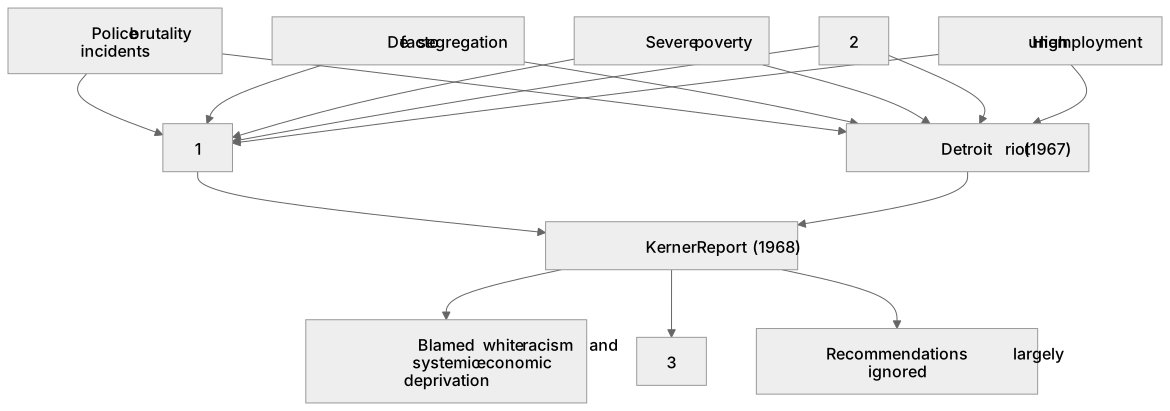
1Box 1
2Box 2
3Box 3
There is more to this lesson
The full lesson goes on to check your understanding and help you earn the marks. Create a free account to carry on, with your progress saved.
A week of Premium from your first lesson · Then the free plan continues · No card, no charge
Test your understanding of Option 33: Key topic 2: Protest, progress and radicalism, 1960–75 - 4 The civil rights movement, 1965–75: The riots of 1965–67 and the Kerner Report (1968).
Active recall beats re-reading. Take an instant quiz now to test what you’ve learned and lock it into long-term memory.
A week of Premium from your first lesson · Then the free plan continues · No card, no charge