Pearson Edexcel · GCSE · History
Course version: 1HI0 · Version from Sept 2016
Key topic 4: Reactions to, and the end of, US involvement in Vietnam,…
Full specification wording
Option 33: Key topic 4: Reactions to, and the end of, US involvement in Vietnam, 1964–75 - 1 Opposition to the war: Public reaction to the My Lai Massacre (1968). The trial of Lt. Calley.
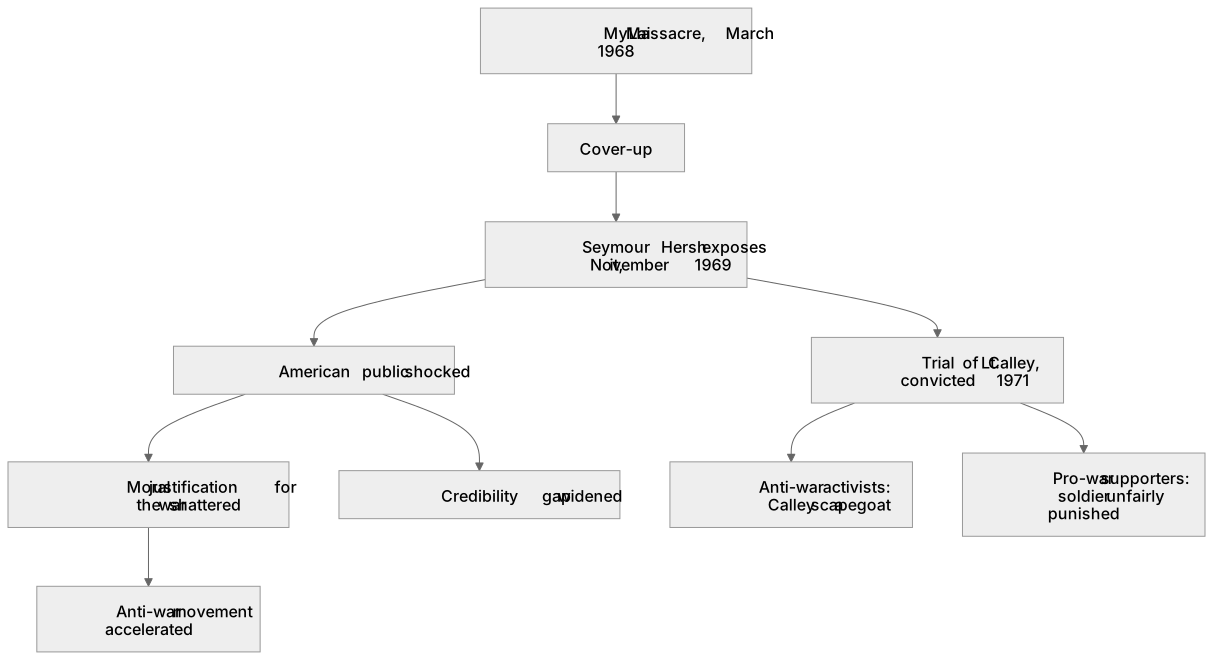
The My Lai Massacre occurred in March 1968 but was covered up until journalist Seymour Hersh exposed it in November 1969.
Checked against the Pearson Edexcel 1HI0 specification (opens in a new tab) on .
- Point 2 of 3
- 4 key terms
Study notes
From the checked teaching notes for this specification point.
The idea
The My Lai Massacre occurred in March 1968 but was covered up until journalist Seymour Hersh exposed it in November 1969. The revelation that US soldiers had murdered hundreds of unarmed Vietnamese civilians profoundly shocked the American public. It shattered the moral justification for the war, accelerating the anti-war movement and widening the credibility gap. The subsequent trial of Lieutenant William Calley, convicted of murder in 1971, further polarised society. Many anti-war activists saw Calley as a scapegoat for higher-level military failures, while pro-war supporters viewed him as a soldier unfairly punished for doing his duty in a brutal guerrilla war.
What earns the marks
- Identify the role of investigative journalism in exposing the massacre to the public in late 1969.
- Explain how the massacre undermined the moral argument for US involvement in Vietnam.
- Describe the polarisation of public opinion during the trial of Lieutenant William Calley.
- Analyse why some viewed Calley as a scapegoat for the failures of higher military command.
Common mistakes and how to put them right
Stating the public reacted in 1968.
Put it right: The massacre happened in 1968, but the public reaction occurred in late 1969 when the story broke.
Claiming Calley was the only soldier involved.
Put it right: Charlie Company was involved, but Calley was the only one convicted.
Assuming everyone wanted Calley punished.
Put it right: Many Americans sympathised with him, believing he was following orders or being used as a scapegoat.
Exam tips
- Use the My Lai Massacre as a key turning point when discussing the growth of the anti-war movement.
- Link the trial of Lieutenant Calley to the broader theme of the 'credibility gap' and loss of trust in the military.
- When evaluating public reaction, ensure you mention both the horror at the event and the divided reaction to Calley's conviction.
Try the lesson
The start of the Option 33: Key topic 4: Reactions to, and the end of, US involvement in Vietnam, 1964–75 - 1 Opposition to the war: Public reaction to the My Lai Massacre (1968). The trial of Lt. Calley. lesson, made from checked teaching notes for this specification point.
Have a go first
What was the primary charge against Lieutenant William Calley during his court martial in 1970?
Listen
The My Lai Massacre occurred in March 1968 but was covered up until journalist Seymour Hersh exposed it in November 1969. The revelation that US soldiers had murdered hundreds of unarmed Vietnamese civilians profoundly shocked the American public. It shattered the moral justification for the war, accelerating the anti-war movement and widening the credibility gap. The subsequent trial of Lieutenant William Calley, convicted of murder in 1971, further polarised society. Many anti-war activists saw Calley as a scapegoat for higher-level military failures, while pro-war supporters viewed him as a soldier unfairly punished for doing his duty in a brutal guerrilla war. A strong answer earns marks for these points. Identify the role of investigative journalism in exposing the massacre to the public in late 1969. Explain how the massacre undermined the moral argument for US involvement in Vietnam. Describe the polarisation of public opinion during the trial of Lieutenant William Calley. Analyse why some viewed Calley as a scapegoat for the failures of higher military command. A common slip: Stating the public reacted in 1968. Instead, the massacre happened in 1968, but the public reaction occurred in late 1969 when the story broke. Exam tip: Use the My Lai Massacre as a key turning point when discussing the growth of the anti-war movement.
See it
Put the events in order
Put these events in the order they happened, earliest first.
- 1. The My Lai Massacre takes place
- 2. Lieutenant William Calley is convicted of murder
- 3. Journalist Seymour Hersh exposes the massacre to the public
Key words
Say what each word means before you turn the card.
Anti-war movement
Try answering aloud or in your head before turning the card.
Media influence
Try answering aloud or in your head before turning the card.
Public opinion and polarisation
Try answering aloud or in your head before turning the card.
Military leadership and accountability
Try answering aloud or in your head before turning the card.
See every definition
- Anti-war movement
- The campaign against the war that the exposure of the massacre accelerated by shattering the moral justification for US involvement.
- Media influence
- The role of investigative journalism, such as journalist Seymour Hersh exposing the massacre in November 1969, in bringing the story to the public.
- Public opinion and polarisation
- The division of society during Lieutenant William Calley's trial, with anti-war activists seeing him as a scapegoat and pro-war supporters viewing him as a soldier unfairly punished.
- Military leadership and accountability
- The question of responsibility raised by the massacre, with some viewing Calley as a scapegoat for higher-level military failures.
Label the diagram
Some boxes have lost their names. Pick the right name for each number.
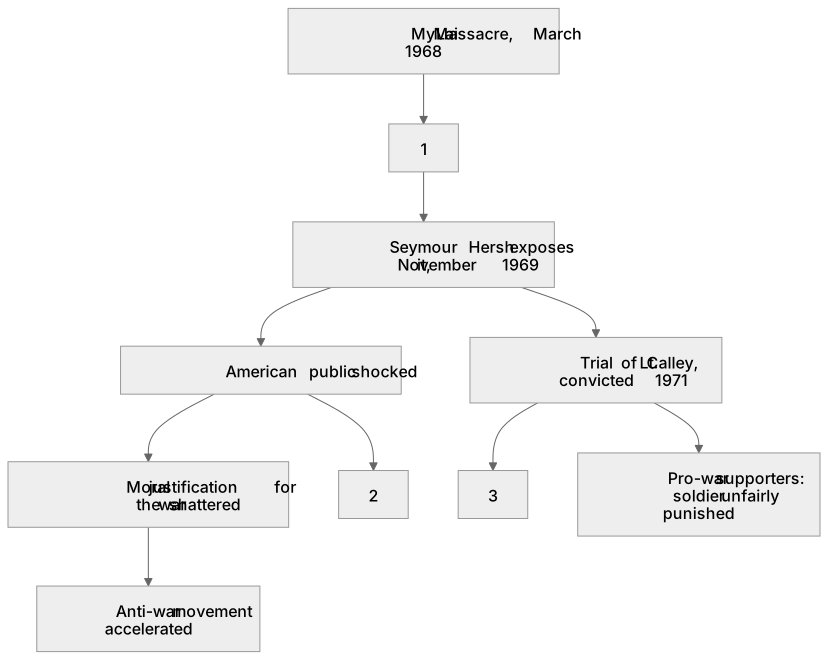
1Box 1
2Box 2
3Box 3
There is more to this lesson
The full lesson goes on to check your understanding and help you earn the marks. Create a free account to carry on, with your progress saved.
A week of Premium from your first lesson · Then the free plan continues · No card, no charge
Test your understanding of Option 33: Key topic 4: Reactions to, and the end of, US involvement in Vietnam, 1964–75 - 1 Opposition to the war: Public reaction to the My Lai Massacre (1968). The trial of Lt. Calley.
Active recall beats re-reading. Take an instant quiz now to test what you’ve learned and lock it into long-term memory.
A week of Premium from your first lesson · Then the free plan continues · No card, no charge