Pearson Edexcel · GCSE · History
Course version: 1HI0 · Version from Sept 2016
Key topic 4: Reactions to, and the end of, US involvement in Vietnam,…
Full specification wording
Option 33: Key topic 4: Reactions to, and the end of, US involvement in Vietnam, 1964–75 - 1 Opposition to the war: The Kent State University shootings (1970).
On 4 May 1970, Ohio National Guardsmen fired into a crowd of student protesters at Kent State University, killing four and wounding nine.
Checked against the Pearson Edexcel 1HI0 specification (opens in a new tab) on .
- Point 3 of 3
- 4 key terms
Study notes
From the checked teaching notes for this specification point.
The idea
On 4 May 1970, Ohio National Guardsmen fired into a crowd of student protesters at Kent State University, killing four and wounding nine. The students were protesting President Nixon's expansion of the Vietnam War into Cambodia. This event caused national outrage, leading to a nationwide student strike that closed hundreds of colleges and universities. The shootings highlighted the deep domestic divisions over the war, demonstrating that the conflict was bringing violence to American soil. It intensified the anti-war movement but also revealed a stark generational and political divide, as some Americans, including Nixon, blamed the students for the unrest, reflecting the sentiments of the 'silent majority' who supported law and order.
What earns the marks
- Identify the trigger for the protests: Nixon's announcement of the US invasion of Cambodia.
- Describe the events of 4 May 1970, where National Guardsmen killed four students.
- Explain the immediate aftermath, including the nationwide student strike involving millions of students.
- Analyse how the event demonstrated the extreme polarisation in American society regarding the war and protest movements.
Common mistakes and how to put them right
Confusing Kent State with Jackson State.
Put it right: Kent State involved the Ohio National Guard and white students, whereas Jackson State involved police and African American students.
Stating the students were protesting the start of the Vietnam War.
Put it right: They were specifically protesting the expansion of the war into Cambodia in 1970.
Assuming universal sympathy for the victims.
Put it right: A significant portion of the public blamed the protesting students for the violence.
Exam tips
- Connect the Kent State shootings to Nixon's policies, specifically the invasion of Cambodia.
- Use this event to illustrate the peak of student anti-war protests and the resulting domestic instability.
- Contrast the reaction of the anti-war movement with the reaction of the 'silent majority' to show balanced knowledge.
Try the lesson
The start of the Option 33: Key topic 4: Reactions to, and the end of, US involvement in Vietnam, 1964–75 - 1 Opposition to the war: The Kent State University shootings (1970). lesson, made from checked teaching notes for this specification point.
Have a go first
Which organisation was responsible for firing on unarmed student protesters at Kent State University on 4 May 1970?
Listen
On 4 May 1970, Ohio National Guardsmen fired into a crowd of student protesters at Kent State University, killing four and wounding nine. The students were protesting President Nixon's expansion of the Vietnam War into Cambodia. This event caused national outrage, leading to a nationwide student strike that closed hundreds of colleges and universities. The shootings highlighted the deep domestic divisions over the war, demonstrating that the conflict was bringing violence to American soil. It intensified the anti-war movement but also revealed a stark generational and political divide, as some Americans, including Nixon, blamed the students for the unrest, reflecting the sentiments of the 'silent majority' who supported law and order. A strong answer earns marks for these points. Identify the trigger for the protests: Nixon's announcement of the US invasion of Cambodia. Describe the events of 4 May 1970, where National Guardsmen killed four students. Explain the immediate aftermath, including the nationwide student strike involving millions of students. Analyse how the event demonstrated the extreme polarisation in American society regarding the war and protest movements. A common slip: Confusing Kent State with Jackson State. Instead, Kent State involved the Ohio National Guard and white students, whereas Jackson State involved police and African American students. Exam tip: Connect the Kent State shootings to Nixon's policies, specifically the invasion of Cambodia.
See it
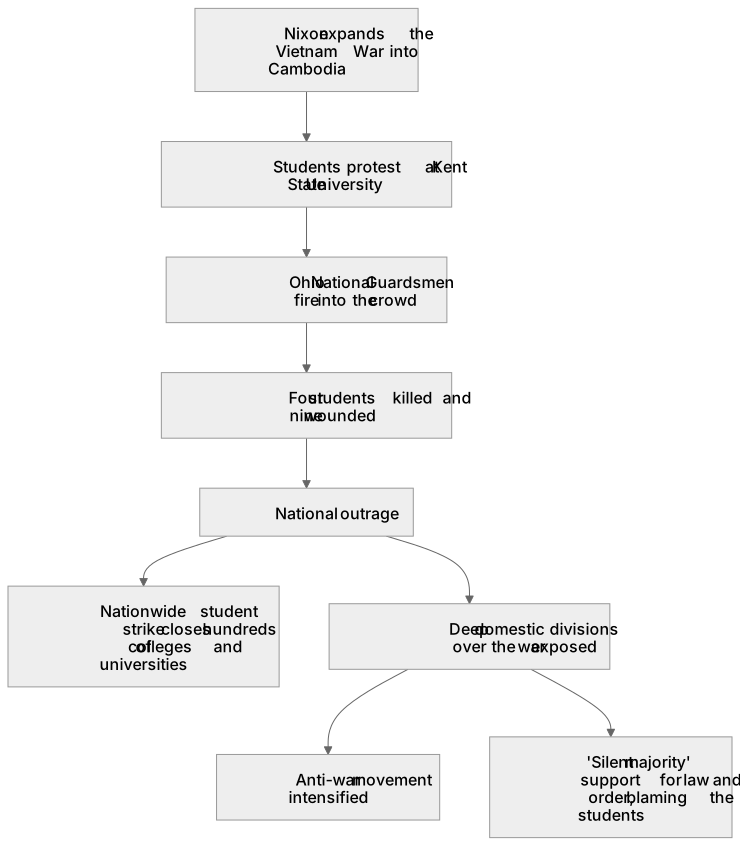
Key words
Say what each word means before you turn the card.
Student protest
Try answering aloud or in your head before turning the card.
Domestic impact of foreign policy
Try answering aloud or in your head before turning the card.
State violence and law enforcement
Try answering aloud or in your head before turning the card.
Social polarisation
Try answering aloud or in your head before turning the card.
See every definition
- Student protest
- Students demonstrating against President Nixon's expansion of the Vietnam War into Cambodia.
- Domestic impact of foreign policy
- The shootings showed the conflict was bringing violence to American soil and caused national outrage.
- State violence and law enforcement
- Ohio National Guardsmen fired into a crowd of student protesters, killing four and wounding nine.
- Social polarisation
- The event revealed a stark generational and political divide, with some Americans, including Nixon, blaming the students for the unrest.
Label the diagram
Some boxes have lost their names. Pick the right name for each number.
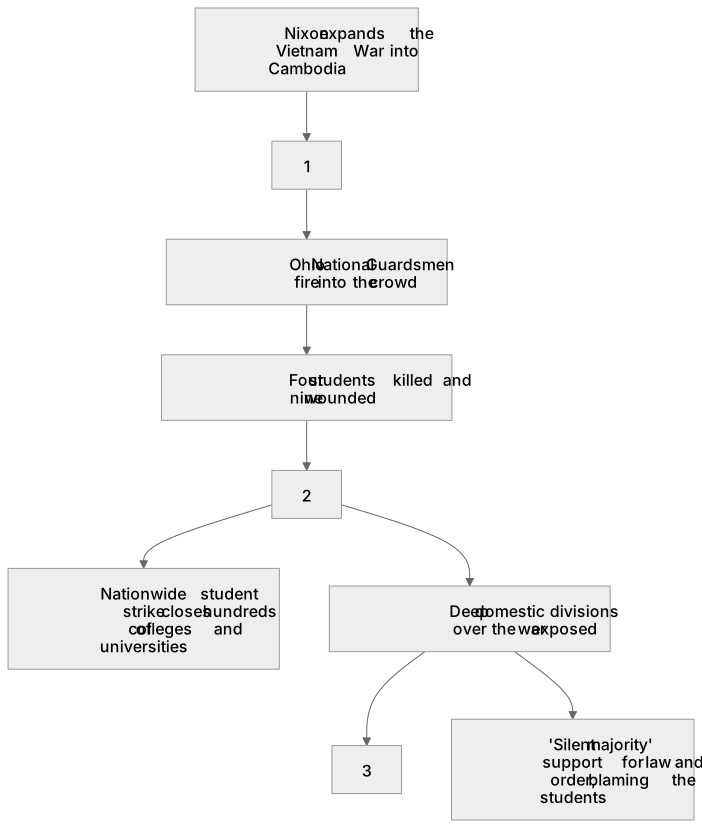
1Box 1
2Box 2
3Box 3
There is more to this lesson
The full lesson goes on to check your understanding and help you earn the marks. Create a free account to carry on, with your progress saved.
A week of Premium from your first lesson · Then the free plan continues · No card, no charge
Test your understanding of Option 33: Key topic 4: Reactions to, and the end of, US involvement in Vietnam, 1964–75 - 1 Opposition to the war: The Kent State University shootings (1970).
Active recall beats re-reading. Take an instant quiz now to test what you’ve learned and lock it into long-term memory.
A week of Premium from your first lesson · Then the free plan continues · No card, no charge