Pearson Edexcel · GCSE · History
Course version: 1HI0 · Version from Sept 2016
Key topic 4: Reactions to, and the end of, US involvement in Vietnam,…
Full specification wording
Option 33: Key topic 4: Reactions to, and the end of, US involvement in Vietnam, 1964–75 - 2 Support for the war: Reasons for support for the war, including the fear of communism.
Despite growing opposition, significant support for the Vietnam War persisted in the US, primarily driven by the fear of communism.
Checked against the Pearson Edexcel 1HI0 specification (opens in a new tab) on .
- Point 1 of 2
- 4 key terms
Study notes
From the checked teaching notes for this specification point.
The idea
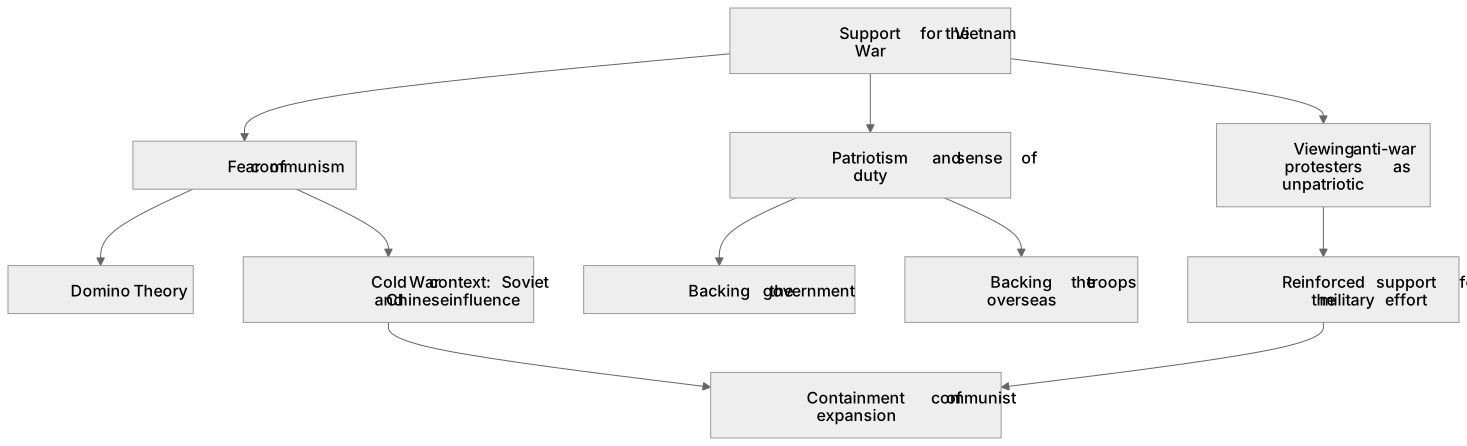
Despite growing opposition, significant support for the Vietnam War persisted in the US, primarily driven by the fear of communism. Many Americans firmly believed in the Domino Theory: the idea that if South Vietnam fell to communism, neighbouring countries would follow, threatening US security. Support was also rooted in patriotism and a sense of duty; many felt a moral obligation to back their government and the troops deployed overseas. Furthermore, in the Cold War context, appearing weak against Soviet and Chinese influence was considered dangerous. Many citizens viewed anti-war protesters as unpatriotic, reinforcing their own support for the military effort to maintain American prestige and contain communist expansion in Asia.
What earns the marks
- Explain the role of the Domino Theory and containment policy in justifying the war to the American public.
- Identify patriotism and loyalty to the government and armed forces as key drivers of support.
- Describe how the broader context of the Cold War and fear of Soviet and Chinese expansion fuelled anti-communist sentiment.
- Analyse how negative reactions to the anti-war movement consolidated pro-war support.
Common mistakes and how to put them right
Focusing entirely on the anti-war movement and ignoring that millions supported the war.
Put it right: Acknowledge that public opinion was deeply divided and pro-war sentiment was substantial.
Treating the fear of communism as an irrational panic.
Put it right: Contextualise it within the very real geopolitical tensions of the Cold War and the established policy of containment.
Assuming support for the war meant support for all military tactics.
Put it right: Many supported the war's aims but were critical of how it was being fought.
Exam tips
- Use the concept of the 'Domino Theory' explicitly when explaining the fear of communism.
- Contrast the reasons for supporting the war with the reasons for opposing it to build a strong analytical argument.
- Remember to mention patriotism and the desire not to abandon US troops as crucial emotional factors for war supporters.
Try the lesson
The start of the Option 33: Key topic 4: Reactions to, and the end of, US involvement in Vietnam, 1964–75 - 2 Support for the war: Reasons for support for the war, including the fear of communism. lesson, made from checked teaching notes for this specification point.
Have a go first
Which political theory was a primary reason for United States public and government support for the Vietnam War?
Listen
Despite growing opposition, significant support for the Vietnam War persisted in the US, primarily driven by the fear of communism. Many Americans firmly believed in the Domino Theory: the idea that if South Vietnam fell to communism, neighbouring countries would follow, threatening US security. Support was also rooted in patriotism and a sense of duty; many felt a moral obligation to back their government and the troops deployed overseas. Furthermore, in the Cold War context, appearing weak against Soviet and Chinese influence was considered dangerous. Many citizens viewed anti-war protesters as unpatriotic, reinforcing their own support for the military effort to maintain American prestige and contain communist expansion in Asia. A strong answer earns marks for these points. Explain the role of the Domino Theory and containment policy in justifying the war to the American public. Identify patriotism and loyalty to the government and armed forces as key drivers of support. Describe how the broader context of the Cold War and fear of Soviet and Chinese expansion fuelled anti-communist sentiment. Analyse how negative reactions to the anti-war movement consolidated pro-war support. A common slip: Focusing entirely on the anti-war movement and ignoring that millions supported the war. Instead, acknowledge that public opinion was deeply divided and pro-war sentiment was substantial. Exam tip: Use the concept of the 'Domino Theory' explicitly when explaining the fear of communism.
See it
Key words
Say what each word means before you turn the card.
Domino Theory
Try answering aloud or in your head before turning the card.
Containment
Try answering aloud or in your head before turning the card.
Patriotism
Try answering aloud or in your head before turning the card.
Cold War
Try answering aloud or in your head before turning the card.
See every definition
- Domino Theory
- The idea that if South Vietnam fell to communism, neighbouring countries would follow, threatening US security.
- Containment
- The policy of containing communist expansion in Asia, used to justify the war to the American public.
- Patriotism
- A sense of duty and moral obligation to back the government and the troops deployed overseas.
- Cold War
- The context in which appearing weak against Soviet and Chinese influence was considered dangerous.
Label the diagram
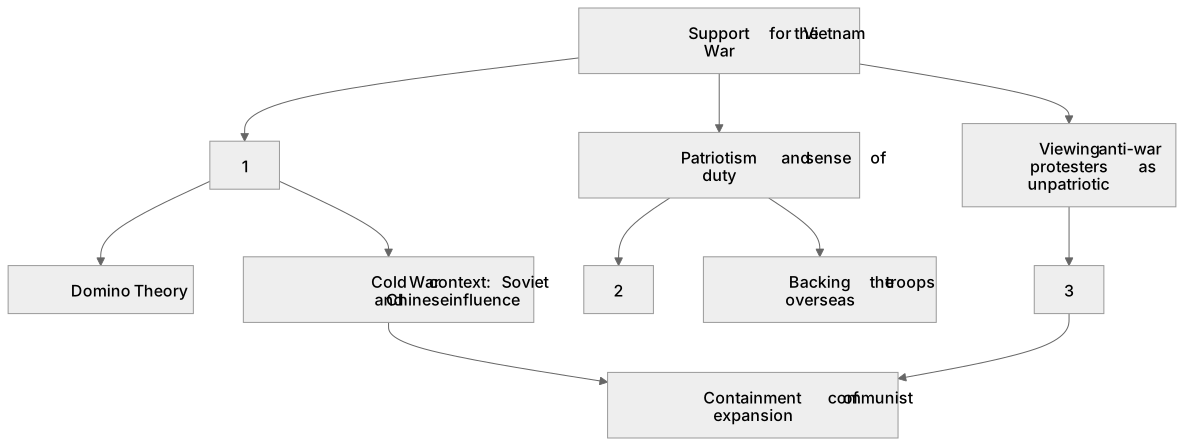
Some boxes have lost their names. Pick the right name for each number.
1Box 1
2Box 2
3Box 3
There is more to this lesson
The full lesson goes on to check your understanding and help you earn the marks. Create a free account to carry on, with your progress saved.
A week of Premium from your first lesson · Then the free plan continues · No card, no charge
Test your understanding of Option 33: Key topic 4: Reactions to, and the end of, US involvement in Vietnam, 1964–75 - 2 Support for the war: Reasons for support for the war, including the fear of communism.
Active recall beats re-reading. Take an instant quiz now to test what you’ve learned and lock it into long-term memory.
A week of Premium from your first lesson · Then the free plan continues · No card, no charge