Pearson Edexcel · GCSE · History
Course version: 1HI0 · Version from Sept 2016
Key topic 4: Reactions to, and the end of, US involvement in Vietnam,…
Full specification wording
Option 33: Key topic 4: Reactions to, and the end of, US involvement in Vietnam, 1964–75 - 2 Support for the war: The ‘hard hats’ and the ‘silent majority’.
The 'silent majority' was a term popularised by President Nixon in a 1969 speech to describe the millions of Americans who supported his Vietnam policies but did not publicly protest.
Checked against the Pearson Edexcel 1HI0 specification (opens in a new tab) on .
- Point 2 of 2
- 4 key terms
Study notes
From the checked teaching notes for this specification point.
The idea
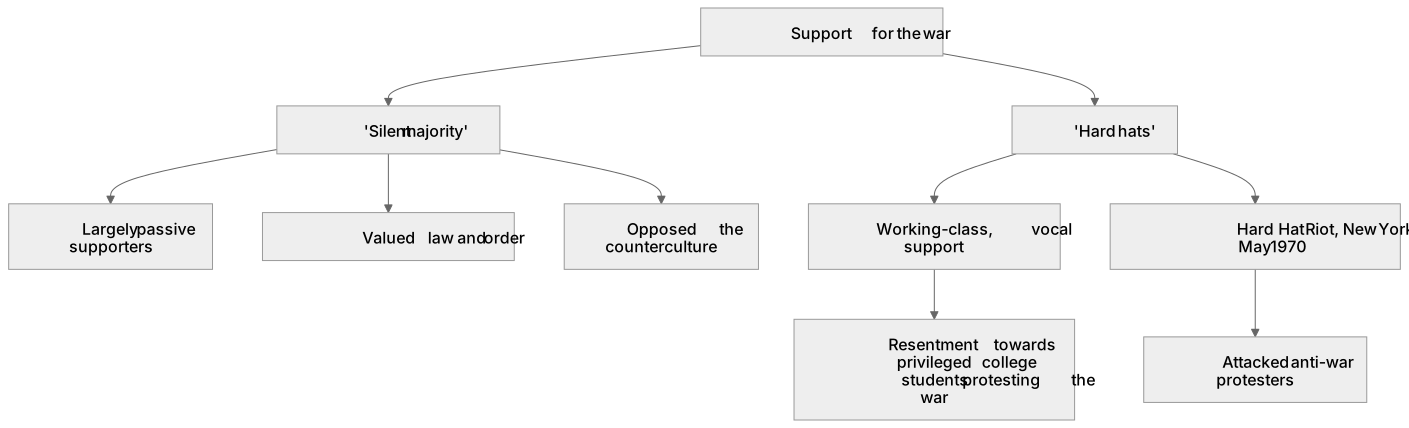
The 'silent majority' was a term popularised by President Nixon in a 1969 speech to describe the millions of Americans who supported his Vietnam policies but did not publicly protest. This demographic, often older and middle-class, valued law and order and opposed the counterculture. The 'hard hats' represented a more vocal, working-class faction of this support. In May 1970, construction workers in New York City attacked anti-war protesters in what became known as the Hard Hat Riot. These workers demonstrated fierce patriotism and resentment towards privileged college students protesting the war. Together, these groups highlight that opposition to the war was not universal and that deep class and cultural divides existed in America.
What earns the marks
- Define the 'silent majority' as the non-protesting Americans who supported Nixon's policies and valued law and order.
- Explain Nixon's political strategy in appealing to the 'silent majority' to gain support for his Vietnam strategy.
- Describe the 'hard hats' as working-class supporters of the war, exemplified by the 1970 Hard Hat Riot in New York.
- Analyse the class tensions between working-class 'hard hats' and middle-class college student protesters.
Common mistakes and how to put them right
Confusing the 'silent majority' with active, violent protesters.
Put it right: The silent majority were largely passive supporters, whereas the 'hard hats' took direct, sometimes violent, action.
Assuming the 'hard hats' were a formal political organisation.
Put it right: It was a colloquial term for patriotic, pro-war construction and blue-collar workers.
Believing Nixon invented the concept of the silent majority.
Put it right: While he popularised the exact phrase in 1969, the demographic had existed and supported the war prior to his speech.
Exam tips
- Use the Hard Hat Riot of May 1970 as a specific example of working-class support for the war and hostility towards the anti-war movement.
- Link the 'silent majority' to Nixon's ability to maintain political power and continue the war despite vocal opposition.
- Discuss the class divide: working-class youths were more likely to be drafted, fuelling resentment against draft-deferred college protesters.
Try the lesson
The start of the Option 33: Key topic 4: Reactions to, and the end of, US involvement in Vietnam, 1964–75 - 2 Support for the war: The ‘hard hats’ and the ‘silent majority’. lesson, made from checked teaching notes for this specification point.
Have a go first
To whom was President Richard Nixon referring when he used the term the 'silent majority' in his 1969 speech?
Listen
The 'silent majority' was a term popularised by President Nixon in a 1969 speech to describe the millions of Americans who supported his Vietnam policies but did not publicly protest. This demographic, often older and middle-class, valued law and order and opposed the counterculture. The 'hard hats' represented a more vocal, working-class faction of this support. In May 1970, construction workers in New York City attacked anti-war protesters in what became known as the Hard Hat Riot. These workers demonstrated fierce patriotism and resentment towards privileged college students protesting the war. Together, these groups highlight that opposition to the war was not universal and that deep class and cultural divides existed in America. A strong answer earns marks for these points. Define the 'silent majority' as the non-protesting Americans who supported Nixon's policies and valued law and order. Explain Nixon's political strategy in appealing to the 'silent majority' to gain support for his Vietnam strategy. Describe the 'hard hats' as working-class supporters of the war, exemplified by the 1970 Hard Hat Riot in New York. Analyse the class tensions between working-class 'hard hats' and middle-class college student protesters. A common slip: Confusing the 'silent majority' with active, violent protesters. Instead, the silent majority were largely passive supporters, whereas the 'hard hats' took direct, sometimes violent, action. Exam tip: Use the Hard Hat Riot of May 1970 as a specific example of working-class support for the war and hostility towards the anti-war movement.
See it
Key words
Say what each word means before you turn the card.
Silent majority
Try answering aloud or in your head before turning the card.
Hard hats
Try answering aloud or in your head before turning the card.
Hard Hat Riot
Try answering aloud or in your head before turning the card.
Class divisions
Try answering aloud or in your head before turning the card.
See every definition
- Silent majority
- Term popularised by President Nixon in a 1969 speech to describe the millions of Americans who supported his Vietnam policies but did not publicly protest.
- Hard hats
- A colloquial term for patriotic, pro-war construction and blue-collar workers, a more vocal, working-class faction of support for the war.
- Hard Hat Riot
- In May 1970, construction workers in New York City attacked anti-war protesters in what became known as the Hard Hat Riot.
- Class divisions
- Deep class and cultural divides existed in America, shown by working-class 'hard hats' resenting privileged college students protesting the war.
Label the diagram
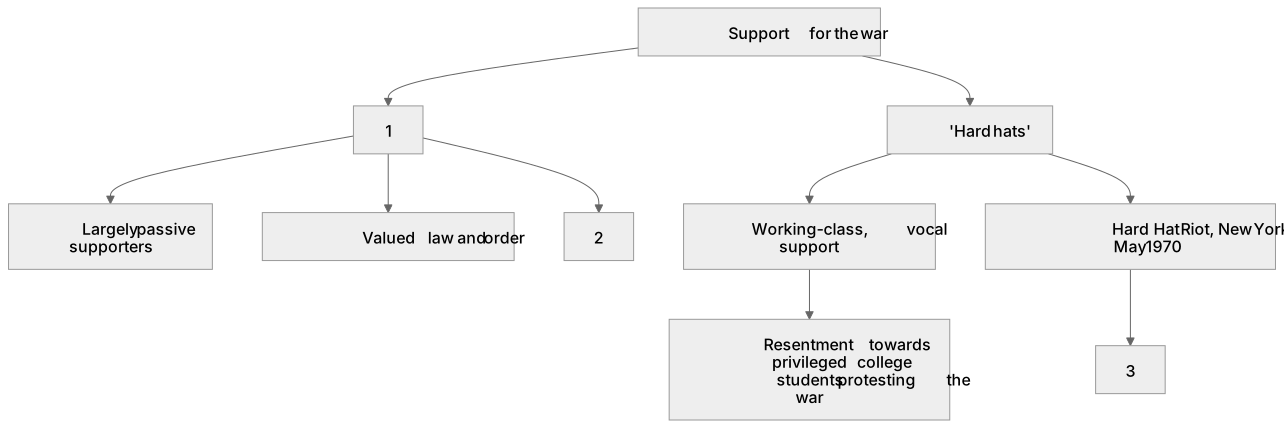
Some boxes have lost their names. Pick the right name for each number.
1Box 1
2Box 2
3Box 3
There is more to this lesson
The full lesson goes on to check your understanding and help you earn the marks. Create a free account to carry on, with your progress saved.
A week of Premium from your first lesson · Then the free plan continues · No card, no charge
Test your understanding of Option 33: Key topic 4: Reactions to, and the end of, US involvement in Vietnam, 1964–75 - 2 Support for the war: The ‘hard hats’ and the ‘silent majority’.
Active recall beats re-reading. Take an instant quiz now to test what you’ve learned and lock it into long-term memory.
A week of Premium from your first lesson · Then the free plan continues · No card, no charge