Pearson Edexcel · GCSE · History
Course version: 1HI0 · Version from Sept 2016
Key topic 4: Reactions to, and the end of, US involvement in Vietnam,…
Full specification wording
Option 33: Key topic 4: Reactions to, and the end of, US involvement in Vietnam, 1964–75 - 3 The peace process and end of the war: The economic and human costs of the war for the USA.
The Vietnam War inflicted profound economic and human costs on the USA.
Checked against the Pearson Edexcel 1HI0 specification (opens in a new tab) on .
- Point 3 of 3
- 3 key terms
Study notes
From the checked teaching notes for this specification point.
The idea
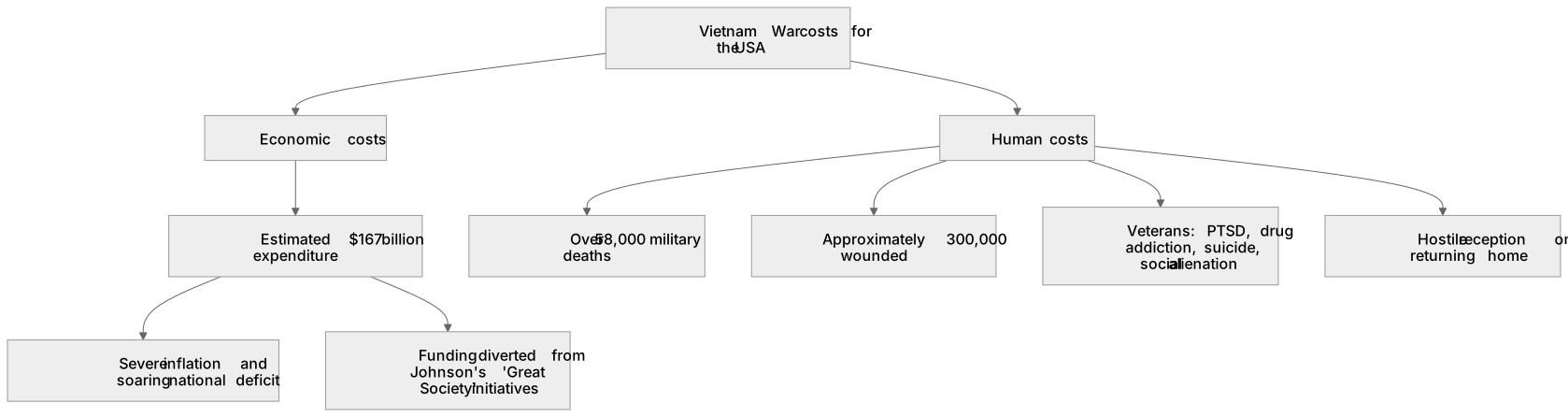
The Vietnam War inflicted profound economic and human costs on the USA. Economically, the conflict cost the federal government an estimated $167 billion, triggering severe inflation and a soaring national deficit. This massive financial drain crippled President Johnson’s 'Great Society' initiatives, diverting crucial funding away from domestic poverty and education programmes. The human cost was equally devastating: over 58,000 American military personnel were killed and approximately 300,000 were wounded. Returning veterans frequently faced severe psychological trauma, including Post-Traumatic Stress Disorder (PTSD), alongside high rates of drug addiction, suicide, and social alienation.
What earns the marks
- Quantify the economic cost of the war, noting the estimated $167 billion expenditure and its contribution to US inflation.
- Explain the domestic political impact of this economic cost, specifically the defunding of President Johnson's 'Great Society' reforms.
- Detail the human cost in terms of casualties, including over 58,000 US military deaths and 300,000 wounded.
- Analyse the long-term human and social costs on veterans, such as PTSD, drug addiction, and the hostile reception they faced upon returning home.
Common mistakes and how to put them right
Stating that the US economy benefited from the Vietnam War.
Put it right by explaining that the massive expenditure caused severe inflation and increased the national deficit.
Focusing only on the number of deaths.
Put it right: Also discussing the hundreds of thousands of wounded soldiers and the psychological trauma suffered by veterans.
Claiming that returning soldiers were universally treated as heroes.
Put it right by noting that many faced hostility, indifference, and a lack of support due to the war's unpopularity.
Exam tips
- Link the economic costs directly to domestic policy failures, such as the stalling of the 'Great Society' programmes, to show broader impact.
- When discussing human costs, include both physical casualties and psychological impacts to provide a comprehensive answer.
- Use specific statistics, such as the 58,000 US deaths, to add precise supporting evidence to your explanations.
Try the lesson
The start of the Option 33: Key topic 4: Reactions to, and the end of, US involvement in Vietnam, 1964–75 - 3 The peace process and end of the war: The economic and human costs of the war for the USA. lesson, made from checked teaching notes for this specification point.
Have a go first
Approximately how many United States military personnel died as a result of the Vietnam War?
Listen
The Vietnam War inflicted profound economic and human costs on the USA. Economically, the conflict cost the federal government an estimated $167 billion, triggering severe inflation and a soaring national deficit. This massive financial drain crippled President Johnson’s 'Great Society' initiatives, diverting crucial funding away from domestic poverty and education programmes. The human cost was equally devastating: over 58,000 American military personnel were killed and approximately 300,000 were wounded. Returning veterans frequently faced severe psychological trauma, including Post-Traumatic Stress Disorder (PTSD), alongside high rates of drug addiction, suicide, and social alienation. A strong answer earns marks for these points. Quantify the economic cost of the war, noting the estimated $167 billion expenditure and its contribution to US inflation. Explain the domestic political impact of this economic cost, specifically the defunding of President Johnson's 'Great Society' reforms. Detail the human cost in terms of casualties, including over 58,000 US military deaths and 300,000 wounded. Analyse the long-term human and social costs on veterans, such as PTSD, drug addiction, and the hostile reception they faced upon returning home. A common slip: Stating that the US economy benefited from the Vietnam War. Instead, explaining that the massive expenditure caused severe inflation and increased the national deficit. Exam tip: Link the economic costs directly to domestic policy failures, such as the stalling of the 'Great Society' programmes, to show broader impact.
See it
Key words
Say what each word means before you turn the card.
Economic impact
Try answering aloud or in your head before turning the card.
Human casualties
Try answering aloud or in your head before turning the card.
Psychological trauma
Try answering aloud or in your head before turning the card.
See every definition
- Economic impact
- The conflict cost the federal government an estimated $167 billion, triggering severe inflation and a soaring national deficit.
- Human casualties
- Over 58,000 American military personnel were killed and approximately 300,000 were wounded.
- Psychological trauma
- Returning veterans frequently faced severe psychological trauma, including Post-Traumatic Stress Disorder (PTSD).
Label the diagram
Some boxes have lost their names. Pick the right name for each number.
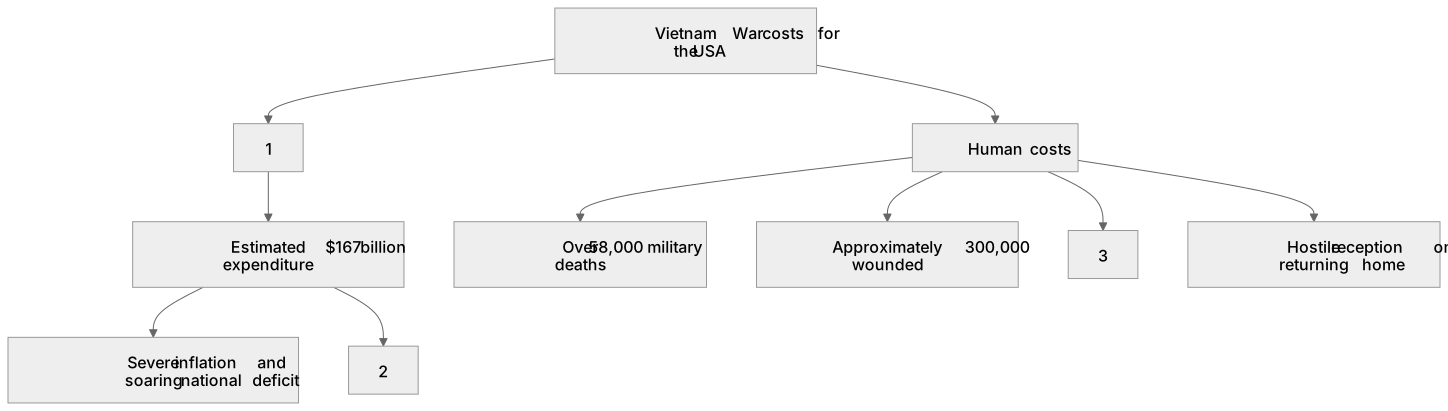
1Box 1
2Box 2
3Box 3
There is more to this lesson
The full lesson goes on to check your understanding and help you earn the marks. Create a free account to carry on, with your progress saved.
A week of Premium from your first lesson · Then the free plan continues · No card, no charge
Test your understanding of Option 33: Key topic 4: Reactions to, and the end of, US involvement in Vietnam, 1964–75 - 3 The peace process and end of the war: The economic and human costs of the war for the USA.
Active recall beats re-reading. Take an instant quiz now to test what you’ve learned and lock it into long-term memory.
A week of Premium from your first lesson · Then the free plan continues · No card, no charge