Pearson Edexcel · GCSE · History
Course version: 1HI0 · Version from Sept 2016
Key topic 4: Reactions to, and the end of, US involvement in Vietnam,…
Full specification wording
Option 33: Key topic 4: Reactions to, and the end of, US involvement in Vietnam, 1964–75 - 3 The peace process and end of the war: The significance of the Paris Peace Agreement (1973).
The Paris Peace Agreement of January 1973 was highly significant as it formally ended direct US military involvement in Vietnam.
Checked against the Pearson Edexcel 1HI0 specification (opens in a new tab) on .
- Point 2 of 3
Study notes
From the checked teaching notes for this specification point.
The idea
The Paris Peace Agreement of January 1973 was highly significant as it formally ended direct US military involvement in Vietnam. Its terms dictated the complete withdrawal of all remaining US armed forces within sixty days and the release of American prisoners of war, allowing President Nixon to claim he had achieved 'peace with honour'. However, its significance also lies in its fatal compromises: while South Vietnamese President Thieu remained in power, North Vietnamese troops were permitted to stay in areas they controlled in the South. This effectively doomed South Vietnam, as the ceasefire quickly broke down, paving the way for the North Vietnamese conquest of Saigon in 1975.
What earns the marks
- Detail the specific terms of the Paris Peace Agreement, including the withdrawal of US troops and the return of American POWs.
- Explain how the agreement allowed Nixon to present the outcome as 'peace with honour' to the American public.
- Analyse the strategic disadvantage the agreement placed on South Vietnam by allowing North Vietnamese forces to remain in the South.
- Evaluate the long-term significance of the agreement in failing to secure a lasting peace, leading to the fall of South Vietnam in 1975.
Common mistakes and how to put them right
Claiming the Paris Peace Agreement ended the war in Vietnam entirely.
Put it right by stating it only ended direct US military involvement, while the civil war continued until 1975.
Stating that the agreement forced all North Vietnamese troops out of South Vietnam.
Put it right by explaining that a significant concession allowed North Vietnamese forces to remain in place in the South.
Believing the agreement led to the immediate collapse of South Vietnam.
Put it right by noting that South Vietnam survived for two more years before falling in April 1975.
Exam tips
- Focus on the dual significance of the agreement: it was a political success for the USA domestically but a strategic disaster for South Vietnam.
- Use specific terms of the treaty, such as the sixty-day withdrawal window for US troops, to support your analysis of its significance.
- When evaluating significance, contrast the short-term achievement of US withdrawal with the long-term failure to preserve an independent South Vietnam.
Try the lesson
The start of the Option 33: Key topic 4: Reactions to, and the end of, US involvement in Vietnam, 1964–75 - 3 The peace process and end of the war: The significance of the Paris Peace Agreement (1973). lesson, made from checked teaching notes for this specification point.
Have a go first
What was one of the most significant immediate outcomes of the Paris Peace Agreement in 1973?
Listen
The Paris Peace Agreement of January 1973 was highly significant as it formally ended direct US military involvement in Vietnam. Its terms dictated the complete withdrawal of all remaining US armed forces within sixty days and the release of American prisoners of war, allowing President Nixon to claim he had achieved 'peace with honour'. However, its significance also lies in its fatal compromises: while South Vietnamese President Thieu remained in power, North Vietnamese troops were permitted to stay in areas they controlled in the South. This effectively doomed South Vietnam, as the ceasefire quickly broke down, paving the way for the North Vietnamese conquest of Saigon in 1975. A strong answer earns marks for these points. Detail the specific terms of the Paris Peace Agreement, including the withdrawal of US troops and the return of American POWs. Explain how the agreement allowed Nixon to present the outcome as 'peace with honour' to the American public. Analyse the strategic disadvantage the agreement placed on South Vietnam by allowing North Vietnamese forces to remain in the South. Evaluate the long-term significance of the agreement in failing to secure a lasting peace, leading to the fall of South Vietnam in 1975. A common slip: Claiming the Paris Peace Agreement ended the war in Vietnam entirely. Instead, stating it only ended direct US military involvement, while the civil war continued until 1975. Exam tip: Focus on the dual significance of the agreement: it was a political success for the USA domestically but a strategic disaster for South Vietnam.
See it
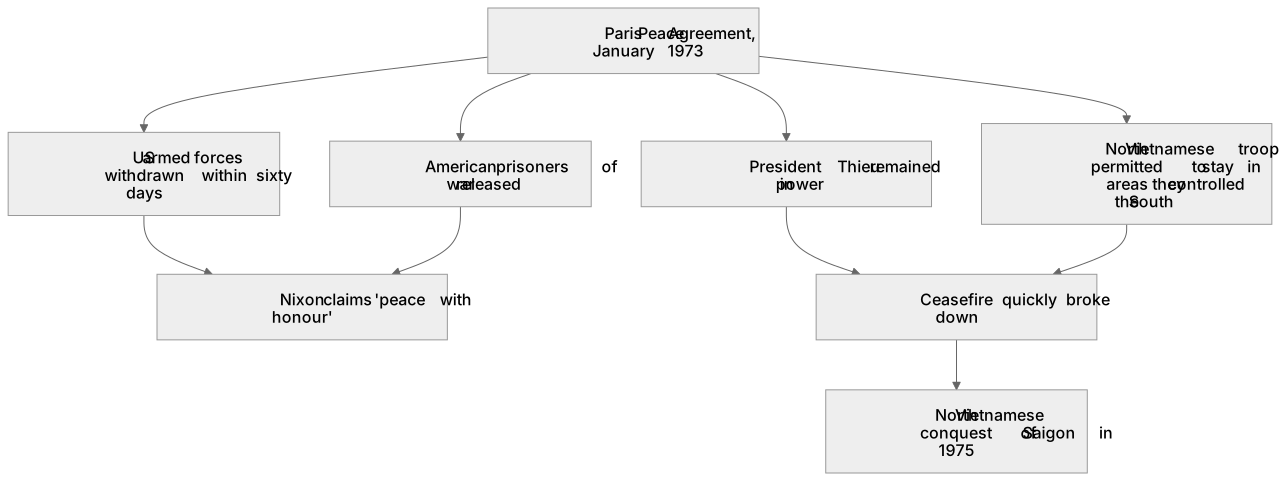
Label the diagram
Some boxes have lost their names. Pick the right name for each number.
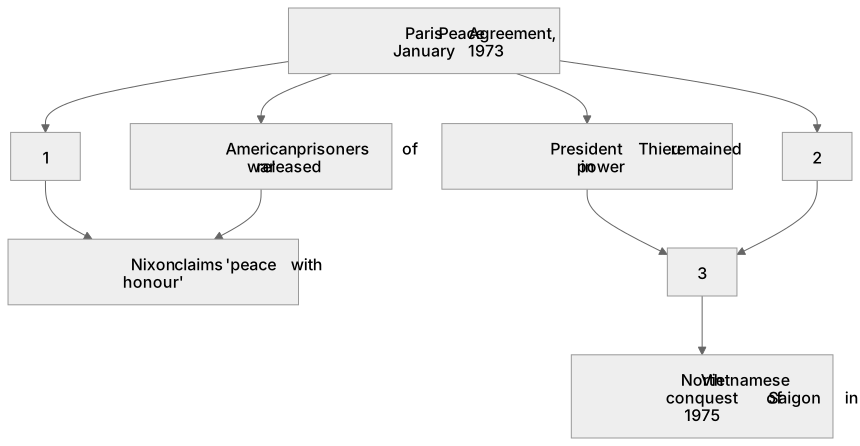
1Box 1
2Box 2
3Box 3
There is more to this lesson
The full lesson goes on to check your understanding and help you earn the marks. Create a free account to carry on, with your progress saved.
A week of Premium from your first lesson · Then the free plan continues · No card, no charge
Test your understanding of Option 33: Key topic 4: Reactions to, and the end of, US involvement in Vietnam, 1964–75 - 3 The peace process and end of the war: The significance of the Paris Peace Agreement (1973).
Active recall beats re-reading. Take an instant quiz now to test what you’ve learned and lock it into long-term memory.
A week of Premium from your first lesson · Then the free plan continues · No card, no charge