Pearson Edexcel · GCSE · History
Course version: 1HI0 · Version from Sept 2016
Key topic 4: Reactions to, and the end of, US involvement in Vietnam,…
Full specification wording
Option 33: Key topic 4: Reactions to, and the end of, US involvement in Vietnam, 1964–75 - 4 Reasons for the failure of the USA in Vietnam: The impact of opposition to the war in the USA.
Opposition to the Vietnam War within the USA had a profound impact on government policy and the conflict's eventual outcome.
Checked against the Pearson Edexcel 1HI0 specification (opens in a new tab) on .
- Point 3 of 3
- 4 key terms
Study notes
From the checked teaching notes for this specification point.
The idea
Opposition to the Vietnam War within the USA had a profound impact on government policy and the conflict's eventual outcome. Driven by the civil rights movement, student activism, and extensive television coverage of atrocities, the anti-war movement steadily eroded public support. Mass demonstrations, such as the 1969 Moratorium to End the War, and tragic events like the Kent State shootings in 1970, placed immense political pressure on US Presidents. This domestic unrest forced President Johnson not to seek re-election and compelled President Nixon to implement 'Vietnamization', gradually withdrawing American troops. Ultimately, the intense domestic opposition restricted military escalation and accelerated the US exit from Vietnam.
What earns the marks
- Explain how media coverage, including the broadcasting of casualties and atrocities, fuelled the anti-war movement and shifted public opinion.
- Describe the role of student protests and mass demonstrations, such as the Moratorium marches, in demonstrating widespread public discontent to the government.
- Analyse the political impact of the opposition, specifically how it influenced Johnson's decision not to run in 1968 and Nixon's policy of Vietnamization.
- Evaluate the effect of draft resistance and the civil rights movement's critique of the war on the military's ability to maintain troop levels and morale.
Common mistakes and how to put them right
Assuming the anti-war movement was the sole reason for US withdrawal.
Put it right: Balance domestic opposition with military failures on the ground in Vietnam.
Stating that opposition only began under Nixon.
Put it right: Opposition actually grew significantly during Johnson's presidency, particularly after the 1968 Tet Offensive.
Claiming that all Americans opposed the war by the late 1960s.
Put it right: Nixon still appealed to the 'Silent Majority' who supported the government, showing that the country was deeply divided rather than uniformly anti-war.
Exam tips
- Use specific examples of opposition, such as the Kent State shootings or the Fulbright hearings, to demonstrate the scale and impact of domestic unrest.
- Connect the anti-war movement directly to changes in government policy, such as the shift towards Vietnamization and troop withdrawals.
- When evaluating reasons for US failure, weigh the impact of domestic opposition against military factors like Vietcong tactics to provide a balanced judgement.
Try the lesson
The start of the Option 33: Key topic 4: Reactions to, and the end of, US involvement in Vietnam, 1964–75 - 4 Reasons for the failure of the USA in Vietnam: The impact of opposition to the war in the USA. lesson, made from checked teaching notes for this specification point.
Have a go first
What was a major impact of the growing anti-war movement in the USA during the late 1960s?
Listen
Opposition to the Vietnam War within the USA had a profound impact on government policy and the conflict's eventual outcome. Driven by the civil rights movement, student activism, and extensive television coverage of atrocities, the anti-war movement steadily eroded public support. Mass demonstrations, such as the 1969 Moratorium to End the War, and tragic events like the Kent State shootings in 1970, placed immense political pressure on US Presidents. This domestic unrest forced President Johnson not to seek re-election and compelled President Nixon to implement 'Vietnamization', gradually withdrawing American troops. Ultimately, the intense domestic opposition restricted military escalation and accelerated the US exit from Vietnam. A strong answer earns marks for these points. Explain how media coverage, including the broadcasting of casualties and atrocities, fuelled the anti-war movement and shifted public opinion. Describe the role of student protests and mass demonstrations, such as the Moratorium marches, in demonstrating widespread public discontent to the government. Analyse the political impact of the opposition, specifically how it influenced Johnson's decision not to run in 1968 and Nixon's policy of Vietnamization. Evaluate the effect of draft resistance and the civil rights movement's critique of the war on the military's ability to maintain troop levels and morale. A common slip: Assuming the anti-war movement was the sole reason for US withdrawal. Instead, balance domestic opposition with military failures on the ground in Vietnam. Exam tip: Use specific examples of opposition, such as the Kent State shootings or the Fulbright hearings, to demonstrate the scale and impact of domestic unrest.
See it
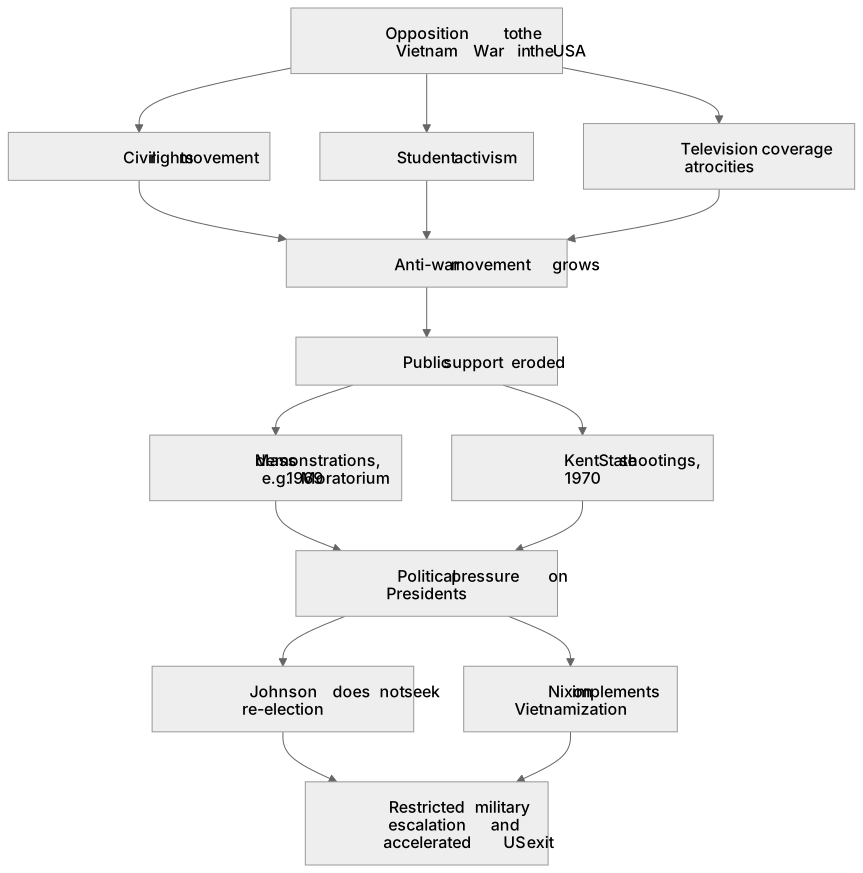
Key words
Say what each word means before you turn the card.
Domestic politics and public opinion
Try answering aloud or in your head before turning the card.
Media and propaganda
Try answering aloud or in your head before turning the card.
Protest and civil disobedience
Try answering aloud or in your head before turning the card.
Government policy and withdrawal
Try answering aloud or in your head before turning the card.
See every definition
- Domestic politics and public opinion
- The anti-war movement steadily eroded public support and placed immense political pressure on US Presidents.
- Media and propaganda
- Extensive television coverage of atrocities fuelled the anti-war movement and shifted public opinion.
- Protest and civil disobedience
- Mass demonstrations, such as the 1969 Moratorium to End the War, demonstrated widespread public discontent to the government.
- Government policy and withdrawal
- Intense domestic opposition restricted military escalation and accelerated the US exit from Vietnam.
Label the diagram
Some boxes have lost their names. Pick the right name for each number.
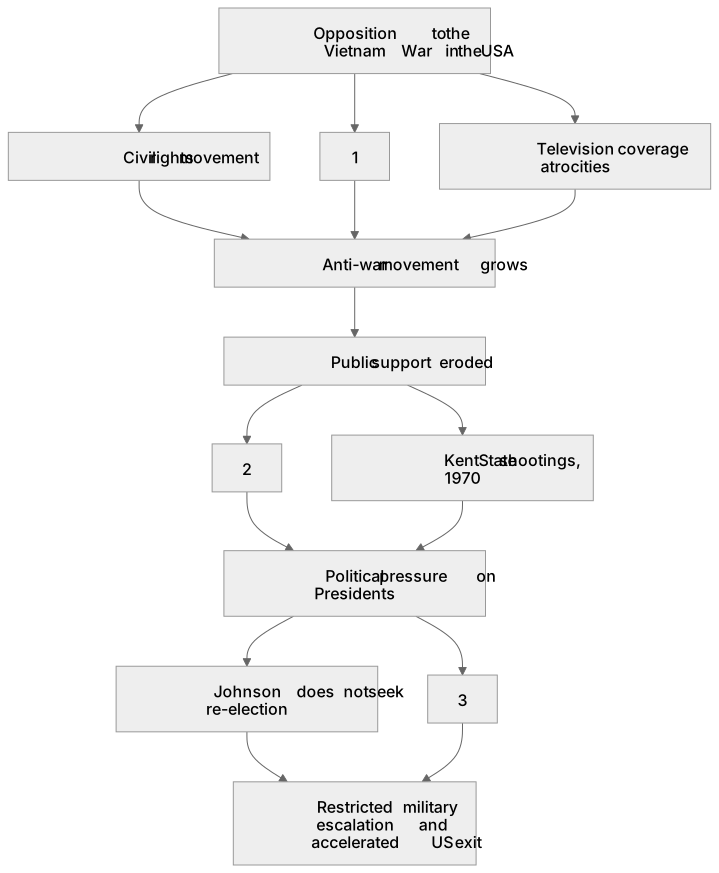
1Box 1
2Box 2
3Box 3
There is more to this lesson
The full lesson goes on to check your understanding and help you earn the marks. Create a free account to carry on, with your progress saved.
A week of Premium from your first lesson · Then the free plan continues · No card, no charge
Test your understanding of Option 33: Key topic 4: Reactions to, and the end of, US involvement in Vietnam, 1964–75 - 4 Reasons for the failure of the USA in Vietnam: The impact of opposition to the war in the USA.
Active recall beats re-reading. Take an instant quiz now to test what you’ve learned and lock it into long-term memory.
A week of Premium from your first lesson · Then the free plan continues · No card, no charge