Pearson Edexcel · GCSE · History
Course version: 1HI0 · Version from Sept 2016
Key topic 4: Reactions to, and the end of, US involvement in Vietnam,…
Full specification wording
Option 33: Key topic 4: Reactions to, and the end of, US involvement in Vietnam, 1964–75 - 4 Reasons for the failure of the USA in Vietnam: The weaknesses of the US armed forces. The failure of US tactics.
The US armed forces in Vietnam suffered from severe structural weaknesses, notably the reliance on young, inexperienced conscripts whose one-year tour of duty prevented the accumulation of combat…
Checked against the Pearson Edexcel 1HI0 specification (opens in a new tab) on .
- Point 2 of 3
- 4 key terms
Study notes
From the checked teaching notes for this specification point.
The idea
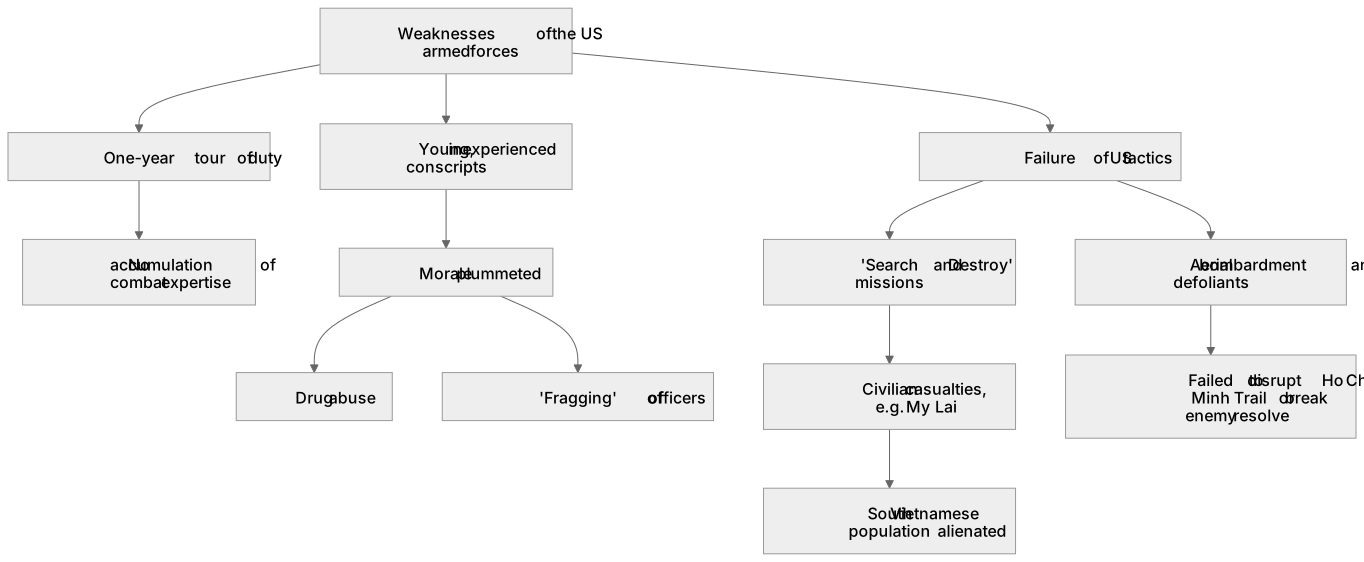
The US armed forces in Vietnam suffered from severe structural weaknesses, notably the reliance on young, inexperienced conscripts whose one-year tour of duty prevented the accumulation of combat expertise. Morale plummeted, leading to widespread drug abuse and 'fragging' (attacking officers). Concurrently, US military tactics failed against the Vietcong's guerrilla warfare. 'Search and Destroy' missions, heavily reliant on helicopters and firepower, often resulted in civilian casualties (like the My Lai massacre), alienating the South Vietnamese population. Furthermore, massive aerial bombardment campaigns, such as Operation Rolling Thunder, and the use of chemical defoliants like Agent Orange, failed to disrupt the Ho Chi Minh Trail or break enemy resolve, ultimately proving counterproductive.
What earns the marks
- Explain how the draft system led to an inexperienced and unmotivated fighting force, with the one-year tour of duty hindering unit cohesion.
- Detail the breakdown of military discipline, evidenced by high rates of drug addiction and incidents of 'fragging' against commanding officers.
- Analyse the failure of 'Search and Destroy' tactics, noting how they often killed innocent civilians and pushed the local population towards supporting the Vietcong.
- Evaluate the limitations of technological superiority, such as how Operation Rolling Thunder failed to stop the supply lines along the Ho Chi Minh Trail.
Common mistakes and how to put them right
Claiming the US military was poorly equipped.
Put it right: The US had vastly superior technology and funding, but the error was that this conventional equipment was unsuited for guerrilla warfare.
Confusing 'Search and Destroy' with guerrilla tactics.
Put it right: 'Search and Destroy' was the US strategy of inserting troops via helicopter to find and eliminate enemy forces, whereas guerrilla tactics were used by the Vietcong.
Stating that all US soldiers were drafted.
Put it right: While conscription was a major issue, many soldiers were volunteers, but the draft disproportionately affected working-class and minority men, lowering overall morale.
Exam tips
- Link specific US weaknesses, such as low morale, directly to the failure of their tactics on the ground to build a cohesive argument.
- Use concrete examples of failed tactics, such as the use of Agent Orange or Operation Rolling Thunder, to support explanations of why the US could not secure victory.
- Contrast US conventional warfare methods with Vietcong guerrilla tactics to highlight why American technological superiority was neutralised.
Try the lesson
The start of the Option 33: Key topic 4: Reactions to, and the end of, US involvement in Vietnam, 1964–75 - 4 Reasons for the failure of the USA in Vietnam: The weaknesses of the US armed forces. The failure of US tactics. lesson, made from checked teaching notes for this specification point.
Have a go first
Which of the following was a significant weakness of the US armed forces during the Vietnam War?
Listen
The US armed forces in Vietnam suffered from severe structural weaknesses, notably the reliance on young, inexperienced conscripts whose one-year tour of duty prevented the accumulation of combat expertise. Morale plummeted, leading to widespread drug abuse and 'fragging' (attacking officers). Concurrently, US military tactics failed against the Vietcong's guerrilla warfare. Search and Destroy' missions, heavily reliant on helicopters and firepower, often resulted in civilian casualties (like the My Lai massacre), alienating the South Vietnamese population. Furthermore, massive aerial bombardment campaigns, such as Operation Rolling Thunder, and the use of chemical defoliants like Agent Orange, failed to disrupt the Ho Chi Minh Trail or break enemy resolve, ultimately proving counterproductive. A strong answer earns marks for these points. Explain how the draft system led to an inexperienced and unmotivated fighting force, with the one-year tour of duty hindering unit cohesion. Detail the breakdown of military discipline, evidenced by high rates of drug addiction and incidents of 'fragging' against commanding officers. Analyse the failure of 'Search and Destroy' tactics, noting how they often killed innocent civilians and pushed the local population towards supporting the Vietcong. Evaluate the limitations of technological superiority, such as how Operation Rolling Thunder failed to stop the supply lines along the Ho Chi Minh Trail. Exam tip: Link specific US weaknesses, such as low morale, directly to the failure of their tactics on the ground to build a cohesive argument.
See it
Key words
Say what each word means before you turn the card.
Morale and discipline
Try answering aloud or in your head before turning the card.
Technological warfare vs guerrilla warfare
Try answering aloud or in your head before turning the card.
Civilian alienation
Try answering aloud or in your head before turning the card.
Military strategy and tactics
Try answering aloud or in your head before turning the card.
See every definition
- Morale and discipline
- US morale plummeted, leading to widespread drug abuse and 'fragging', which was the attacking of officers.
- Technological warfare vs guerrilla warfare
- Conventional equipment was unsuited for guerrilla warfare, so US technological superiority was neutralised against the Vietcong's guerrilla tactics.
- Civilian alienation
- 'Search and Destroy' missions often resulted in civilian casualties, alienating the South Vietnamese population and pushing the local population towards supporting the Vietcong.
- Military strategy and tactics
- US tactics failed against the Vietcong's guerrilla warfare, and massive aerial bombardment campaigns failed to disrupt the Ho Chi Minh Trail or break enemy resolve.
Label the diagram
Some boxes have lost their names. Pick the right name for each number.
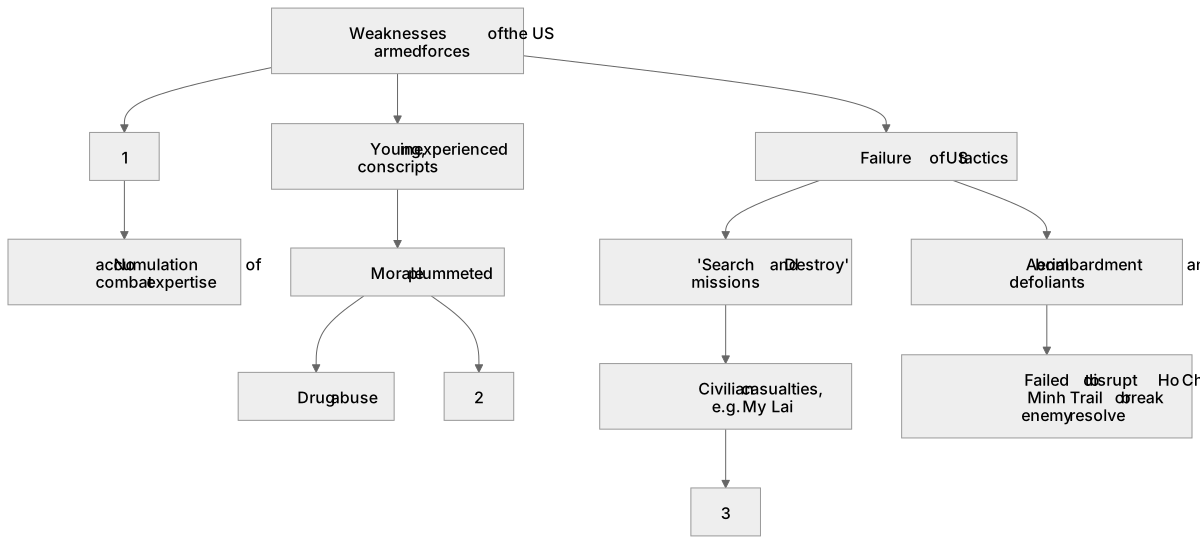
1Box 1
2Box 2
3Box 3
There is more to this lesson
The full lesson goes on to check your understanding and help you earn the marks. Create a free account to carry on, with your progress saved.
A week of Premium from your first lesson · Then the free plan continues · No card, no charge
Test your understanding of Option 33: Key topic 4: Reactions to, and the end of, US involvement in Vietnam, 1964–75 - 4 Reasons for the failure of the USA in Vietnam: The weaknesses of the US armed forces. The failure of US tactics.
Active recall beats re-reading. Take an instant quiz now to test what you’ve learned and lock it into long-term memory.
A week of Premium from your first lesson · Then the free plan continues · No card, no charge