Pearson Edexcel · GCSE · History
Course version: 1HI0 · Version from Sept 2016
Key topic 4: Reactions to, and the end of, US involvement in Vietnam,…
Full specification wording
Option 33: Key topic 4: Reactions to, and the end of, US involvement in Vietnam, 1964–75 - 4 Reasons for the failure of the USA in Vietnam: The strengths of North Vietnam, including the significance of Russian and Chinese support, Vietcong tactics and the Ho Chi Minh Trail.
North Vietnam’s ultimate victory relied on significant strategic strengths, particularly the ideological commitment of its people.
Checked against the Pearson Edexcel 1HI0 specification (opens in a new tab) on .
- Point 1 of 3
- 4 key terms
Study notes
From the checked teaching notes for this specification point.
The idea
North Vietnam’s ultimate victory relied on significant strategic strengths, particularly the ideological commitment of its people. The significance of Russian and Chinese support was paramount; both communist powers provided billions of dollars in vital aid, including advanced surface-to-air missiles, artillery, and medical supplies. Vietcong guerrilla tactics, such as complex tunnel networks, booby traps, and sudden ambushes, effectively neutralised superior American firepower. Furthermore, the Ho Chi Minh Trail was a crucial logistical artery. Despite relentless US bombing campaigns, this vast network of jungle paths continuously supplied the Vietcong with troops and weapons from the North.
What earns the marks
- Explain how the ideological commitment and resilience of the North Vietnamese and Vietcong served as a fundamental strength against US forces.
- Detail the significance of Russian and Chinese support, including the provision of billions of dollars in aid, weaponry, and surface-to-air missiles.
- Analyse the effectiveness of Vietcong guerrilla tactics, such as ambushes, booby traps, and tunnel systems, in countering superior US firepower.
- Evaluate the strategic importance of the Ho Chi Minh Trail in maintaining the supply of troops and equipment to the South despite heavy US bombing.
Common mistakes and how to put them right
Claiming that North Vietnam fought the USA entirely alone.
Put it right by emphasising the crucial military and financial support provided by the Soviet Union and China.
Stating that the Vietcong fought conventional, open battles against the USA.
Put it right by explaining their reliance on guerrilla tactics, ambushes, and blending in with civilians.
Believing the Ho Chi Minh Trail was a single, paved road.
Put it right by describing it as a complex, constantly shifting network of jungle paths that was highly resilient to bombing.
Exam tips
- Ensure you explicitly link the strengths of North Vietnam to the reasons for the failure of the USA, showing cause and effect.
- Use the Ho Chi Minh Trail as a prime example of North Vietnamese logistical resilience in the face of Operation Rolling Thunder.
- When discussing guerrilla tactics, explain why they were specifically effective against the conventional military strategies employed by the USA.
Try the lesson
The start of the Option 33: Key topic 4: Reactions to, and the end of, US involvement in Vietnam, 1964–75 - 4 Reasons for the failure of the USA in Vietnam: The strengths of North Vietnam, including the significance of Russian and Chinese support, Vietcong tactics and the Ho Chi Minh Trail. lesson, made from checked teaching notes for this specification point.
Have a go first
What was the primary purpose of the Ho Chi Minh Trail during the Vietnam War?
Listen
North Vietnam’s ultimate victory relied on significant strategic strengths, particularly the ideological commitment of its people. The significance of Russian and Chinese support was paramount; both communist powers provided billions of dollars in vital aid, including advanced surface-to-air missiles, artillery, and medical supplies. Vietcong guerrilla tactics, such as complex tunnel networks, booby traps, and sudden ambushes, effectively neutralised superior American firepower. Furthermore, the Ho Chi Minh Trail was a crucial logistical artery. Despite relentless US bombing campaigns, this vast network of jungle paths continuously supplied the Vietcong with troops and weapons from the North. A strong answer earns marks for these points. Explain how the ideological commitment and resilience of the North Vietnamese and Vietcong served as a fundamental strength against US forces. Detail the significance of Russian and Chinese support, including the provision of billions of dollars in aid, weaponry, and surface-to-air missiles. Analyse the effectiveness of Vietcong guerrilla tactics, such as ambushes, booby traps, and tunnel systems, in countering superior US firepower. Evaluate the strategic importance of the Ho Chi Minh Trail in maintaining the supply of troops and equipment to the South despite heavy US bombing. A common slip: Claiming that North Vietnam fought the USA entirely alone. Instead, emphasising the crucial military and financial support provided by the Soviet Union and China. Exam tip: Ensure you explicitly link the strengths of North Vietnam to the reasons for the failure of the USA, showing cause and effect.
See it
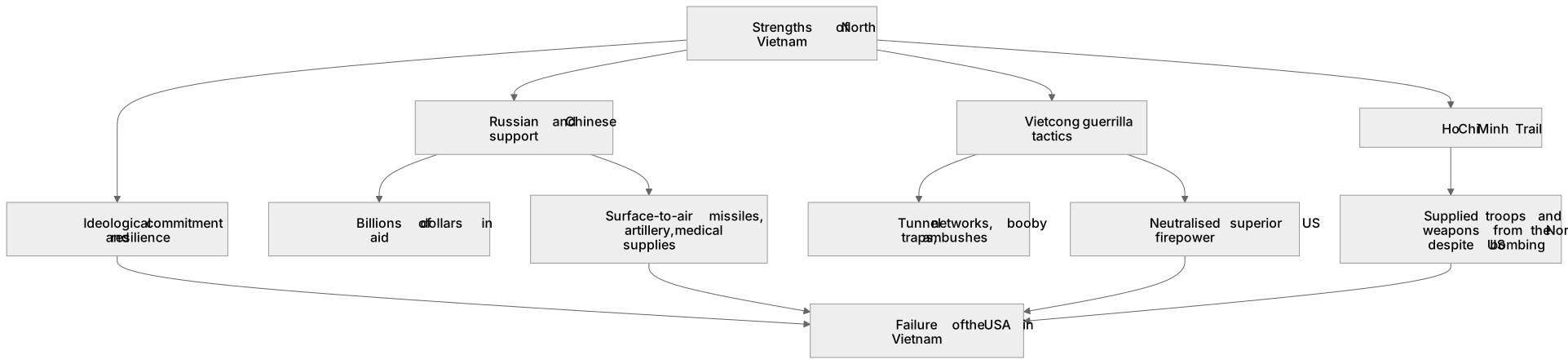
Key words
Say what each word means before you turn the card.
Guerrilla tactics
Try answering aloud or in your head before turning the card.
Ho Chi Minh Trail
Try answering aloud or in your head before turning the card.
Russian and Chinese support
Try answering aloud or in your head before turning the card.
Ideological commitment
Try answering aloud or in your head before turning the card.
See every definition
- Guerrilla tactics
- Methods such as complex tunnel networks, booby traps and sudden ambushes that effectively neutralised superior American firepower.
- Ho Chi Minh Trail
- A crucial logistical artery, a vast network of jungle paths that continuously supplied the Vietcong with troops and weapons from the North despite relentless US bombing campaigns.
- Russian and Chinese support
- Aid from both communist powers, who provided billions of dollars in vital aid, including advanced surface-to-air missiles, artillery and medical supplies.
- Ideological commitment
- The commitment of North Vietnam's people, on which its ultimate victory relied as a fundamental strength against US forces.
Label the diagram
Some boxes have lost their names. Pick the right name for each number.
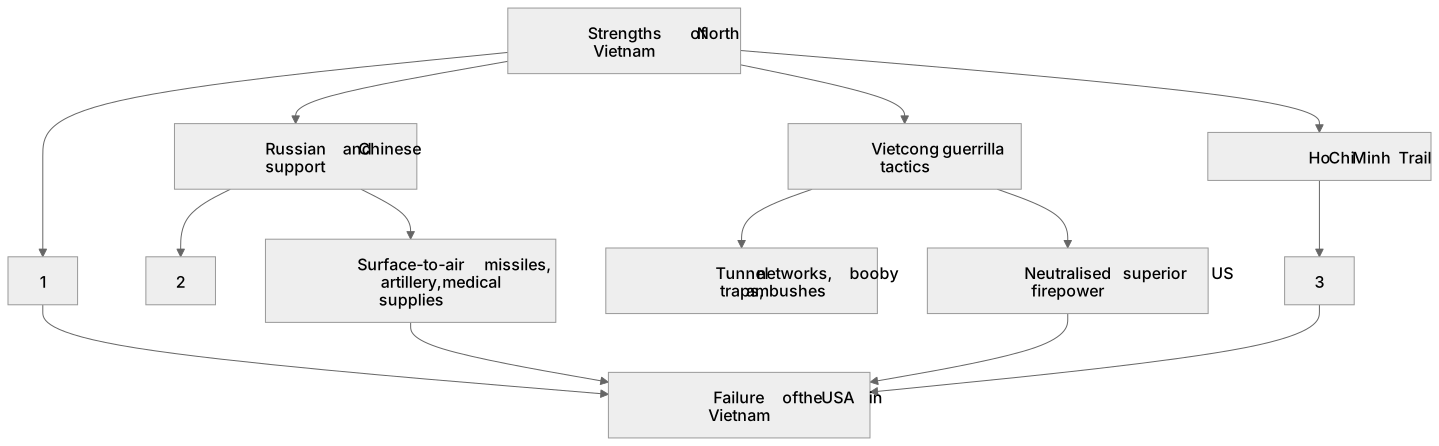
1Box 1
2Box 2
3Box 3
There is more to this lesson
The full lesson goes on to check your understanding and help you earn the marks. Create a free account to carry on, with your progress saved.
A week of Premium from your first lesson · Then the free plan continues · No card, no charge
Test your understanding of Option 33: Key topic 4: Reactions to, and the end of, US involvement in Vietnam, 1964–75 - 4 Reasons for the failure of the USA in Vietnam: The strengths of North Vietnam, including the significance of Russian and Chinese support, Vietcong tactics and the Ho Chi Minh Trail.
Active recall beats re-reading. Take an instant quiz now to test what you’ve learned and lock it into long-term memory.
A week of Premium from your first lesson · Then the free plan continues · No card, no charge