Pearson Edexcel · GCSE · History
Course version: 1HI0 · Version from Sept 2016
Key topic 1: Anglo-Saxon England and the Norman Conquest, 1060–66 - 4 The…
Full specification wording
Option B1: Key topic 1: Anglo-Saxon England and the Norman Conquest, 1060–66 - 4 The Norman invasion: The Battle of Hastings.
The Battle of Hastings took place on 14 October 1066 between King Harold’s Anglo-Saxon army and William of Normandy’s invading forces.
Checked against the Pearson Edexcel 1HI0 specification (opens in a new tab) on .
- Point 1 of 2
- 3 key terms
Study notes
From the checked teaching notes for this specification point.
The idea
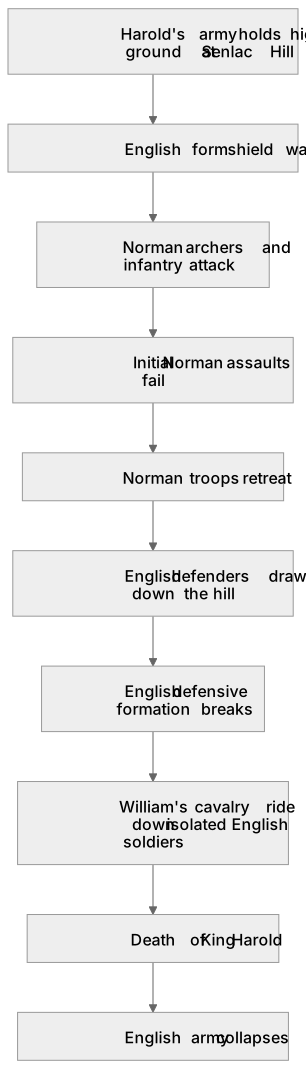
The Battle of Hastings took place on 14 October 1066 between King Harold’s Anglo-Saxon army and William of Normandy’s invading forces. Harold secured the high ground at Senlac Hill, forming a formidable shield wall that initially repelled Norman archers and infantry. The battle's turning point occurred when Norman troops retreated—whether in genuine panic or as a feigned flight tactic—drawing English defenders down the hill and breaking their defensive formation. This allowed William's cavalry to ride down the isolated English soldiers. The battle culminated in the death of King Harold, traditionally depicted as being struck in the eye by an arrow or cut down by Norman knights, leading to the collapse of the English army and securing the Norman conquest of England.
What earns the marks
- Describe the initial English advantage of holding the high ground at Senlac Hill with a strong shield wall.
- Explain the failure of the initial Norman assaults, including the ineffectiveness of archers firing uphill.
- Detail the use of the 'feigned retreat' tactic by the Normans to break the English shield wall.
- Identify the death of Harold Godwinson as the decisive moment that caused the English forces to rout.
Common mistakes and how to put them right
Claiming the battle took place in Hastings.
Put it right: The battle actually occurred at Senlac Hill, several miles away from Hastings.
Stating the English had cavalry.
Put it right: The Anglo-Saxons fought entirely on foot as infantry, using horses only for transport to the battlefield.
Assuming the feigned retreat was definitely planned from the start.
Put it right: Acknowledge historical debate; the first retreat may have been genuine panic, which William then adapted into a deliberate tactic.
Exam tips
- Structure narrative accounts of the battle chronologically, starting with the shield wall and ending with Harold's death.
- Use specific military terminology like 'shield wall', 'housecarls', 'fyrd', and 'feigned retreat' to demonstrate precise knowledge.
- Link the events of the battle directly to the advantages and disadvantages each side held at the beginning of the day.
Try the lesson
The start of the Option B1: Key topic 1: Anglo-Saxon England and the Norman Conquest, 1060–66 - 4 The Norman invasion: The Battle of Hastings. lesson, made from checked teaching notes for this specification point.
Have a go first
Where did King Harold Godwinson position his army at the beginning of the Battle of Hastings?
Listen
The Battle of Hastings took place on 14 October 1066 between King Harold’s Anglo-Saxon army and William of Normandy’s invading forces. Harold secured the high ground at Senlac Hill, forming a formidable shield wall that initially repelled Norman archers and infantry. The battle's turning point occurred when Norman troops retreated—whether in genuine panic or as a feigned flight tactic—drawing English defenders down the hill and breaking their defensive formation. This allowed William's cavalry to ride down the isolated English soldiers. The battle culminated in the death of King Harold, traditionally depicted as being struck in the eye by an arrow or cut down by Norman knights, leading to the collapse of the English army and securing the Norman conquest of England. A strong answer earns marks for these points. Describe the initial English advantage of holding the high ground at Senlac Hill with a strong shield wall. Explain the failure of the initial Norman assaults, including the ineffectiveness of archers firing uphill. Detail the use of the 'feigned retreat' tactic by the Normans to break the English shield wall. Identify the death of Harold Godwinson as the decisive moment that caused the English forces to rout. A common slip: Claiming the battle took place in Hastings. Instead, The battle actually occurred at Senlac Hill, several miles away from Hastings. Exam tip: Structure narrative accounts of the battle chronologically, starting with the shield wall and ending with Harold's death.
See it
Key words
Say what each word means before you turn the card.
shield wall
Try answering aloud or in your head before turning the card.
turning point
Try answering aloud or in your head before turning the card.
conquest
Try answering aloud or in your head before turning the card.
See every definition
- shield wall
- A formidable defensive formation formed by Harold's Anglo-Saxon army on the high ground at Senlac Hill, which initially repelled Norman archers and infantry.
- turning point
- The moment when Norman troops retreated, drawing the English defenders down the hill and breaking their defensive formation.
- conquest
- The securing of Norman control over England, brought about by the collapse of the English army after King Harold's death.
Label the diagram
Some boxes have lost their names. Pick the right name for each number.
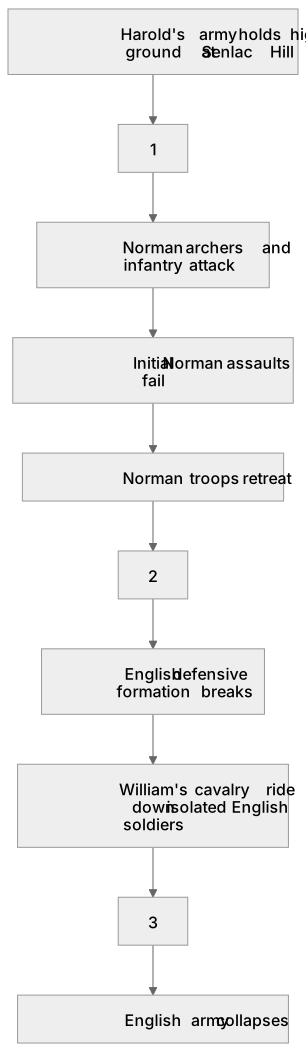
1Box 1
2Box 2
3Box 3
There is more to this lesson
The full lesson goes on to check your understanding and help you earn the marks. Create a free account to carry on, with your progress saved.
A week of Premium from your first lesson · Then the free plan continues · No card, no charge
Test your understanding of Option B1: Key topic 1: Anglo-Saxon England and the Norman Conquest, 1060–66 - 4 The Norman invasion: The Battle of Hastings.
Active recall beats re-reading. Take an instant quiz now to test what you’ve learned and lock it into long-term memory.
A week of Premium from your first lesson · Then the free plan continues · No card, no charge