Pearson Edexcel · GCSE · History
Course version: 1HI0 · Version from Sept 2016
Key topic 2: William I in power: securing the kingdom, 1066–87 - 1…
Full specification wording
Option B1: Key topic 2: William I in power: securing the kingdom, 1066–87 - 1 Establishing control: Reasons for the building of castles; their key features and importance.
William I built castles primarily to establish physical and psychological control over a hostile English population.
Checked against the Pearson Edexcel 1HI0 specification (opens in a new tab) on .
- Point 3 of 3
- 4 key terms
Study notes
From the checked teaching notes for this specification point.
The idea
William I built castles primarily to establish physical and psychological control over a hostile English population. Unlike Anglo-Saxon fortified towns (burhs), Norman motte and bailey castles were built quickly in strategic locations, such as river crossings and rebellious towns like York. Key features included the motte (a raised earth mound), the keep (a wooden tower on the motte for defence), the bailey (an enclosed courtyard for soldiers and horses), and a palisade (wooden fence). Their importance lay in providing secure bases for Norman garrisons to launch cavalry patrols, suppress local uprisings, and dominate the surrounding landscape, serving as a constant, intimidating reminder of Norman military supremacy and royal authority.
What earns the marks
- Identify the strategic reasons for building castles, such as controlling rebellious populations and securing key routes.
- Describe the key features of a motte and bailey castle, including the motte, keep, bailey, and palisade.
- Explain the military importance of castles as secure bases for Norman cavalry to patrol and suppress rebellions.
- Analyse the psychological impact of castles as symbols of Norman dominance over the conquered English.
Common mistakes and how to put them right
Confusing Norman castles with Anglo-Saxon burhs.
Put it right: Burhs were large fortified towns to protect communities, whereas Norman castles were small, private military bases to control the local area.
Describing early Norman castles as being made of stone.
Put it right: The vast majority of early Norman castles were motte and bailey structures built from earth and timber for speed.
Stating that castles were only used for defence.
Put it right: They were also offensive bases used to launch patrols and dominate the surrounding region.
Exam tips
- Be prepared to draw or label a simple diagram of a motte and bailey castle in your revision to remember the key features.
- Use the word 'psychological' when explaining how the imposing sight of a castle intimidated the local English population.
- Contrast the speed of building timber castles with the time taken to build stone castles to explain their rapid spread across England.
Try the lesson
The start of the Option B1: Key topic 2: William I in power: securing the kingdom, 1066–87 - 1 Establishing control: Reasons for the building of castles; their key features and importance. lesson, made from checked teaching notes for this specification point.
Have a go first
What was the primary function of the 'motte' in a traditional Norman motte and bailey castle?
Listen
William I built castles primarily to establish physical and psychological control over a hostile English population. Unlike Anglo-Saxon fortified towns (burhs), Norman motte and bailey castles were built quickly in strategic locations, such as river crossings and rebellious towns like York. Key features included the motte (a raised earth mound), the keep (a wooden tower on the motte for defence), the bailey (an enclosed courtyard for soldiers and horses), and a palisade (wooden fence). Their importance lay in providing secure bases for Norman garrisons to launch cavalry patrols, suppress local uprisings, and dominate the surrounding landscape, serving as a constant, intimidating reminder of Norman military supremacy and royal authority. A strong answer earns marks for these points. Identify the strategic reasons for building castles, such as controlling rebellious populations and securing key routes. Describe the key features of a motte and bailey castle, including the motte, keep, bailey, and palisade. Explain the military importance of castles as secure bases for Norman cavalry to patrol and suppress rebellions. Analyse the psychological impact of castles as symbols of Norman dominance over the conquered English. A common slip: Confusing Norman castles with Anglo-Saxon burhs. Instead, burhs were large fortified towns to protect communities, whereas Norman castles were small, private military bases to control the local area. Exam tip: Be prepared to draw or label a simple diagram of a motte and bailey castle in your revision to remember the key features.
See it
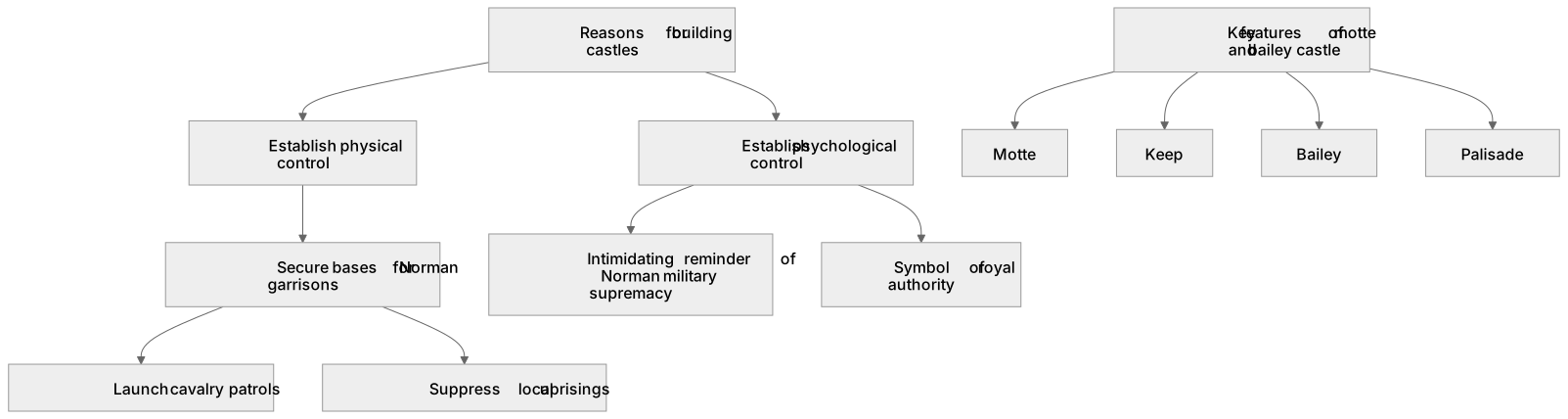
Key words
Say what each word means before you turn the card.
Motte and bailey castle
Try answering aloud or in your head before turning the card.
Motte
Try answering aloud or in your head before turning the card.
Bailey
Try answering aloud or in your head before turning the card.
Palisade
Try answering aloud or in your head before turning the card.
See every definition
- Motte and bailey castle
- A castle built quickly from earth and timber, with a raised earth mound, a wooden tower, an enclosed courtyard and a wooden fence.
- Motte
- A raised earth mound on which the keep, a wooden tower for defence, stood.
- Bailey
- An enclosed courtyard within a castle, used for soldiers and horses.
- Palisade
- A wooden fence forming part of a castle's defences.
Label the diagram
Some boxes have lost their names. Pick the right name for each number.
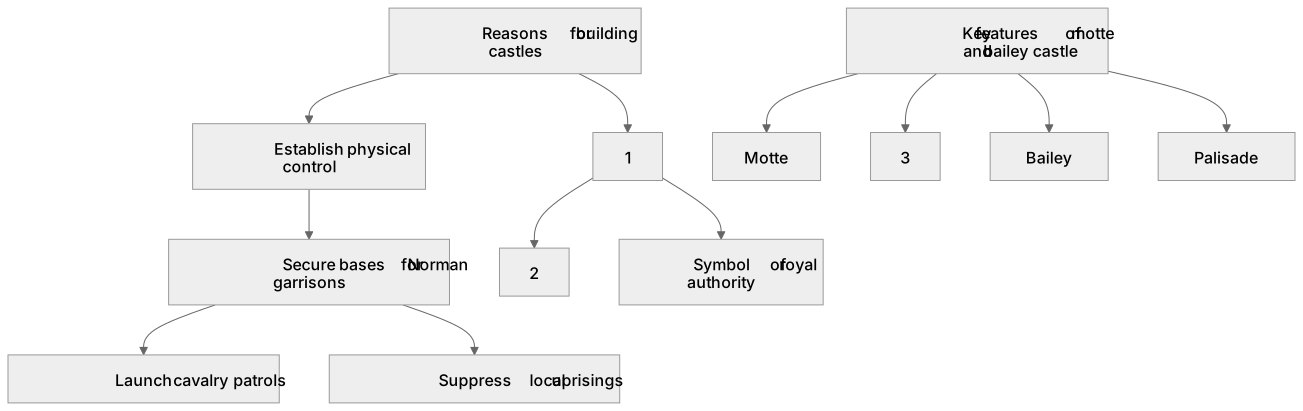
1Box 1
2Box 2
3Box 3
There is more to this lesson
The full lesson goes on to check your understanding and help you earn the marks. Create a free account to carry on, with your progress saved.
A week of Premium from your first lesson · Then the free plan continues · No card, no charge
Test your understanding of Option B1: Key topic 2: William I in power: securing the kingdom, 1066–87 - 1 Establishing control: Reasons for the building of castles; their key features and importance.
Active recall beats re-reading. Take an instant quiz now to test what you’ve learned and lock it into long-term memory.
A week of Premium from your first lesson · Then the free plan continues · No card, no charge