Pearson Edexcel · GCSE · History
Course version: 1HI0 · Version from Sept 2016
Key topic 2: William I in power: securing the kingdom, 1066–87 - 1…
Full specification wording
Option B1: Key topic 2: William I in power: securing the kingdom, 1066–87 - 1 Establishing control: Rewarding followers and establishing control on the borderlands through the use of earls. The Marcher earldoms.
William I secured his new kingdom by rewarding loyal Norman followers with land, particularly in vulnerable border regions.
Checked against the Pearson Edexcel 1HI0 specification (opens in a new tab) on .
- Point 2 of 3
- 3 key terms
Study notes
From the checked teaching notes for this specification point.
The idea
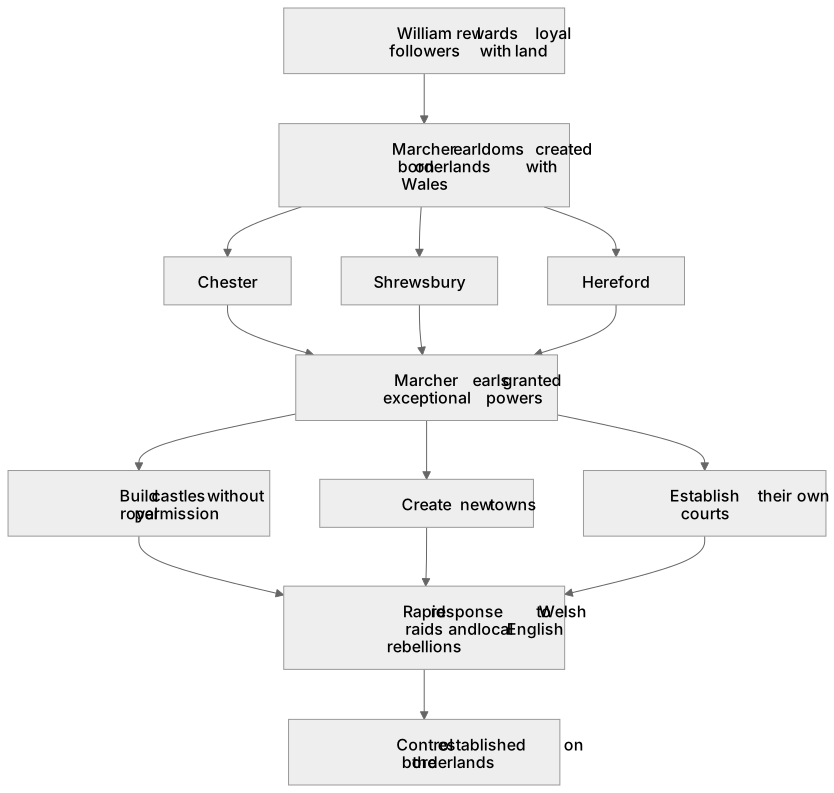
William I secured his new kingdom by rewarding loyal Norman followers with land, particularly in vulnerable border regions. To establish control on the volatile borderlands with Wales, he created the Marcher earldoms (Chester, Shrewsbury, and Hereford). These earls were granted exceptional powers: they could build castles without royal permission, create new towns, and establish their own courts. This decentralised authority allowed them to respond rapidly to Welsh raids and suppress local English rebellions without waiting for the king's orders. By granting these privileges to trusted allies like William FitzOsbern, William effectively delegated the defence of the frontier, ensuring stability while rewarding those who had supported his invasion.
What earns the marks
- Explain how William rewarded loyal followers with land to secure their continued support.
- Identify the three Marcher earldoms: Chester, Shrewsbury, and Hereford.
- Describe the special privileges granted to Marcher earls, such as building castles without permission and holding their own courts.
- Analyse how these privileges helped establish control on the Welsh borderlands by allowing rapid military responses.
Common mistakes and how to put them right
Stating that Marcher earls were independent of the king.
Put it right: They had special privileges but still owed allegiance and military service to William.
Confusing the Marcher earldoms with earldoms in the north of England.
Put it right: The Marcher earldoms were specifically located on the border with Wales.
Assuming all earls in England had the same powers.
Put it right: Marcher earls had unique rights, such as building castles without royal permission, which other earls did not possess.
Exam tips
- Use the specific names of the Marcher earldoms (Chester, Shrewsbury, Hereford) to add precise detail to your answers.
- Link the creation of the Marcher earldoms directly to the theme of establishing control and defending against Welsh threats.
- When discussing rewards, explain that land grants were conditional on loyalty and military service.
Try the lesson
The start of the Option B1: Key topic 2: William I in power: securing the kingdom, 1066–87 - 1 Establishing control: Rewarding followers and establishing control on the borderlands through the use of earls. The Marcher earldoms. lesson, made from checked teaching notes for this specification point.
Have a go first
Which of the following was a key feature of the Marcher earldoms created by William I?
Listen
William I secured his new kingdom by rewarding loyal Norman followers with land, particularly in vulnerable border regions. To establish control on the volatile borderlands with Wales, he created the Marcher earldoms (Chester, Shrewsbury, and Hereford). These earls were granted exceptional powers: they could build castles without royal permission, create new towns, and establish their own courts. This decentralised authority allowed them to respond rapidly to Welsh raids and suppress local English rebellions without waiting for the king's orders. By granting these privileges to trusted allies like William FitzOsbern, William effectively delegated the defence of the frontier, ensuring stability while rewarding those who had supported his invasion. A strong answer earns marks for these points. Explain how William rewarded loyal followers with land to secure their continued support. Identify the three Marcher earldoms: Chester, Shrewsbury, and Hereford. Describe the special privileges granted to Marcher earls, such as building castles without permission and holding their own courts. Analyse how these privileges helped establish control on the Welsh borderlands by allowing rapid military responses. A common slip: Stating that Marcher earls were independent of the king. Instead, they had special privileges but still owed allegiance and military service to William. Exam tip: Use the specific names of the Marcher earldoms (Chester, Shrewsbury, Hereford) to add precise detail to your answers.
See it
Key words
Say what each word means before you turn the card.
Marcher earldoms
Try answering aloud or in your head before turning the card.
Patronage and reward
Try answering aloud or in your head before turning the card.
Royal authority and control
Try answering aloud or in your head before turning the card.
See every definition
- Marcher earldoms
- Earldoms created on the volatile borderlands with Wales, namely Chester, Shrewsbury and Hereford, to establish control there.
- Patronage and reward
- Granting land to loyal followers to secure their continued support, with grants conditional on loyalty and military service.
- Royal authority and control
- Establishing control on the borderlands by delegating the defence of the frontier to trusted allies through the use of earls.
Label the diagram
Some boxes have lost their names. Pick the right name for each number.
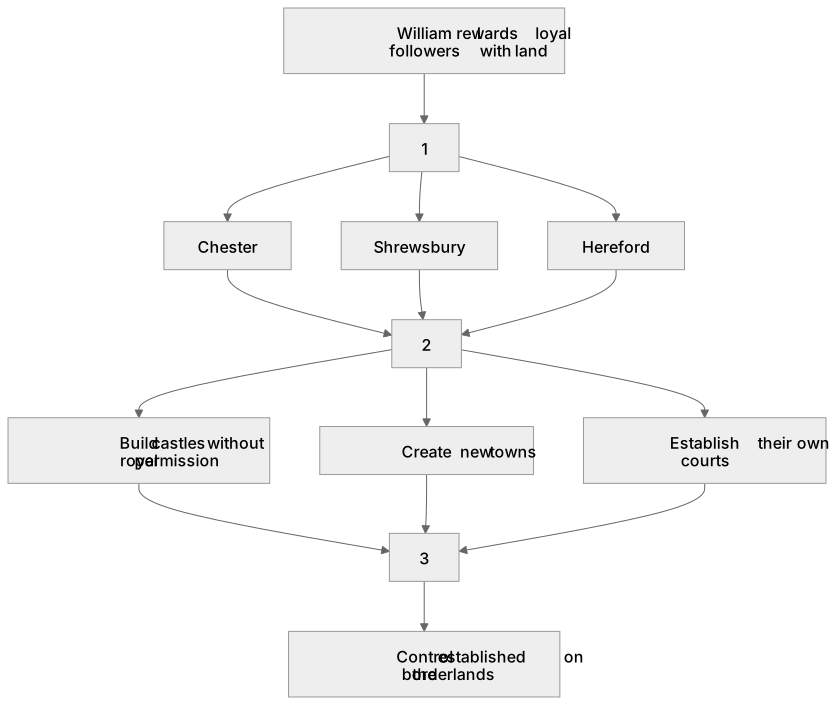
1Box 1
2Box 2
3Box 3
There is more to this lesson
The full lesson goes on to check your understanding and help you earn the marks. Create a free account to carry on, with your progress saved.
A week of Premium from your first lesson · Then the free plan continues · No card, no charge
Test your understanding of Option B1: Key topic 2: William I in power: securing the kingdom, 1066–87 - 1 Establishing control: Rewarding followers and establishing control on the borderlands through the use of earls. The Marcher earldoms.
Active recall beats re-reading. Take an instant quiz now to test what you’ve learned and lock it into long-term memory.
A week of Premium from your first lesson · Then the free plan continues · No card, no charge