Pearson Edexcel · GCSE · History
Course version: 1HI0 · Version from Sept 2016
Key topic 2: William I in power: securing the kingdom, 1066–87 - 4 Revolt…
Full specification wording
Option B1: Key topic 2: William I in power: securing the kingdom, 1066–87 - 4 Revolt of the Earls, 1075: Reasons for and features of the revolt.
The Revolt of the Earls in 1075 was a significant rebellion against William I, uniquely led by his own Norman and Anglo-Saxon earls.
Checked against the Pearson Edexcel 1HI0 specification (opens in a new tab) on .
- Point 1 of 2
Study notes
From the checked teaching notes for this specification point.
The idea
The Revolt of the Earls in 1075 was a significant rebellion against William I, uniquely led by his own Norman and Anglo-Saxon earls. The primary reasons included resentment over William's reduction of their earldoms' size and power, particularly for Ralph de Gael and Roger de Breteuil. Waltheof, the last Anglo-Saxon earl, was also drawn into the plot. Key features of the revolt involved the conspirators planning to divide England into three, seeking Danish support, and timing the uprising while William was in Normandy. The revolt highlights the fragility of Norman alliances and the ongoing threat of foreign intervention, demonstrating that resistance to William's rule was not exclusively Anglo-Saxon.
What earns the marks
- Identify the key leaders of the revolt: Ralph de Gael, Roger de Breteuil, and Waltheof.
- Explain the reasons for the revolt, focusing on the earls' loss of land, privileges, and power under William's centralising policies.
- Describe the features of the rebellion, including the plot hatched at a wedding feast and the plan to divide England.
- Note the involvement of external forces, specifically the request for a Danish fleet to support the uprising.
Common mistakes and how to put them right
Assuming the revolt was purely an Anglo-Saxon uprising.
Put it right by emphasising that it was led by two Norman earls alongside one Anglo-Saxon.
Stating that William was present in England during the outbreak.
Put it right by noting that William was in Normandy, leaving Lanfranc to manage the crisis.
Confusing the 1075 revolt with earlier rebellions like the Harrying of the North.
Put it right by distinguishing the specific leaders and motives of 1075.
Exam tips
- Clearly distinguish between the motives of the Norman earls (loss of power) and the Anglo-Saxon earl Waltheof.
- Use the revolt to demonstrate that William faced threats from his own supporters, not just the conquered English.
- Mention the role of Archbishop Lanfranc in organising the defence against the rebels while William was absent.
Try the lesson
The start of the Option B1: Key topic 2: William I in power: securing the kingdom, 1066–87 - 4 Revolt of the Earls, 1075: Reasons for and features of the revolt. lesson, made from checked teaching notes for this specification point.
Have a go first
Who were the main leaders of the Revolt of the Earls in 1075?
Listen
The Revolt of the Earls in 1075 was a significant rebellion against William I, uniquely led by his own Norman and Anglo-Saxon earls. The primary reasons included resentment over William's reduction of their earldoms' size and power, particularly for Ralph de Gael and Roger de Breteuil. Waltheof, the last Anglo-Saxon earl, was also drawn into the plot. Key features of the revolt involved the conspirators planning to divide England into three, seeking Danish support, and timing the uprising while William was in Normandy. The revolt highlights the fragility of Norman alliances and the ongoing threat of foreign intervention, demonstrating that resistance to William's rule was not exclusively Anglo-Saxon. A strong answer earns marks for these points. Identify the key leaders of the revolt: Ralph de Gael, Roger de Breteuil, and Waltheof. Explain the reasons for the revolt, focusing on the earls' loss of land, privileges, and power under William's centralising policies. Describe the features of the rebellion, including the plot hatched at a wedding feast and the plan to divide England. Note the involvement of external forces, specifically the request for a Danish fleet to support the uprising. A common slip: Assuming the revolt was purely an Anglo-Saxon uprising. Instead, emphasising that it was led by two Norman earls alongside one Anglo-Saxon. Exam tip: Clearly distinguish between the motives of the Norman earls (loss of power) and the Anglo-Saxon earl Waltheof.
See it
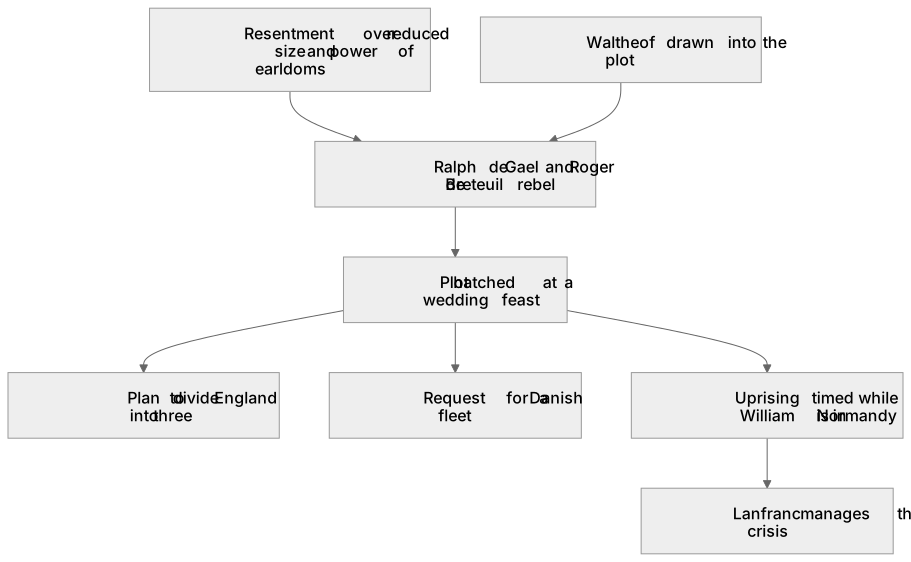
Label the diagram
Some boxes have lost their names. Pick the right name for each number.
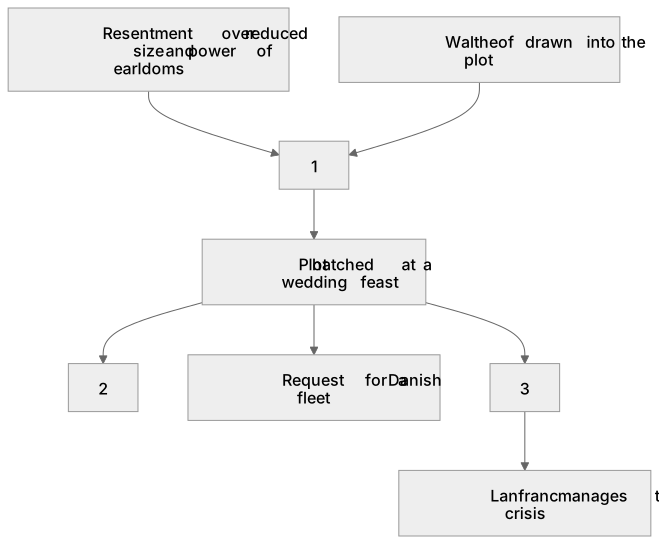
1Box 1
2Box 2
3Box 3
There is more to this lesson
The full lesson goes on to check your understanding and help you earn the marks. Create a free account to carry on, with your progress saved.
A week of Premium from your first lesson · Then the free plan continues · No card, no charge
Test your understanding of Option B1: Key topic 2: William I in power: securing the kingdom, 1066–87 - 4 Revolt of the Earls, 1075: Reasons for and features of the revolt.
Active recall beats re-reading. Take an instant quiz now to test what you’ve learned and lock it into long-term memory.
A week of Premium from your first lesson · Then the free plan continues · No card, no charge