Pearson Edexcel · GCSE · History
Course version: 1HI0 · Version from Sept 2016
Key topic 3: Norman England, 1066–88 - 1 The feudal system and the Church:…
Full specification wording
Option B1: Key topic 3: Norman England, 1066–88 - 1 The feudal system and the Church: The Church in England: its role in society and relationship to government, including the significance of Stigand and Lanfranc. The Normanisation and reform of the Church in the reign of William I.
The Church in Norman England was central to society and government, acting as a major landholder and reinforcing royal authority.
Checked against the Pearson Edexcel 1HI0 specification (opens in a new tab) on .
- Point 2 of 3
- 4 key terms
Study notes
From the checked teaching notes for this specification point.
The idea
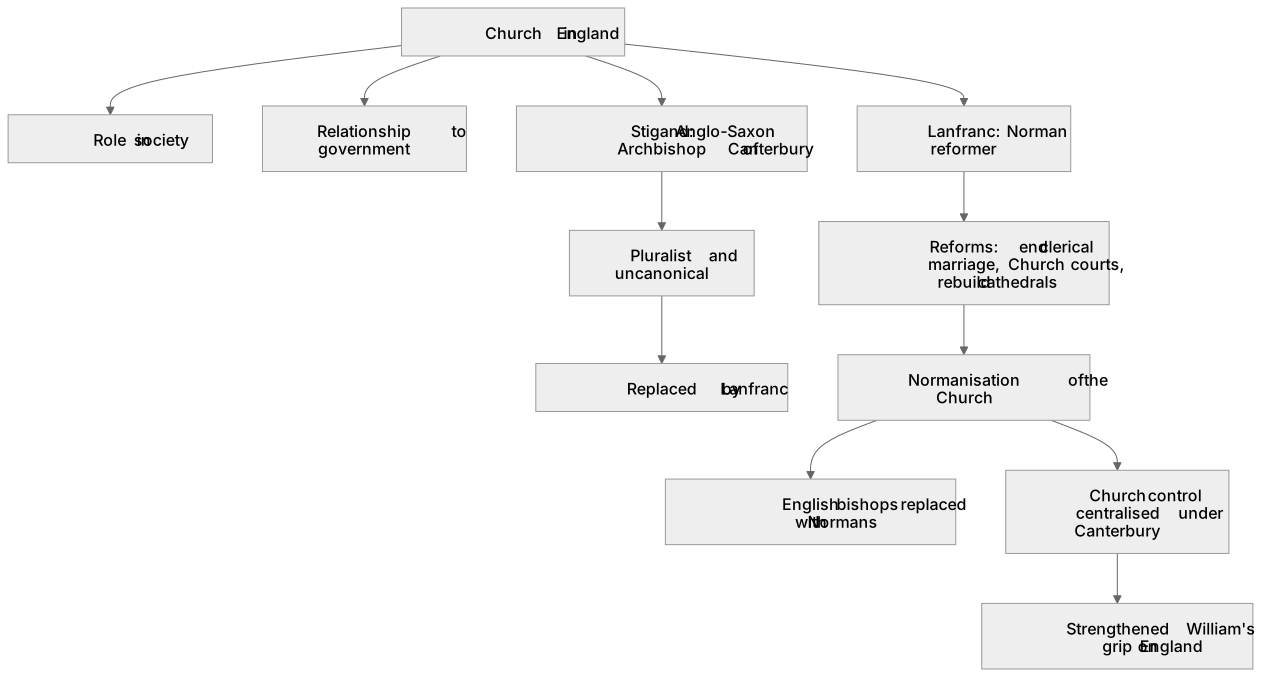
The Church in Norman England was central to society and government, acting as a major landholder and reinforcing royal authority. Stigand, the Anglo-Saxon Archbishop of Canterbury, was pluralist and uncanonical, symbolising the corruption William sought to reform. He was replaced by Lanfranc, who spearheaded the Normanisation of the Church. Lanfranc introduced strict reforms, including ending clerical marriage, establishing Church courts separate from secular ones, and rebuilding cathedrals. This Normanisation ensured the Church supported William's regime, replacing English bishops with Normans and centralising Church control under Canterbury, thereby strengthening William's grip on England.
What earns the marks
- Explain the societal role of the Church, such as providing education, charity, and spiritual guidance.
- Describe the Church's relationship with the government, including providing literate clerks and reinforcing the king's divine right.
- Contrast Stigand's corrupt practices, such as pluralism and simony, with Lanfranc's strict reforms.
- Detail Lanfranc's reforms, including separate Church courts, clerical celibacy, and the primacy of Canterbury.
- Explain the process of Normanisation, noting the replacement of Anglo-Saxon bishops and abbots with Normans.
Common mistakes and how to put them right
Confusing Stigand and Lanfranc.
Put it right: Stigand was the Anglo-Saxon archbishop removed by William, while Lanfranc was the Norman reformer.
Assuming the Church only had a religious role.
Put it right: Emphasise the Church's massive political and economic power, holding about a quarter of the land in England.
Thinking Lanfranc's reforms were purely religious.
Put it right: Note that reforms like separate Church courts also served to centralise Norman control and assert William's authority.
Exam tips
- Use the contrast between Stigand and Lanfranc to illustrate the broader theme of Normanisation.
- When discussing government, mention that bishops and abbots were key members of the royal council and provided knight service.
- Link Church reforms to William's need to justify his conquest as a papal-sanctioned invasion endorsed by the Pope.
Try the lesson
The start of the Option B1: Key topic 3: Norman England, 1066–88 - 1 The feudal system and the Church: The Church in England: its role in society and relationship to government, including the significance of Stigand and Lanfranc. The Normanisation and reform of the Church in the reign of William I. lesson, made from checked teaching notes for this specification point.
Have a go first
Who replaced Stigand as Archbishop of Canterbury in 1070, leading the Normanisation of the English Church?
Listen
The Church in Norman England was central to society and government, acting as a major landholder and reinforcing royal authority. Stigand, the Anglo-Saxon Archbishop of Canterbury, was pluralist and uncanonical, symbolising the corruption William sought to reform. He was replaced by Lanfranc, who spearheaded the Normanisation of the Church. Lanfranc introduced strict reforms, including ending clerical marriage, establishing Church courts separate from secular ones, and rebuilding cathedrals. This Normanisation ensured the Church supported William's regime, replacing English bishops with Normans and centralising Church control under Canterbury, thereby strengthening William's grip on England. A strong answer earns marks for these points. Explain the societal role of the Church, such as providing education, charity, and spiritual guidance. Describe the Church's relationship with the government, including providing literate clerks and reinforcing the king's divine right. Contrast Stigand's corrupt practices, such as pluralism and simony, with Lanfranc's strict reforms. Detail Lanfranc's reforms, including separate Church courts, clerical celibacy, and the primacy of Canterbury. A common slip: Confusing Stigand and Lanfranc. Instead, Stigand was the Anglo-Saxon archbishop removed by William, while Lanfranc was the Norman reformer. Exam tip: Use the contrast between Stigand and Lanfranc to illustrate the broader theme of Normanisation.
See it
Key words
Say what each word means before you turn the card.
Normanisation
Try answering aloud or in your head before turning the card.
Religious reform
Try answering aloud or in your head before turning the card.
Centralisation of power
Try answering aloud or in your head before turning the card.
Stigand
Try answering aloud or in your head before turning the card.
See every definition
- Normanisation
- The process by which the Church was reformed and English bishops were replaced with Normans, centralising Church control under Canterbury and strengthening William's grip on England.
- Religious reform
- Strict changes introduced by Lanfranc, including ending clerical marriage, establishing Church courts separate from secular ones, and rebuilding cathedrals.
- Centralisation of power
- The centralising of Church control under Canterbury, which ensured the Church supported William's regime and strengthened his grip on England.
- Stigand
- The Anglo-Saxon Archbishop of Canterbury who was pluralist and uncanonical, symbolising the corruption William sought to reform.
Label the diagram
Some boxes have lost their names. Pick the right name for each number.
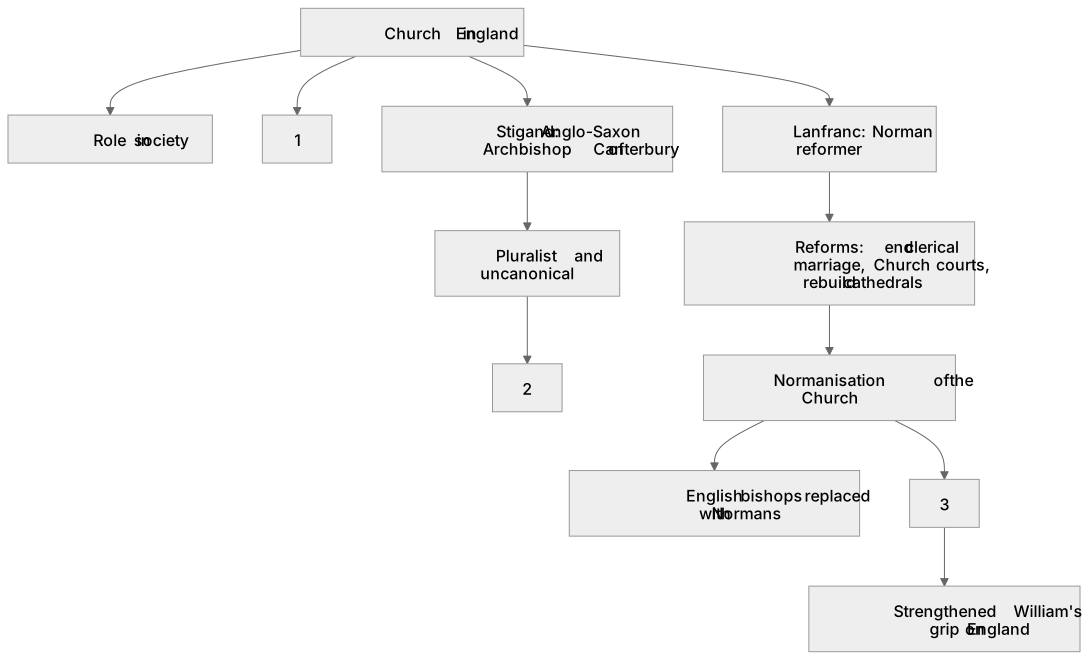
1Box 1
2Box 2
3Box 3
There is more to this lesson
The full lesson goes on to check your understanding and help you earn the marks. Create a free account to carry on, with your progress saved.
A week of Premium from your first lesson · Then the free plan continues · No card, no charge
Test your understanding of Option B1: Key topic 3: Norman England, 1066–88 - 1 The feudal system and the Church: The Church in England: its role in society and relationship to government, including the significance of Stigand and Lanfranc. The Normanisation and reform of the Church in the reign of William I.
Active recall beats re-reading. Take an instant quiz now to test what you’ve learned and lock it into long-term memory.
A week of Premium from your first lesson · Then the free plan continues · No card, no charge