Pearson Edexcel · GCSE · History
Course version: 1HI0 · Version from Sept 2016
Key topic 3: Norman England, 1066–88 - 1 The feudal system and the Church:…
Full specification wording
Option B1: Key topic 3: Norman England, 1066–88 - 1 The feudal system and the Church: The feudal hierarchy. The role and importance of tenants-in-chief and knights. The nature of feudalism (landholding, homage, knight service, labour service); forfeiture.
The Norman feudal hierarchy was a rigid social and political structure introduced by William I to control England.
Checked against the Pearson Edexcel 1HI0 specification (opens in a new tab) on .
- Point 1 of 3
- 4 key terms
Study notes
From the checked teaching notes for this specification point.
The idea
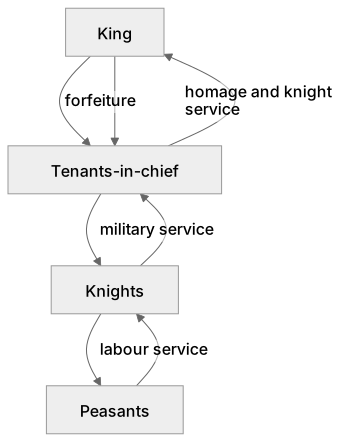
The Norman feudal hierarchy was a rigid social and political structure introduced by William I to control England. At the top was the king, who owned all land. He granted estates to tenants-in-chief (barons and bishops) in return for homage and knight service. These tenants-in-chief were crucial for providing military forces and administering justice. They, in turn, granted land to knights, who provided military service and protected the manors. At the base were peasants, who provided labour service in exchange for land to farm. The nature of feudalism relied on this chain of conditional landholding; if duties were not fulfilled, the land could be reclaimed through forfeiture, ensuring absolute loyalty to the Crown.
What earns the marks
- Describe the feudal hierarchy as a pyramid with the king at the top, followed by tenants-in-chief, knights, and peasants.
- Explain the role of tenants-in-chief in providing knight service, advising the king, and managing large estates.
- Detail the importance of knights in providing military service (usually 40 days a year) and maintaining local control.
- Define the nature of feudalism through key concepts: landholding in exchange for service, the oath of homage, labour service by peasants, and the threat of forfeiture.
Common mistakes and how to put them right
Confusing knight service with labour service.
Put it right by specifying that knights provided military service while peasants provided agricultural labour.
Assuming tenants-in-chief owned their land outright.
Put it right by explaining that all land was held conditionally from the king and could be subject to forfeiture.
Believing the feudal system was identical to the Anglo-Saxon system.
Put it right by highlighting the formalised, top-down nature of Norman feudalism based on strict land tenure.
Exam tips
- Use the term 'forfeiture' explicitly when explaining how William maintained control over his rebellious barons.
- Be prepared to explain how the feudal system solved William's problems of raising an army and governing a hostile country.
- Link the concept of homage to the personal loyalty required to hold land, reinforcing the king's ultimate authority.
Try the lesson
The start of the Option B1: Key topic 3: Norman England, 1066–88 - 1 The feudal system and the Church: The feudal hierarchy. The role and importance of tenants-in-chief and knights. The nature of feudalism (landholding, homage, knight service, labour service); forfeiture. lesson, made from checked teaching notes for this specification point.
Have a go first
Under the Norman feudal system, what was 'knight service'?
Listen
The Norman feudal hierarchy was a rigid social and political structure introduced by William I to control England. At the top was the king, who owned all land. He granted estates to tenants-in-chief (barons and bishops) in return for homage and knight service. These tenants-in-chief were crucial for providing military forces and administering justice. They, in turn, granted land to knights, who provided military service and protected the manors. At the base were peasants, who provided labour service in exchange for land to farm. The nature of feudalism relied on this chain of conditional landholding; if duties were not fulfilled, the land could be reclaimed through forfeiture, ensuring absolute loyalty to the Crown. A strong answer earns marks for these points. Describe the feudal hierarchy as a pyramid with the king at the top, followed by tenants-in-chief, knights, and peasants. Explain the role of tenants-in-chief in providing knight service, advising the king, and managing large estates. Detail the importance of knights in providing military service (usually 40 days a year) and maintaining local control. Define the nature of feudalism through key concepts: landholding in exchange for service, the oath of homage, labour service by peasants, and the threat of forfeiture. A common slip: Confusing knight service with labour service. Instead, specifying that knights provided military service while peasants provided agricultural labour. Exam tip: Use the term 'forfeiture' explicitly when explaining how William maintained control over his rebellious barons.
See it
Key words
Say what each word means before you turn the card.
Feudal hierarchy
Try answering aloud or in your head before turning the card.
Tenants-in-chief
Try answering aloud or in your head before turning the card.
Knight service
Try answering aloud or in your head before turning the card.
Forfeiture
Try answering aloud or in your head before turning the card.
See every definition
- Feudal hierarchy
- A rigid social and political structure with the king at the top, followed by tenants-in-chief, knights and peasants.
- Tenants-in-chief
- Barons and bishops who received estates from the king in return for homage and knight service.
- Knight service
- Military service provided by knights, usually 40 days a year, in return for land.
- Forfeiture
- The reclaiming of land when duties were not fulfilled, ensuring absolute loyalty to the Crown.
Label the diagram
Some boxes have lost their names. Pick the right name for each number.
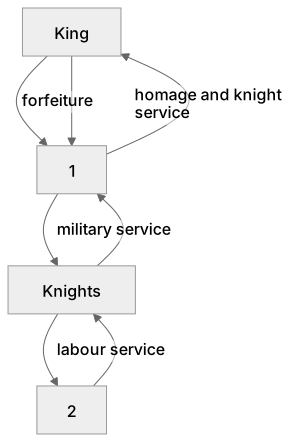
1Box 1
2Box 2
There is more to this lesson
The full lesson goes on to check your understanding and help you earn the marks. Create a free account to carry on, with your progress saved.
A week of Premium from your first lesson · Then the free plan continues · No card, no charge
Test your understanding of Option B1: Key topic 3: Norman England, 1066–88 - 1 The feudal system and the Church: The feudal hierarchy. The role and importance of tenants-in-chief and knights. The nature of feudalism (landholding, homage, knight service, labour service); forfeiture.
Active recall beats re-reading. Take an instant quiz now to test what you’ve learned and lock it into long-term memory.
A week of Premium from your first lesson · Then the free plan continues · No card, no charge