Pearson Edexcel · GCSE · History
Course version: 1HI0 · Version from Sept 2016
Key topic 3: Norman England, 1066–88 - 2 Norman government: Changes to…
Full specification wording
Option B1: Key topic 3: Norman England, 1066–88 - 2 Norman government: Changes to government after the Conquest. Centralised power and the limited use of earls under William I. The role of regents during William’s absences.
Following the Conquest, William I altered English government to centralise his power and prevent challenges to his authority.
Checked against the Pearson Edexcel 1HI0 specification (opens in a new tab) on .
- Point 1 of 3
- 4 key terms
Study notes
From the checked teaching notes for this specification point.
The idea
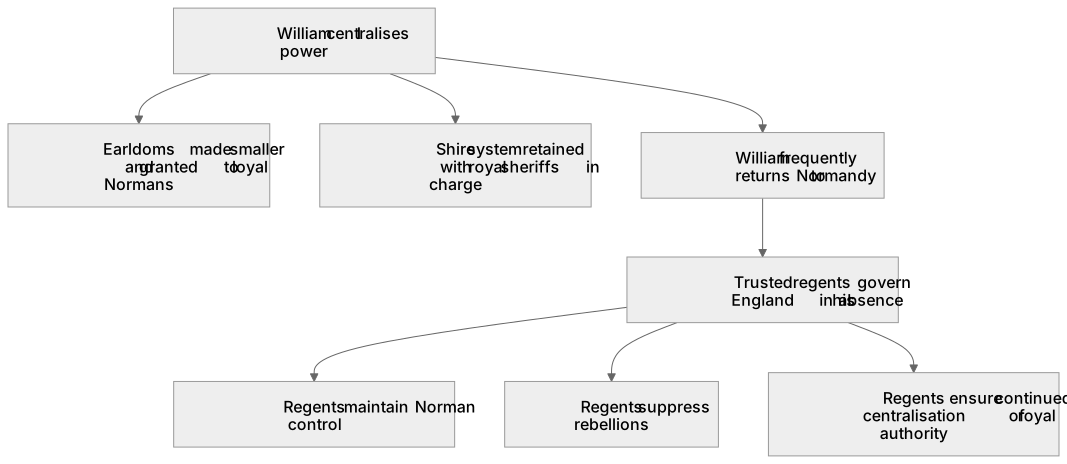
Following the Conquest, William I altered English government to centralise his power and prevent challenges to his authority. He reduced the power of the great earldoms that had dominated Anglo-Saxon England, making them smaller and granting them to loyal Normans, thereby limiting the use of earls. William retained the shire system but placed his own sheriffs in charge. Because William frequently returned to Normandy to manage his continental lands, he relied on trusted regents, such as Lanfranc and Odo of Bayeux, to govern England in his absence. These regents wielded immense power, maintaining Norman control, suppressing rebellions, and ensuring the continued centralisation of royal authority while the king was abroad.
What earns the marks
- Explain how William centralised power by claiming ownership of all land and distributing it directly to tenants-in-chief.
- Describe the reduction in the size and power of earldoms compared to the Anglo-Saxon period, limiting the threat of over-mighty subjects.
- Detail the role of regents, such as Odo of Bayeux and Lanfranc, in governing England during William's frequent absences in Normandy.
- Explain how regents maintained control through the use of castles, sheriffs, and military force.
- Discuss the continuity of the shire and hundred courts, but with increased royal oversight.
Common mistakes and how to put them right
Assuming William abolished earls completely.
Put it right: William kept earls but made their territories smaller and their power more dependent on the king.
Misunderstanding the role of a regent.
Put it right: Define a regent as someone appointed to rule the country in the monarch's absence, not just an advisor.
Thinking William spent all his time in England.
Put it right: Note that William spent up to 75% of his time in Normandy after 1072, making regents crucial.
Exam tips
- Use Odo of Bayeux and Lanfranc as specific examples of regents with contrasting styles of governance.
- Link the limited use of earls to the lessons William learned from the rebellions of 1068 to 1070.
- When discussing centralisation, mention the Domesday Book as a tool for royal control and taxation.
Try the lesson
The start of the Option B1: Key topic 3: Norman England, 1066–88 - 2 Norman government: Changes to government after the Conquest. Centralised power and the limited use of earls under William I. The role of regents during William’s absences. lesson, made from checked teaching notes for this specification point.
Have a go first
Who did William I frequently appoint as a regent to govern England during his absences in Normandy?
Listen
Following the Conquest, William I altered English government to centralise his power and prevent challenges to his authority. He reduced the power of the great earldoms that had dominated Anglo-Saxon England, making them smaller and granting them to loyal Normans, thereby limiting the use of earls. William retained the shire system but placed his own sheriffs in charge. Because William frequently returned to Normandy to manage his continental lands, he relied on trusted regents, such as Lanfranc and Odo of Bayeux, to govern England in his absence. These regents wielded immense power, maintaining Norman control, suppressing rebellions, and ensuring the continued centralisation of royal authority while the king was abroad. A strong answer earns marks for these points. Explain how William centralised power by claiming ownership of all land and distributing it directly to tenants-in-chief. Describe the reduction in the size and power of earldoms compared to the Anglo-Saxon period, limiting the threat of over-mighty subjects. Detail the role of regents, such as Odo of Bayeux and Lanfranc, in governing England during William's frequent absences in Normandy. Explain how regents maintained control through the use of castles, sheriffs, and military force. A common slip: Assuming William abolished earls completely. Instead, William kept earls but made their territories smaller and their power more dependent on the king. Exam tip: Use Odo of Bayeux and Lanfranc as specific examples of regents with contrasting styles of governance.
See it
Key words
Say what each word means before you turn the card.
Centralisation of power
Try answering aloud or in your head before turning the card.
Royal authority
Try answering aloud or in your head before turning the card.
Delegation and regency
Try answering aloud or in your head before turning the card.
Continuity and change
Try answering aloud or in your head before turning the card.
See every definition
- Centralisation of power
- The process by which William I altered English government to concentrate his power and prevent challenges to his authority.
- Royal authority
- The king's power, which regents ensured continued to be centralised while William was abroad.
- Delegation and regency
- Reliance on trusted regents, such as Lanfranc and Odo of Bayeux, to govern England in the king's absence.
- Continuity and change
- William retained the shire system but placed his own sheriffs in charge, showing both continuity and change in government.
Label the diagram
Some boxes have lost their names. Pick the right name for each number.
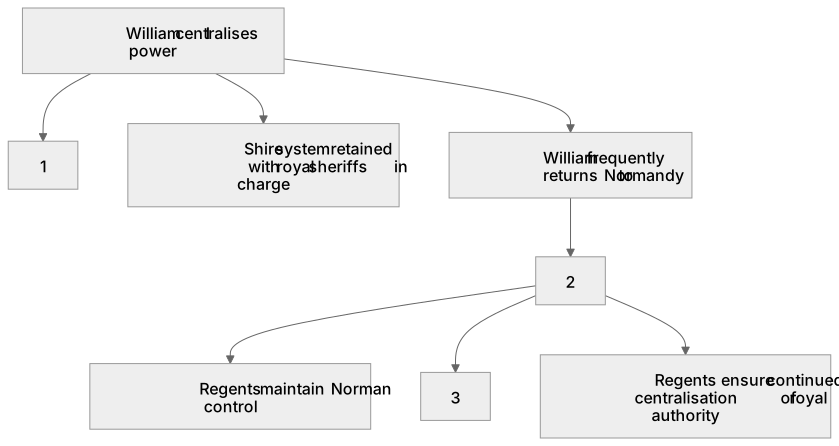
1Box 1
2Box 2
3Box 3
There is more to this lesson
The full lesson goes on to check your understanding and help you earn the marks. Create a free account to carry on, with your progress saved.
A week of Premium from your first lesson · Then the free plan continues · No card, no charge
Test your understanding of Option B1: Key topic 3: Norman England, 1066–88 - 2 Norman government: Changes to government after the Conquest. Centralised power and the limited use of earls under William I. The role of regents during William’s absences.
Active recall beats re-reading. Take an instant quiz now to test what you’ve learned and lock it into long-term memory.
A week of Premium from your first lesson · Then the free plan continues · No card, no charge