Pearson Edexcel · GCSE · History
Course version: 1HI0 · Version from Sept 2016
Key topic 3: Norman England, 1066–88 - 2 Norman government: The office of…
Full specification wording
Option B1: Key topic 3: Norman England, 1066–88 - 2 Norman government: The office of sheriff and the demesne. Introduction and significance of the ‘forest’.
In Norman government, the office of sheriff became significantly more powerful.
Checked against the Pearson Edexcel 1HI0 specification (opens in a new tab) on .
- Point 2 of 3
Study notes
From the checked teaching notes for this specification point.
The idea
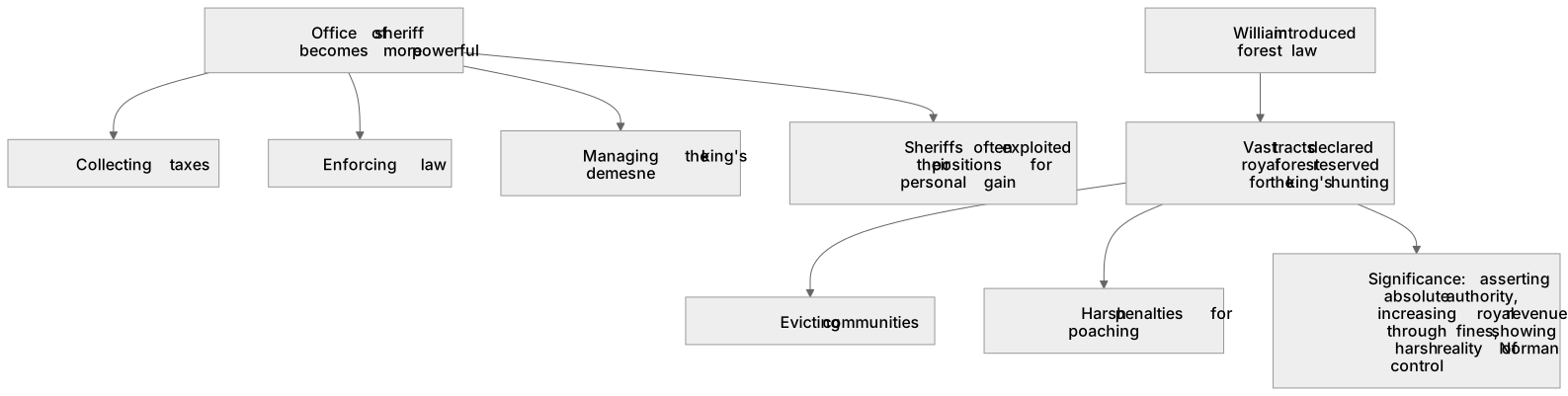
In Norman government, the office of sheriff became significantly more powerful. Sheriffs were royal officials responsible for collecting taxes, enforcing law, and managing the king's demesne (land retained directly by the king). Norman sheriffs often exploited their positions for personal gain. William also introduced forest law, declaring vast tracts of land as royal forest reserved exclusively for his hunting. This involved evicting communities and imposing harsh penalties for poaching. The significance of the forest lay not only in protecting the king's sport but also in asserting his absolute authority, increasing royal revenue through fines, and demonstrating the harsh reality of Norman control over the English landscape.
What earns the marks
- Describe the expanded role of the sheriff in Norman England, including tax collection, military duties, and managing the royal demesne.
- Explain the concept of the royal demesne as land held directly by the king, which provided a major source of royal income.
- Define the forest in the Norman context as land legally reserved for the king's hunting, not necessarily woodland.
- Detail the harshness of forest laws, including punishments like blinding for poaching deer or boar.
- Analyse the significance of the forest in demonstrating royal power, generating revenue through fines, and causing social resentment.
Common mistakes and how to put them right
Thinking a forest was just a large wood.
Put it right: Explain that forest was a legal term for land subject to forest law, which could include villages, heathland, and fields.
Assuming sheriffs were popular local representatives.
Put it right: Highlight that Norman sheriffs were often deeply unpopular due to their corruption and harsh exactions.
Confusing the demesne with all land in England.
Put it right: Clarify that while the king owned all land theoretically, the demesne was the specific portion he kept for his own direct use and income.
Exam tips
- Use the New Forest as a prime example of William's creation of royal hunting grounds and the resulting evictions.
- Connect the resentment against sheriffs and forest laws to the broader theme of Norman oppression of the Anglo-Saxons.
- Remember that the royal demesne and forest fines were crucial for funding William's military campaigns and castles.
Try the lesson
The start of the Option B1: Key topic 3: Norman England, 1066–88 - 2 Norman government: The office of sheriff and the demesne. Introduction and significance of the ‘forest’. lesson, made from checked teaching notes for this specification point.
Have a go first
What was the primary purpose of the 'forest' introduced by William I?
Listen
In Norman government, the office of sheriff became significantly more powerful. Sheriffs were royal officials responsible for collecting taxes, enforcing law, and managing the king's demesne (land retained directly by the king). Norman sheriffs often exploited their positions for personal gain. William also introduced forest law, declaring vast tracts of land as royal forest reserved exclusively for his hunting. This involved evicting communities and imposing harsh penalties for poaching. The significance of the forest lay not only in protecting the king's sport but also in asserting his absolute authority, increasing royal revenue through fines, and demonstrating the harsh reality of Norman control over the English landscape. A strong answer earns marks for these points. Describe the expanded role of the sheriff in Norman England, including tax collection, military duties, and managing the royal demesne. Explain the concept of the royal demesne as land held directly by the king, which provided a major source of royal income. Define the forest in the Norman context as land legally reserved for the king's hunting, not necessarily woodland. Detail the harshness of forest laws, including punishments like blinding for poaching deer or boar. A common slip: Thinking a forest was just a large wood. Instead, Explain that forest was a legal term for land subject to forest law, which could include villages, heathland, and fields. Exam tip: Use the New Forest as a prime example of William's creation of royal hunting grounds and the resulting evictions.
See it
Label the diagram
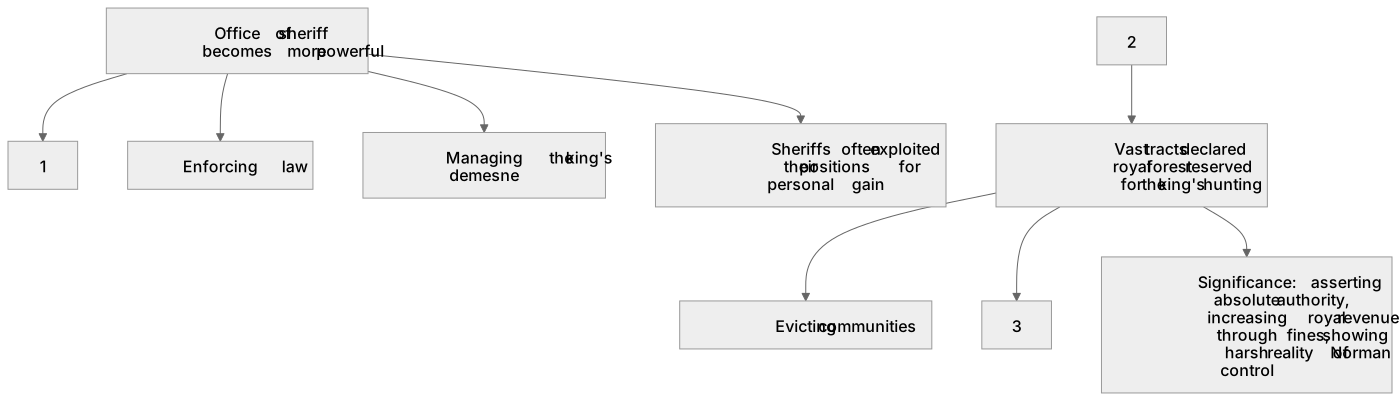
Some boxes have lost their names. Pick the right name for each number.
1Box 1
2Box 2
3Box 3
There is more to this lesson
The full lesson goes on to check your understanding and help you earn the marks. Create a free account to carry on, with your progress saved.
A week of Premium from your first lesson · Then the free plan continues · No card, no charge
Test your understanding of Option B1: Key topic 3: Norman England, 1066–88 - 2 Norman government: The office of sheriff and the demesne. Introduction and significance of the ‘forest’.
Active recall beats re-reading. Take an instant quiz now to test what you’ve learned and lock it into long-term memory.
A week of Premium from your first lesson · Then the free plan continues · No card, no charge