Pearson Edexcel · GCSE · History
Course version: 1HI0 · Version from Sept 2016
Key topic 3: Norman England, 1066–88 - 2 Norman government: The Domesday…
Full specification wording
Option B1: Key topic 3: Norman England, 1066–88 - 2 Norman government: The Domesday survey and Domesday Book and their significance for Norman government and finance.
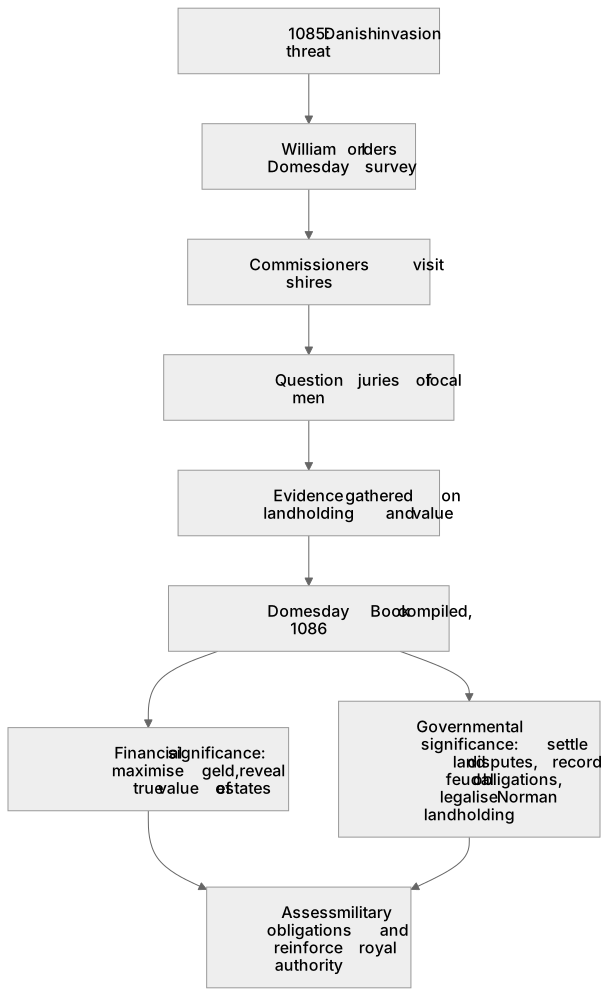
Ordered in 1085 by William I under threat of Danish invasion, the Domesday survey was a massive logistical exercise to record landholding across England.
Checked against the Pearson Edexcel 1HI0 specification (opens in a new tab) on .
- Point 3 of 3
- 4 key terms
Study notes
From the checked teaching notes for this specification point.
The idea
Ordered in 1085 by William I under threat of Danish invasion, the Domesday survey was a massive logistical exercise to record landholding across England. Commissioners gathered evidence from local juries to compile the Domesday Book (1086). For Norman finance, it allowed William to maximise taxation (the geld) by revealing exactly who owned what and its value, ensuring no one evaded their dues. For government, it formalised the feudal system, legally recording the transfer of land from Anglo-Saxons to Normans and settling land disputes. It demonstrated the immense administrative power of the Norman state, allowing William to assess the military obligations of his tenants-in-chief and reinforcing his absolute authority over his newly conquered kingdom.
What earns the marks
- Explain the context of the survey, specifically the 1085 invasion threat and the need to assess military and financial resources.
- Describe the process of the survey, including commissioners visiting shires and questioning juries of local men to ensure accuracy.
- Analyse the financial significance, showing how it allowed William to extract maximum geld and discover the true value of estates.
- Analyse the governmental significance, explaining how it settled land disputes, legalised Norman land grabs, and recorded feudal obligations.
Common mistakes and how to put them right
Stating the Domesday Book was a census of the population.
Put it right: It was a survey of land ownership and value, not a count of every individual person.
Claiming the Domesday Book was written to introduce the feudal system.
Put it right: It recorded and formalised the existing feudal landholding system rather than creating it from scratch.
Confusing the survey with the book.
Put it right: The survey was the process of gathering the information via commissioners, while the book was the final written record.
Exam tips
- When discussing significance, explicitly separate financial benefits like taxation from governmental benefits like legal control and military assessment.
- Use the 1085 Danish invasion threat as a key contextual trigger for why William needed to know his exact resources.
- Link the Domesday Book to the broader theme of Norman control, showing how it cemented the dispossession of the Anglo-Saxon nobility.
Try the lesson
The start of the Option B1: Key topic 3: Norman England, 1066–88 - 2 Norman government: The Domesday survey and Domesday Book and their significance for Norman government and finance. lesson, made from checked teaching notes for this specification point.
Have a go first
What was the primary purpose of the Domesday survey ordered by William the Conqueror in 1085?
Listen
Ordered in 1085 by William I under threat of Danish invasion, the Domesday survey was a massive logistical exercise to record landholding across England. Commissioners gathered evidence from local juries to compile the Domesday Book (1086). For Norman finance, it allowed William to maximise taxation (the geld) by revealing exactly who owned what and its value, ensuring no one evaded their dues. For government, it formalised the feudal system, legally recording the transfer of land from Anglo-Saxons to Normans and settling land disputes. It demonstrated the immense administrative power of the Norman state, allowing William to assess the military obligations of his tenants-in-chief and reinforcing his absolute authority over his newly conquered kingdom. A strong answer earns marks for these points. Explain the context of the survey, specifically the 1085 invasion threat and the need to assess military and financial resources. Describe the process of the survey, including commissioners visiting shires and questioning juries of local men to ensure accuracy. Analyse the financial significance, showing how it allowed William to extract maximum geld and discover the true value of estates. Analyse the governmental significance, explaining how it settled land disputes, legalised Norman land grabs, and recorded feudal obligations. A common slip: Stating the Domesday Book was a census of the population. Instead, It was a survey of land ownership and value, not a count of every individual person. Exam tip: When discussing significance, explicitly separate financial benefits like taxation from governmental benefits like legal control and military assessment.
See it
Key words
Say what each word means before you turn the card.
Domesday survey
Try answering aloud or in your head before turning the card.
Domesday Book
Try answering aloud or in your head before turning the card.
Feudalism
Try answering aloud or in your head before turning the card.
Royal authority
Try answering aloud or in your head before turning the card.
See every definition
- Domesday survey
- Ordered in 1085 by William I under threat of Danish invasion, it was a massive logistical exercise to record landholding across England, gathering evidence from local juries.
- Domesday Book
- The final written record compiled in 1086 from the evidence gathered by commissioners, as distinct from the survey, which was the process of gathering the information.
- Feudalism
- The existing system of landholding which the Domesday Book recorded and formalised rather than created, legally recording the transfer of land from Anglo-Saxons to Normans.
- Royal authority
- William's absolute power over his newly conquered kingdom, reinforced by the survey's demonstration of the immense administrative power of the Norman state.
Label the diagram
Some boxes have lost their names. Pick the right name for each number.
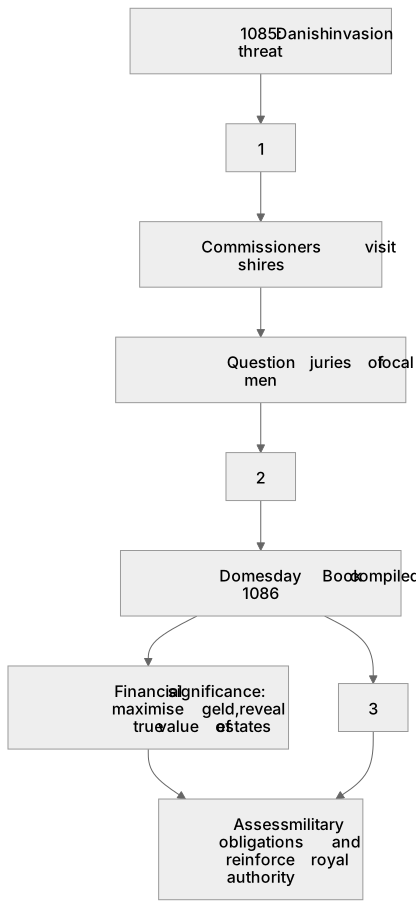
1Box 1
2Box 2
3Box 3
There is more to this lesson
The full lesson goes on to check your understanding and help you earn the marks. Create a free account to carry on, with your progress saved.
A week of Premium from your first lesson · Then the free plan continues · No card, no charge
Test your understanding of Option B1: Key topic 3: Norman England, 1066–88 - 2 Norman government: The Domesday survey and Domesday Book and their significance for Norman government and finance.
Active recall beats re-reading. Take an instant quiz now to test what you’ve learned and lock it into long-term memory.
A week of Premium from your first lesson · Then the free plan continues · No card, no charge