Pearson Edexcel · GCSE · History
Course version: 1HI0 · Version from Sept 2016
Key topic 1: Life and government in England, 1189–1216 - 3 Royal…
Full specification wording
Option B2: Key topic 1: Life and government in England, 1189–1216 - 3 Royal government and finances: How England was governed when Richard was absent, 1189–99, and during King John’s continued presence in England, 1199–1216.
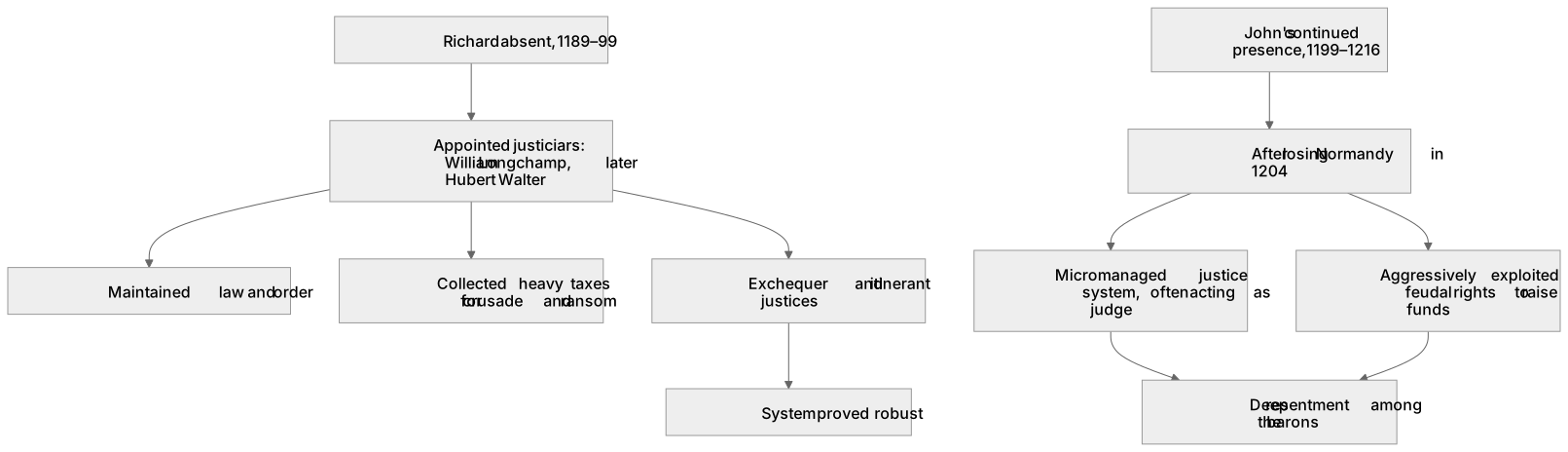
During Richard's absence (1189–99), England was governed by appointed justiciars, notably William Longchamp and later Hubert Walter.
Checked against the Pearson Edexcel 1HI0 specification (opens in a new tab) on .
- Point 1 of 2
- 4 key terms
Study notes
From the checked teaching notes for this specification point.
The idea
During Richard's absence (1189–99), England was governed by appointed justiciars, notably William Longchamp and later Hubert Walter. They maintained law and order, collected heavy taxes to fund Richard's crusade and ransom, and managed the kingdom effectively despite John's early rebellions. The system proved robust, relying on the Exchequer and itinerant justices. Conversely, John's continued presence in England (1199–1216), especially after losing Normandy in 1204, led to oppressive government. John micromanaged the justice system, often acting as a judge himself, and aggressively exploited feudal rights to raise funds to win back his French lands. This constant, heavy-handed royal presence bred deep resentment among the barons.
What earns the marks
- Explain the role of the justiciar (e.g., Hubert Walter) in governing England and raising taxes during Richard's absence.
- Describe how the administrative system, including the Exchequer and sheriffs, functioned effectively without the king.
- Contrast this with John's permanent presence after 1204, which led to his direct interference in the justice system.
- Analyse how John's constant presence and aggressive financial demands (like scutage and wardships) alienated the English barons.
Common mistakes and how to put them right
Believing England descended into chaos while Richard was away.
Put it right: The government functioned very well under capable justiciars like Hubert Walter.
Thinking John was always in England throughout his reign.
Put it right: John spent his early years fighting in France; his continuous presence in England only began after the loss of Normandy in 1204.
Assuming John's involvement in justice was entirely negative.
Put it right: John was genuinely interested in justice and often provided fair judgements, but his use of the courts to punish enemies caused anger.
Exam tips
- Use the contrast between Richard's absence and John's presence to explain why the barons rebelled against John but not Richard.
- Mention specific financial methods used by both kings, such as the collection of Richard's ransom or John's frequent use of scutage.
- Highlight the importance of Hubert Walter, who served both kings and helped maintain stability.
Try the lesson
The start of the Option B2: Key topic 1: Life and government in England, 1189–1216 - 3 Royal government and finances: How England was governed when Richard was absent, 1189–99, and during King John’s continued presence in England, 1199–1216. lesson, made from checked teaching notes for this specification point.
Have a go first
Which official position was appointed to govern England as the king's deputy during Richard I's long absences?
Listen
During Richard's absence (1189–99), England was governed by appointed justiciars, notably William Longchamp and later Hubert Walter. They maintained law and order, collected heavy taxes to fund Richard's crusade and ransom, and managed the kingdom effectively despite John's early rebellions. The system proved robust, relying on the Exchequer and itinerant justices. Conversely, John's continued presence in England (1199–1216), especially after losing Normandy in 1204, led to oppressive government. John micromanaged the justice system, often acting as a judge himself, and aggressively exploited feudal rights to raise funds to win back his French lands. This constant, heavy-handed royal presence bred deep resentment among the barons. A strong answer earns marks for these points. Explain the role of the justiciar (e.g., Hubert Walter) in governing England and raising taxes during Richard's absence. Describe how the administrative system, including the Exchequer and sheriffs, functioned effectively without the king. Contrast this with John's permanent presence after 1204, which led to his direct interference in the justice system. Analyse how John's constant presence and aggressive financial demands (like scutage and wardships) alienated the English barons. A common slip: Believing England descended into chaos while Richard was away. Instead, The government functioned very well under capable justiciars like Hubert Walter. Exam tip: Use the contrast between Richard's absence and John's presence to explain why the barons rebelled against John but not Richard.
See it
Key words
Say what each word means before you turn the card.
justiciar
Try answering aloud or in your head before turning the card.
Exchequer
Try answering aloud or in your head before turning the card.
scutage
Try answering aloud or in your head before turning the card.
wardships
Try answering aloud or in your head before turning the card.
See every definition
- justiciar
- An appointed official who governed England during Richard's absence, notably William Longchamp and later Hubert Walter.
- Exchequer
- Part of the administrative system that helped the kingdom function effectively without the king.
- scutage
- One of the aggressive financial demands John used to raise funds to win back his French lands.
- wardships
- One of the aggressive financial demands John used to raise funds to win back his French lands.
Label the diagram
Some boxes have lost their names. Pick the right name for each number.
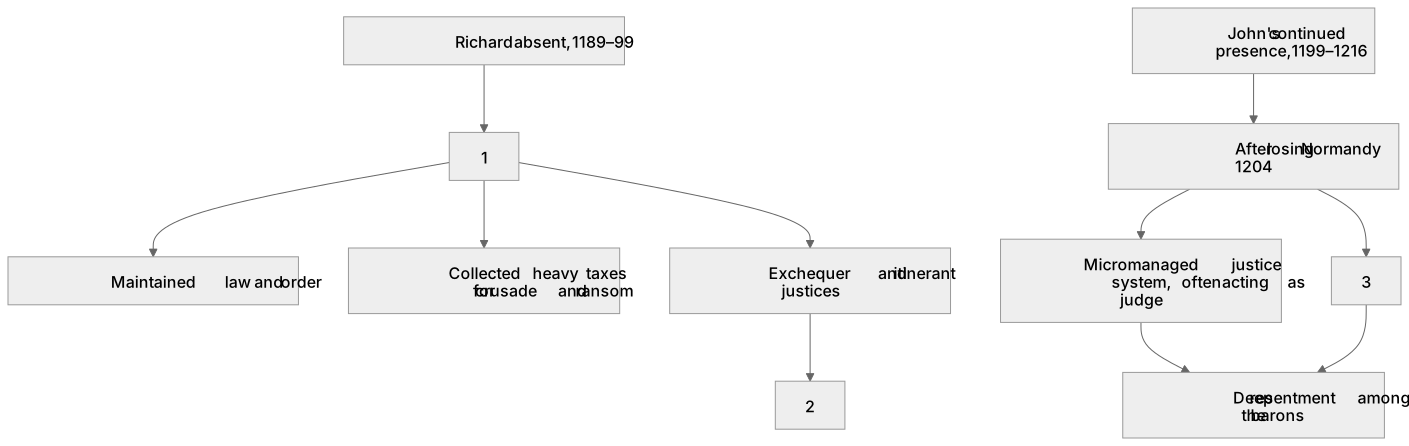
1Box 1
2Box 2
3Box 3
There is more to this lesson
The full lesson goes on to check your understanding and help you earn the marks. Create a free account to carry on, with your progress saved.
A week of Premium from your first lesson · Then the free plan continues · No card, no charge
Test your understanding of Option B2: Key topic 1: Life and government in England, 1189–1216 - 3 Royal government and finances: How England was governed when Richard was absent, 1189–99, and during King John’s continued presence in England, 1199–1216.
Active recall beats re-reading. Take an instant quiz now to test what you’ve learned and lock it into long-term memory.
A week of Premium from your first lesson · Then the free plan continues · No card, no charge