Pearson Edexcel · GCSE · History
Course version: 1HI0 · Version from Sept 2016
Key topic 1: Life and government in England, 1189–1216 - 3 Royal…
Full specification wording
Option B2: Key topic 1: Life and government in England, 1189–1216 - 3 Royal government and finances: Royal revenues: the royal demesne and the role of sheriffs in collecting revenues; feudal incidents; scutage; taxes on moveables and income in 1207.
The monarch relied on various income sources to fund government and warfare.
Checked against the Pearson Edexcel 1HI0 specification (opens in a new tab) on .
- Point 2 of 2
- 4 key terms
Study notes
From the checked teaching notes for this specification point.
The idea
The monarch relied on various income sources to fund government and warfare. The royal demesne (land owned directly by the king) provided significant revenue, collected by sheriffs who paid a fixed sum to the Exchequer and kept any surplus. Feudal incidents were financial obligations owed by tenants-in-chief, such as wardship, marriage fines, and relief. Scutage allowed knights to pay a fee instead of providing military service, which Richard I and John used frequently to fund mercenaries. In 1207, King John introduced a radical new tax on moveables and income, demanding a thirteenth of the value of a person's goods and revenues. This raised an unprecedented £60,000 but caused widespread resentment among his subjects.
What earns the marks
- Explain the role of the royal demesne as the king's personal land, generating rent and agricultural income.
- Describe how sheriffs collected the 'farm' from the royal demesne and the financial incentive they had to extract maximum revenue.
- Define feudal incidents, providing examples such as relief, wardship, and marriage fines.
- Explain scutage as a payment in lieu of military service, highlighting its increased use by Richard I and John.
- Detail the 1207 tax on moveables and income, noting it was a thirteenth of goods and income, and its impact on King John's unpopularity.
Common mistakes and how to put them right
Confusing scutage with a general tax on all citizens.
Put it right: Scutage was specifically a payment made by knights and barons in lieu of their feudal military service.
Assuming sheriffs were paid a salary by the king.
Put it right: Sheriffs paid a fixed sum to the Exchequer and kept any extra money they collected as their personal profit.
Thinking the 1207 tax was a regular, annual event.
Put it right: The 1207 tax on moveables and income was a one-off, extraordinary measure introduced by King John.
Exam tips
- Use the 1207 tax on moveables as a key example of King John's financial extortion when discussing causes of baronial rebellion.
- When explaining royal revenues, categorise them into traditional sources (demesne, feudal incidents) and extraordinary sources (scutage, 1207 tax).
- Ensure you can define 'feudal incidents' clearly, using 'wardship' or 'relief' as specific supporting examples.
Try the lesson
The start of the Option B2: Key topic 1: Life and government in England, 1189–1216 - 3 Royal government and finances: Royal revenues: the royal demesne and the role of sheriffs in collecting revenues; feudal incidents; scutage; taxes on moveables and income in 1207. lesson, made from checked teaching notes for this specification point.
Have a go first
What was 'scutage' in the context of royal revenues between 1189 and 1216?
Listen
The monarch relied on various income sources to fund government and warfare. The royal demesne (land owned directly by the king) provided significant revenue, collected by sheriffs who paid a fixed sum to the Exchequer and kept any surplus. Feudal incidents were financial obligations owed by tenants-in-chief, such as wardship, marriage fines, and relief. Scutage allowed knights to pay a fee instead of providing military service, which Richard I and John used frequently to fund mercenaries. In 1207, King John introduced a radical new tax on moveables and income, demanding a thirteenth of the value of a person's goods and revenues. This raised an unprecedented £60,000 but caused widespread resentment among his subjects. A strong answer earns marks for these points. Explain the role of the royal demesne as the king's personal land, generating rent and agricultural income. Describe how sheriffs collected the 'farm' from the royal demesne and the financial incentive they had to extract maximum revenue. Define feudal incidents, providing examples such as relief, wardship, and marriage fines. Explain scutage as a payment in lieu of military service, highlighting its increased use by Richard I and John. A common slip: Confusing scutage with a general tax on all citizens. Instead, Scutage was specifically a payment made by knights and barons in lieu of their feudal military service. Exam tip: Use the 1207 tax on moveables as a key example of King John's financial extortion when discussing causes of baronial rebellion.
See it
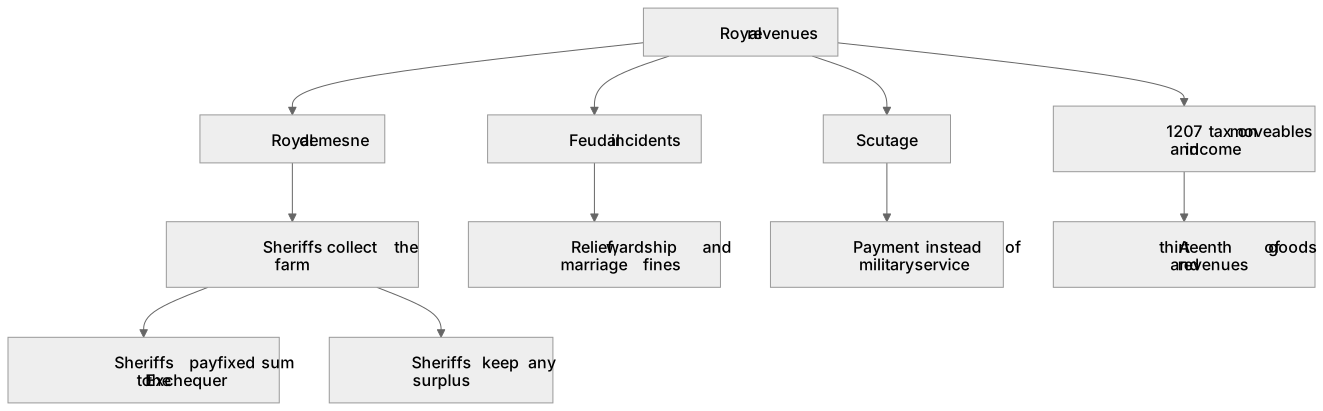
Key words
Say what each word means before you turn the card.
Royal demesne
Try answering aloud or in your head before turning the card.
Sheriffs
Try answering aloud or in your head before turning the card.
Feudal incidents
Try answering aloud or in your head before turning the card.
Scutage
Try answering aloud or in your head before turning the card.
See every definition
- Royal demesne
- Land owned directly by the king, which provided significant revenue and generated rent and agricultural income.
- Sheriffs
- Officials who collected revenues from the royal demesne, paid a fixed sum to the Exchequer and kept any surplus as personal profit.
- Feudal incidents
- Financial obligations owed by tenants-in-chief, such as wardship, marriage fines and relief.
- Scutage
- A fee paid by knights instead of providing military service, used frequently by Richard I and John to fund mercenaries.
Label the diagram
Some boxes have lost their names. Pick the right name for each number.
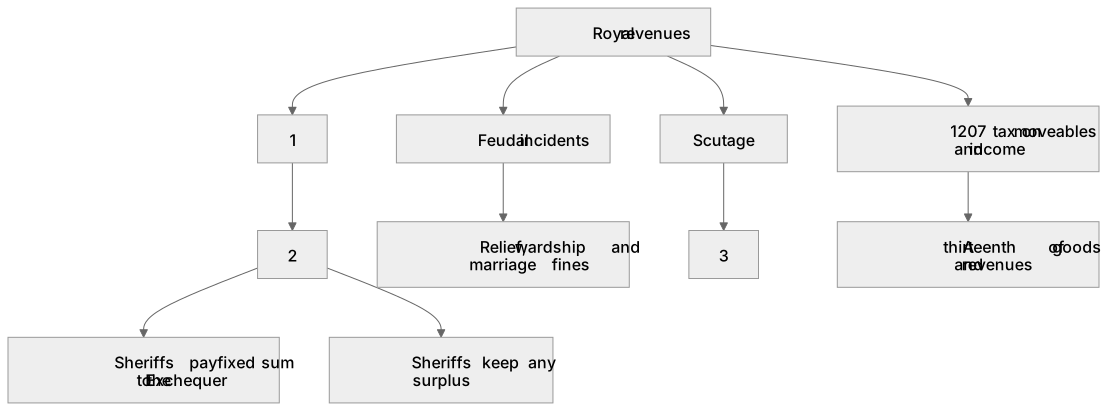
1Box 1
2Box 2
3Box 3
There is more to this lesson
The full lesson goes on to check your understanding and help you earn the marks. Create a free account to carry on, with your progress saved.
A week of Premium from your first lesson · Then the free plan continues · No card, no charge
Test your understanding of Option B2: Key topic 1: Life and government in England, 1189–1216 - 3 Royal government and finances: Royal revenues: the royal demesne and the role of sheriffs in collecting revenues; feudal incidents; scutage; taxes on moveables and income in 1207.
Active recall beats re-reading. Take an instant quiz now to test what you’ve learned and lock it into long-term memory.
A week of Premium from your first lesson · Then the free plan continues · No card, no charge