Pearson Edexcel · GCSE · History
Course version: 1HI0 · Version from Sept 2016
Key topic 1: Life and government in England, 1189–1216 - 4 English…
Full specification wording
Option B2: Key topic 1: Life and government in England, 1189–1216 - 4 English society: Countryside: the nature of agriculture and peasant life.
The countryside was the centre of the medieval economy, dominated by the manorial system.
Checked against the Pearson Edexcel 1HI0 specification (opens in a new tab) on .
- Point 1 of 3
- 4 key terms
Study notes
From the checked teaching notes for this specification point.
The idea
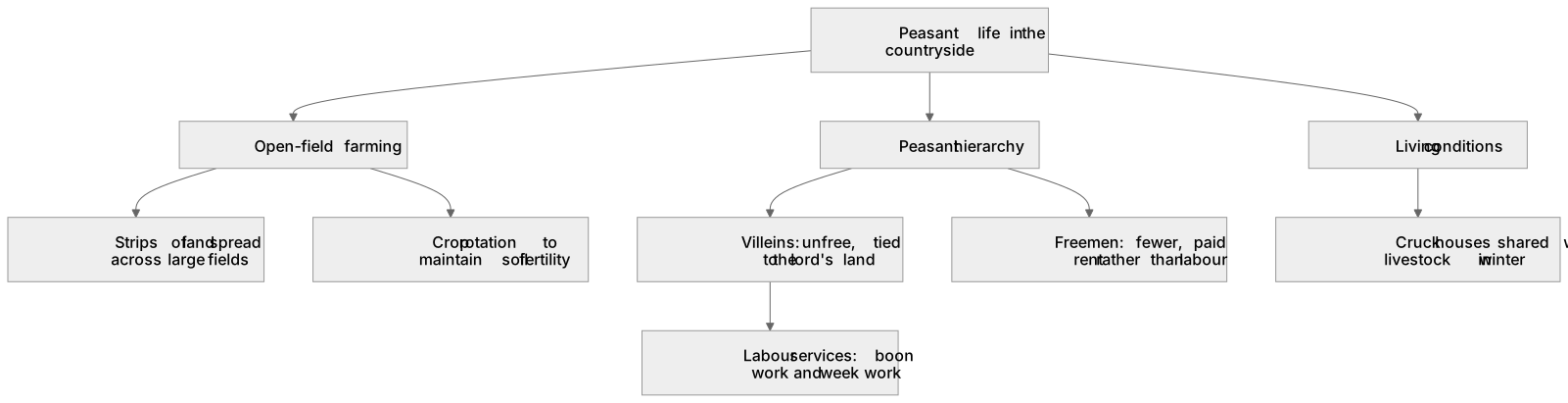
The countryside was the centre of the medieval economy, dominated by the manorial system. Agriculture relied on open-field farming, where peasants worked strips of land spread across large fields, practising crop rotation to maintain soil fertility. Peasant life was dictated by the agricultural calendar, involving backbreaking labour such as ploughing and harvesting. Society was strictly hierarchical; villeins (unfree peasants) were tied to the lord's land, owing labour services like boon work and week work in exchange for their own plots. Freemen, though fewer in number, paid rent rather than labour. Living conditions were basic, with peasants inhabiting cruck houses shared with their livestock during the harsh winter months.
What earns the marks
- Describe the open-field system and the use of crop rotation to prevent soil exhaustion.
- Explain the distinction between freemen (who paid rent and could move) and villeins (who were tied to the manor and owed labour service).
- Detail the types of labour service owed by villeins, including week work and seasonal boon work.
- Describe the living conditions of peasants, including the structure of cruck houses and their diet.
- Explain the role of the manor and the lord in controlling peasant life and agriculture.
Common mistakes and how to put them right
Believing all peasants were slaves.
Put it right: Peasants were not owned as property; villeins were tied to the land and owed service, while freemen had more liberties.
Assuming peasants lived in isolated farmhouses.
Put it right: Peasants lived in nucleated villages surrounded by large open fields divided into strips.
Thinking peasants only worked for the lord.
Put it right: Peasants worked the lord's demesne but also farmed their own strips of land to feed their families.
Exam tips
- Use specific terms like 'villein', 'freeman', 'boon work', and 'open-field system' to demonstrate precise historical knowledge.
- Contrast the lives of freemen and villeins to show an understanding of the social hierarchy within the peasantry.
- Link the nature of agriculture to the vulnerability of peasant life, such as the devastating impact of a bad harvest.
Try the lesson
The start of the Option B2: Key topic 1: Life and government in England, 1189–1216 - 4 English society: Countryside: the nature of agriculture and peasant life. lesson, made from checked teaching notes for this specification point.
Have a go first
In medieval English agriculture, what was the 'open-field system'?
Listen
The countryside was the centre of the medieval economy, dominated by the manorial system. Agriculture relied on open-field farming, where peasants worked strips of land spread across large fields, practising crop rotation to maintain soil fertility. Peasant life was dictated by the agricultural calendar, involving backbreaking labour such as ploughing and harvesting. Society was strictly hierarchical; villeins (unfree peasants) were tied to the lord's land, owing labour services like boon work and week work in exchange for their own plots. Freemen, though fewer in number, paid rent rather than labour. Living conditions were basic, with peasants inhabiting cruck houses shared with their livestock during the harsh winter months. A strong answer earns marks for these points. Describe the open-field system and the use of crop rotation to prevent soil exhaustion. Explain the distinction between freemen (who paid rent and could move) and villeins (who were tied to the manor and owed labour service). Detail the types of labour service owed by villeins, including week work and seasonal boon work. Describe the living conditions of peasants, including the structure of cruck houses and their diet. A common slip: Believing all peasants were slaves. Instead, Peasants were not owned as property; villeins were tied to the land and owed service, while freemen had more liberties. Exam tip: Use specific terms like 'villein', 'freeman', 'boon work', and 'open-field system' to demonstrate precise historical knowledge.
See it
Key words
Say what each word means before you turn the card.
Social hierarchy
Try answering aloud or in your head before turning the card.
Everyday life
Try answering aloud or in your head before turning the card.
The rural economy
Try answering aloud or in your head before turning the card.
Feudal obligations
Try answering aloud or in your head before turning the card.
See every definition
- Social hierarchy
- Society was strictly hierarchical, with peasants divided between villeins, who were unfree, and freemen, who were fewer in number.
- Everyday life
- Peasant life was dictated by the agricultural calendar and involved backbreaking labour such as ploughing and harvesting.
- The rural economy
- The countryside was the centre of the medieval economy, dominated by the manorial system.
- Feudal obligations
- Villeins were tied to the lord's land, owing labour services like boon work and week work in exchange for their own plots.
Label the diagram
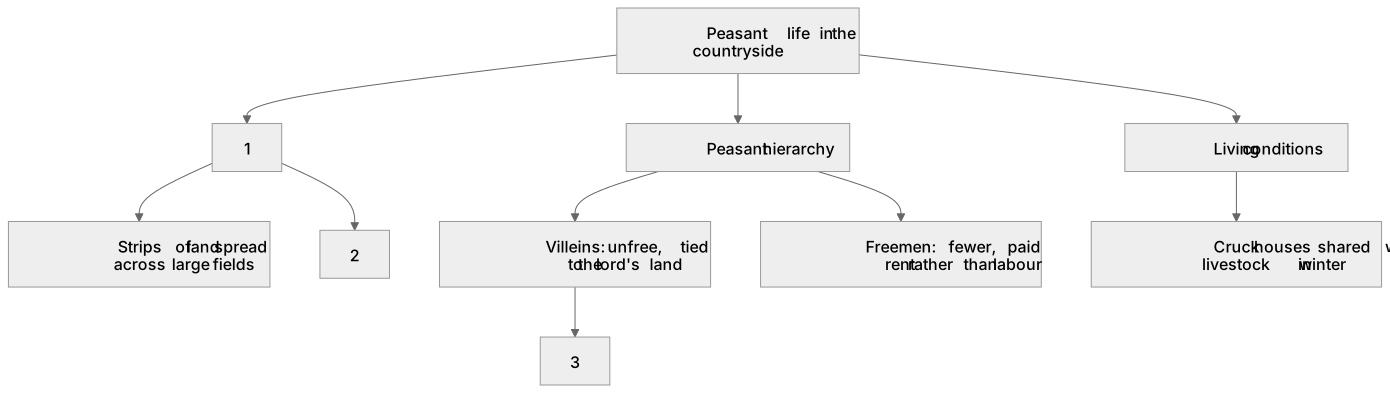
Some boxes have lost their names. Pick the right name for each number.
1Box 1
2Box 2
3Box 3
There is more to this lesson
The full lesson goes on to check your understanding and help you earn the marks. Create a free account to carry on, with your progress saved.
A week of Premium from your first lesson · Then the free plan continues · No card, no charge
Test your understanding of Option B2: Key topic 1: Life and government in England, 1189–1216 - 4 English society: Countryside: the nature of agriculture and peasant life.
Active recall beats re-reading. Take an instant quiz now to test what you’ve learned and lock it into long-term memory.
A week of Premium from your first lesson · Then the free plan continues · No card, no charge