Pearson Edexcel · GCSE · History
Course version: 1HI0 · Version from Sept 2016
Key topic 1: Life and government in England, 1189–1216 - 4 English…
Full specification wording
Option B2: Key topic 1: Life and government in England, 1189–1216 - 4 English society: Towns: life in towns; their role in the economy.
Medieval towns were vital hubs of trade and industry.
Checked against the Pearson Edexcel 1HI0 specification (opens in a new tab) on .
- Point 2 of 3
- 4 key terms
Study notes
From the checked teaching notes for this specification point.
The idea
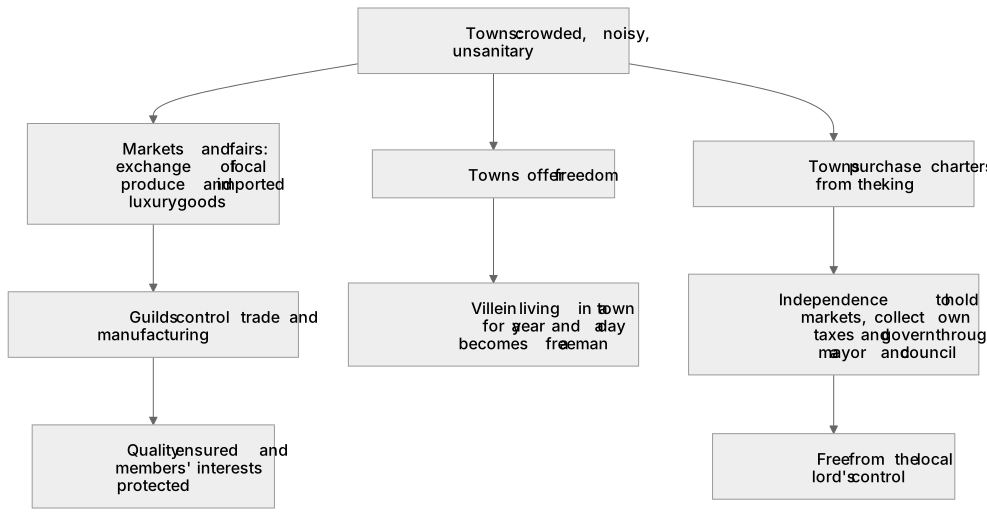
Medieval towns were vital hubs of trade and industry. Life in towns was crowded, noisy, and unsanitary, with houses built closely together, increasing the risk of fire and disease. Despite these conditions, towns offered freedom; a villein who lived in a town for a year and a day became a freeman. Towns played a crucial role in the economy through markets and fairs, facilitating the exchange of local produce and imported luxury goods. Guilds controlled trade and manufacturing, ensuring quality and protecting members' interests. Many towns purchased charters from the king, granting them independence to hold markets, collect their own taxes, and govern themselves through a mayor and council, free from the local lord's control.
What earns the marks
- Explain the economic function of towns as centres for local markets and international trade fairs.
- Describe the physical environment of towns, noting the crowded conditions, poor sanitation, and fire risks.
- Detail the role of guilds in regulating prices, maintaining quality standards, and training apprentices.
- Explain the significance of town charters in granting self-government and economic privileges.
- Discuss the social mobility towns offered, such as the rule allowing villeins to gain freedom after a year and a day.
Common mistakes and how to put them right
Assuming most of the population lived in towns.
Put it right: The vast majority of the population lived in the countryside; towns were relatively small and few in number.
Confusing markets with fairs.
Put it right: Markets were regular (often weekly) events for local trade, whereas fairs were annual events attracting international merchants.
Believing towns were controlled by the local lord.
Put it right: Many towns bought charters from the king to gain independence from local lords and govern themselves.
Exam tips
- Emphasise the economic importance of the wool trade when discussing the role of towns in the wider economy.
- Use the concept of a town charter to explain how towns contributed to royal revenues while gaining independence.
- Contrast the freedom and economic opportunities of town life with the restrictions of the rural manorial system.
Try the lesson
The start of the Option B2: Key topic 1: Life and government in England, 1189–1216 - 4 English society: Towns: life in towns; their role in the economy. lesson, made from checked teaching notes for this specification point.
Have a go first
What was the primary economic function of towns in England between 1189 and 1216?
Listen
Medieval towns were vital hubs of trade and industry. Life in towns was crowded, noisy, and unsanitary, with houses built closely together, increasing the risk of fire and disease. Despite these conditions, towns offered freedom; a villein who lived in a town for a year and a day became a freeman. Towns played a crucial role in the economy through markets and fairs, facilitating the exchange of local produce and imported luxury goods. Guilds controlled trade and manufacturing, ensuring quality and protecting members' interests. Many towns purchased charters from the king, granting them independence to hold markets, collect their own taxes, and govern themselves through a mayor and council, free from the local lord's control. A strong answer earns marks for these points. Explain the economic function of towns as centres for local markets and international trade fairs. Describe the physical environment of towns, noting the crowded conditions, poor sanitation, and fire risks. Detail the role of guilds in regulating prices, maintaining quality standards, and training apprentices. Explain the significance of town charters in granting self-government and economic privileges. A common slip: Assuming most of the population lived in towns. Instead, The vast majority of the population lived in the countryside; towns were relatively small and few in number. Exam tip: Emphasise the economic importance of the wool trade when discussing the role of towns in the wider economy.
See it
Key words
Say what each word means before you turn the card.
Guilds
Try answering aloud or in your head before turning the card.
Charters
Try answering aloud or in your head before turning the card.
Markets and fairs
Try answering aloud or in your head before turning the card.
Social mobility
Try answering aloud or in your head before turning the card.
See every definition
- Guilds
- Groups that controlled trade and manufacturing, ensuring quality and protecting members' interests.
- Charters
- Documents many towns purchased from the king, granting them independence to hold markets, collect their own taxes, and govern themselves through a mayor and council, free from the local lord's control.
- Markets and fairs
- Events through which towns played a crucial role in the economy, facilitating the exchange of local produce and imported luxury goods.
- Social mobility
- The opportunity towns offered, such as the rule that a villein who lived in a town for a year and a day became a freeman.
Label the diagram
Some boxes have lost their names. Pick the right name for each number.
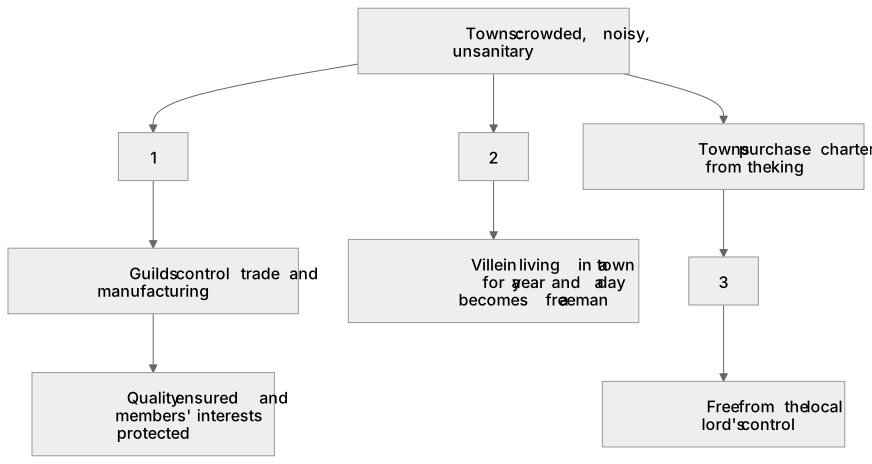
1Box 1
2Box 2
3Box 3
There is more to this lesson
The full lesson goes on to check your understanding and help you earn the marks. Create a free account to carry on, with your progress saved.
A week of Premium from your first lesson · Then the free plan continues · No card, no charge
Test your understanding of Option B2: Key topic 1: Life and government in England, 1189–1216 - 4 English society: Towns: life in towns; their role in the economy.
Active recall beats re-reading. Take an instant quiz now to test what you’ve learned and lock it into long-term memory.
A week of Premium from your first lesson · Then the free plan continues · No card, no charge