Pearson Edexcel · GCSE · History
Course version: 1HI0 · Version from Sept 2016
Key topic 2: Involvements overseas, 1189–1204 - 1 The nature of crusading:…
Full specification wording
Option B2: Key topic 2: Involvements overseas, 1189–1204 - 1 The nature of crusading: The concept of crusade and attitudes in England to the crusades.
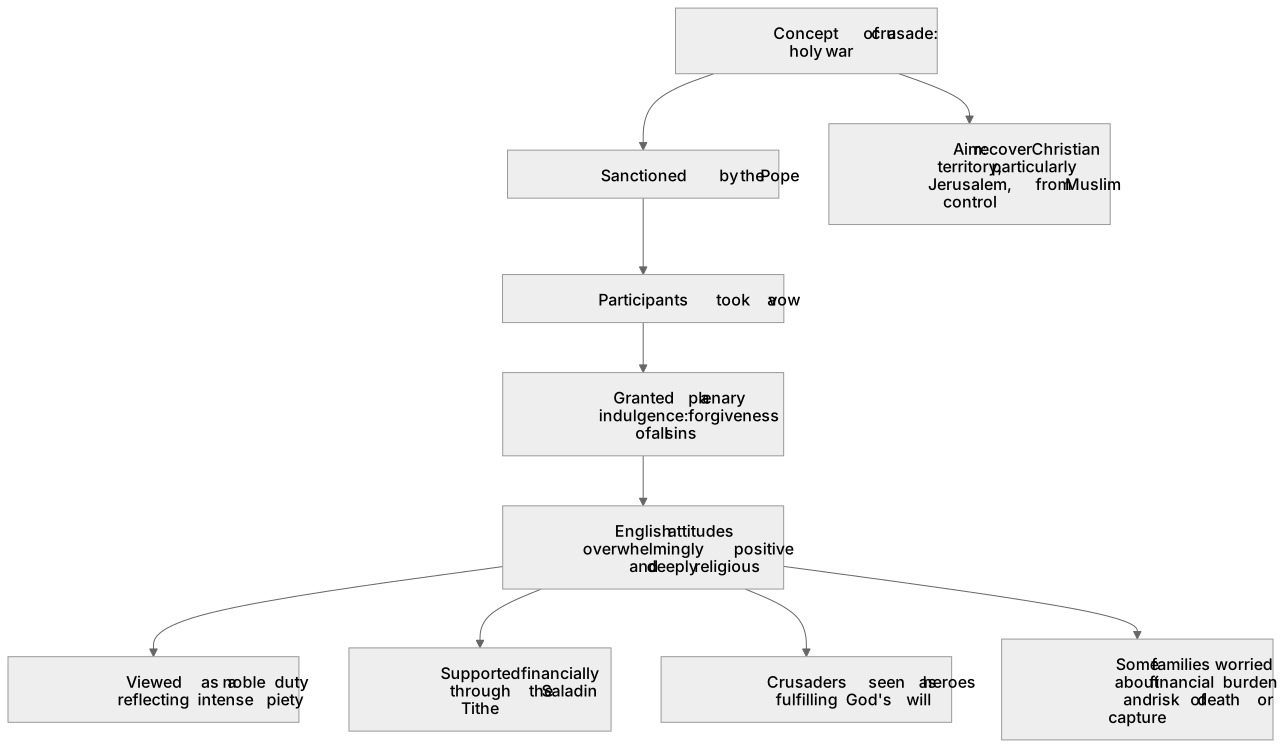
The concept of a crusade was rooted in the idea of a holy war, sanctioned by the Pope, to recover Christian territory, particularly Jerusalem, from Muslim control.
Checked against the Pearson Edexcel 1HI0 specification (opens in a new tab) on .
- Point 1 of 2
- 3 key terms
Study notes
From the checked teaching notes for this specification point.
The idea
The concept of a crusade was rooted in the idea of a holy war, sanctioned by the Pope, to recover Christian territory, particularly Jerusalem, from Muslim control. Participants took a vow and were granted a plenary indulgence, promising the forgiveness of all sins. In England, attitudes towards the crusades were overwhelmingly positive and deeply religious. The crusades were viewed as a noble duty, reflecting the intense piety of medieval society. English people supported the crusades financially through the Saladin Tithe, and many viewed crusaders as heroes fulfilling God's will, though some families worried about the immense financial burden and the high risk of death or capture.
What earns the marks
- Define a crusade as a holy war authorised by the Pope to reclaim the Holy Land.
- Explain the religious motivation, specifically the promise of a full indulgence and forgiveness of sins.
- Describe the general English attitude as highly supportive and driven by deep religious devotion.
- Identify the financial impact on England, such as the collection of the Saladin Tithe to fund the campaign.
Common mistakes and how to put them right
Believing crusades were purely for financial gain.
Put it right: Emphasise that while some sought wealth, the primary motivation and concept were deeply religious, centred on the forgiveness of sins.
Thinking everyone in England went on crusade.
Put it right: Clarify that while attitudes were supportive, only a fraction of the population actually went, with many supporting it financially instead.
Confusing a crusade with a standard medieval war.
Put it right: Highlight that a crusade required papal authorisation and involved taking a specific religious vow.
Exam tips
- Use the term 'plenary indulgence' to demonstrate specific knowledge of religious motivations.
- When discussing attitudes, mention the Saladin Tithe as concrete evidence of national support and financial commitment.
- Link the concept of crusade to the broader context of medieval religious beliefs and the fear of purgatory.
Try the lesson
The start of the Option B2: Key topic 2: Involvements overseas, 1189–1204 - 1 The nature of crusading: The concept of crusade and attitudes in England to the crusades. lesson, made from checked teaching notes for this specification point.
Have a go first
What was the primary religious promise made by the Pope to those who went on a crusade?
Listen
The concept of a crusade was rooted in the idea of a holy war, sanctioned by the Pope, to recover Christian territory, particularly Jerusalem, from Muslim control. Participants took a vow and were granted a plenary indulgence, promising the forgiveness of all sins. In England, attitudes towards the crusades were overwhelmingly positive and deeply religious. The crusades were viewed as a noble duty, reflecting the intense piety of medieval society. English people supported the crusades financially through the Saladin Tithe, and many viewed crusaders as heroes fulfilling God's will, though some families worried about the immense financial burden and the high risk of death or capture. A strong answer earns marks for these points. Define a crusade as a holy war authorised by the Pope to reclaim the Holy Land. Explain the religious motivation, specifically the promise of a full indulgence and forgiveness of sins. Describe the general English attitude as highly supportive and driven by deep religious devotion. Identify the financial impact on England, such as the collection of the Saladin Tithe to fund the campaign. A common slip: Believing crusades were purely for financial gain. Instead, Emphasise that while some sought wealth, the primary motivation and concept were deeply religious, centred on the forgiveness of sins. Exam tip: Use the term 'plenary indulgence' to demonstrate specific knowledge of religious motivations.
See it
Key words
Say what each word means before you turn the card.
Crusade
Try answering aloud or in your head before turning the card.
Plenary indulgence
Try answering aloud or in your head before turning the card.
Saladin Tithe
Try answering aloud or in your head before turning the card.
See every definition
- Crusade
- A holy war sanctioned by the Pope to recover Christian territory, particularly Jerusalem, from Muslim control.
- Plenary indulgence
- A promise granting the forgiveness of all sins to participants who took a vow.
- Saladin Tithe
- A means by which English people supported the crusades financially.
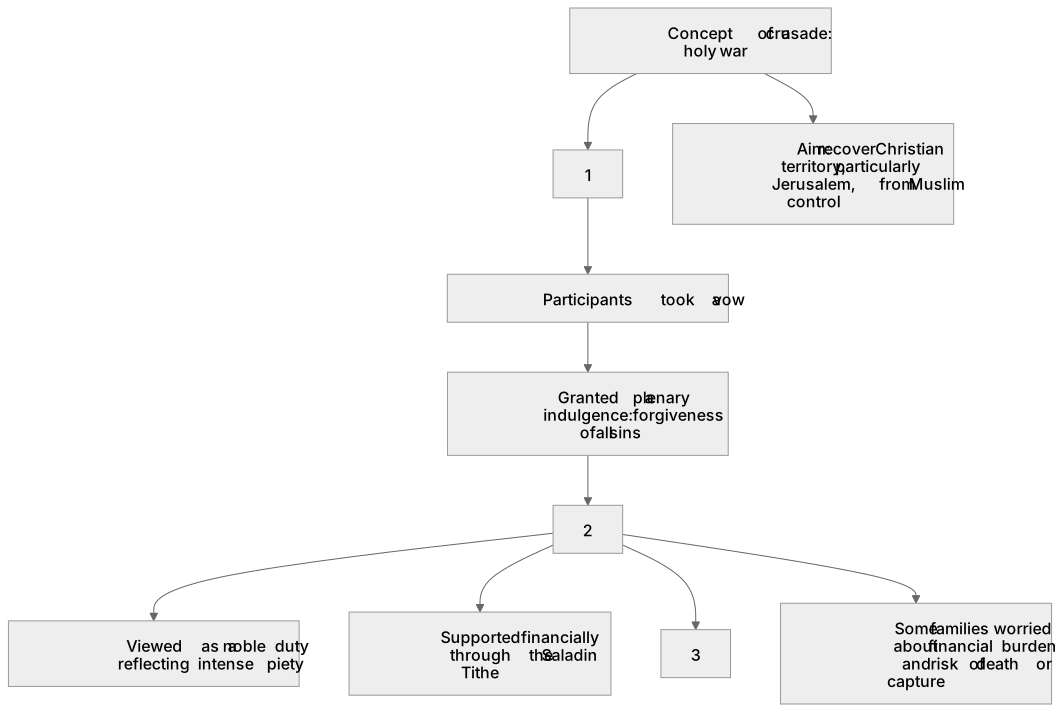
Label the diagram
Some boxes have lost their names. Pick the right name for each number.
1Box 1
2Box 2
3Box 3
There is more to this lesson
The full lesson goes on to check your understanding and help you earn the marks. Create a free account to carry on, with your progress saved.
A week of Premium from your first lesson · Then the free plan continues · No card, no charge
Test your understanding of Option B2: Key topic 2: Involvements overseas, 1189–1204 - 1 The nature of crusading: The concept of crusade and attitudes in England to the crusades.
Active recall beats re-reading. Take an instant quiz now to test what you’ve learned and lock it into long-term memory.
A week of Premium from your first lesson · Then the free plan continues · No card, no charge