Pearson Edexcel · GCSE · History
Course version: 1HI0 · Version from Sept 2016
Key topic 2: Involvements overseas, 1189–1204 - 1 The nature of crusading:…
Full specification wording
Option B2: Key topic 2: Involvements overseas, 1189–1204 - 1 The nature of crusading: The nature of the English crusading army: who they were, why they went.
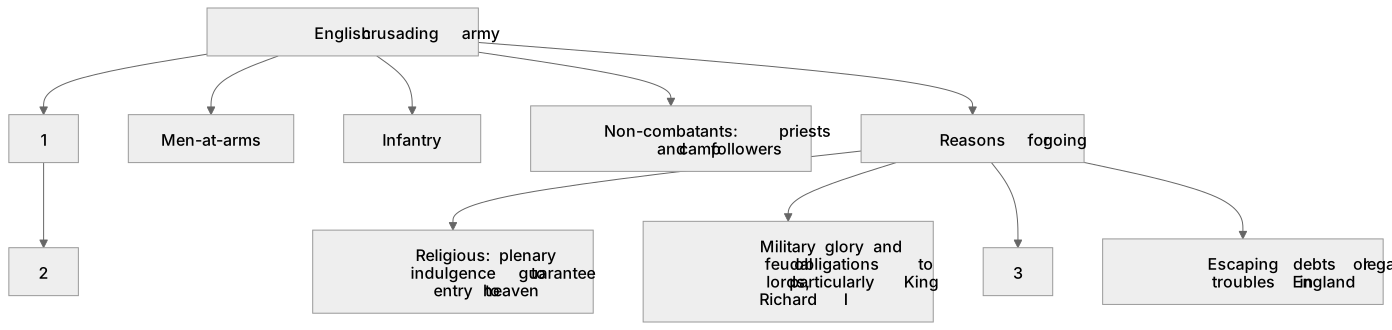
The English crusading army was a diverse force, composed of highly trained knights, men-at-arms, infantry, and non-combatants such as priests and camp followers.
Checked against the Pearson Edexcel 1HI0 specification (opens in a new tab) on .
- Point 2 of 2
- 4 key terms
Study notes
From the checked teaching notes for this specification point.
The idea
The English crusading army was a diverse force, composed of highly trained knights, men-at-arms, infantry, and non-combatants such as priests and camp followers. The core consisted of the nobility and their retinues, bound by the feudal system. People joined for various reasons. The primary motivation was religious: securing a plenary indulgence to guarantee entry to heaven. However, other factors played a crucial role. Knights sought military glory and the opportunity to fulfil feudal obligations to their lords, particularly King Richard I. Some individuals were motivated by the prospect of financial gain through plunder, while others sought to escape debts or legal troubles back in England.
What earns the marks
- Identify the composition of the army, including knights, infantry, and non-combatants like priests.
- Explain the religious motivation of seeking forgiveness for sins through a papal indulgence.
- Describe the feudal obligations that compelled many knights and soldiers to follow their lords.
- Discuss secondary motivations such as the desire for wealth, land, military glory, or escaping debt.
Common mistakes and how to put them right
Assuming the army consisted only of knights.
Put it right: Note that the army included infantry, archers, and many non-combatants who provided essential support.
Stating that all crusaders went solely for religious reasons.
Put it right: Acknowledge that while religion was the main driver, economic, social, and feudal factors were also significant.
Believing peasants made up the bulk of the fighting force.
Put it right: Explain that warfare was expensive, so the core fighters were well-equipped knights and professional men-at-arms.
Exam tips
- Categorise motivations into religious, economic, and social/feudal to structure your answers clearly.
- Mention the role of King Richard I in inspiring and compelling his subjects to join the army.
- Use specific examples of non-combatants to show a comprehensive understanding of the army's makeup.
Try the lesson
The start of the Option B2: Key topic 2: Involvements overseas, 1189–1204 - 1 The nature of crusading: The nature of the English crusading army: who they were, why they went. lesson, made from checked teaching notes for this specification point.
Have a go first
Which group of people made up the core fighting force of the English crusading army?
Listen
The English crusading army was a diverse force, composed of highly trained knights, men-at-arms, infantry, and non-combatants such as priests and camp followers. The core consisted of the nobility and their retinues, bound by the feudal system. People joined for various reasons. The primary motivation was religious: securing a plenary indulgence to guarantee entry to heaven. However, other factors played a crucial role. Knights sought military glory and the opportunity to fulfil feudal obligations to their lords, particularly King Richard I. Some individuals were motivated by the prospect of financial gain through plunder, while others sought to escape debts or legal troubles back in England. A strong answer earns marks for these points. Identify the composition of the army, including knights, infantry, and non-combatants like priests. Explain the religious motivation of seeking forgiveness for sins through a papal indulgence. Describe the feudal obligations that compelled many knights and soldiers to follow their lords. Discuss secondary motivations such as the desire for wealth, land, military glory, or escaping debt. A common slip: Assuming the army consisted only of knights. Instead, Note that the army included infantry, archers, and many non-combatants who provided essential support. Exam tip: Categorise motivations into religious, economic, and social/feudal to structure your answers clearly.
See it

Key words
Say what each word means before you turn the card.
Military organisation
Try answering aloud or in your head before turning the card.
Social structure
Try answering aloud or in your head before turning the card.
Religious motivation
Try answering aloud or in your head before turning the card.
Economic factors
Try answering aloud or in your head before turning the card.
See every definition
- Military organisation
- The army was a diverse force of highly trained knights, men-at-arms, infantry and non-combatants such as priests and camp followers, its core being the nobility and their retinues bound by the feudal system.
- Social structure
- The core of the force consisted of the nobility and their retinues, bound by the feudal system, with warfare being expensive so that the core fighters were well-equipped knights and professional men-at-arms.
- Religious motivation
- The primary motivation was religious: securing a plenary indulgence to guarantee entry to heaven, with the religious motivation described as seeking forgiveness for sins through a papal indulgence.
- Economic factors
- Some individuals were motivated by the prospect of financial gain through plunder, while others sought to escape debts or legal troubles back in England.
Label the diagram
Some boxes have lost their names. Pick the right name for each number.
1Box 1
2Box 2
3Box 3
There is more to this lesson
The full lesson goes on to check your understanding and help you earn the marks. Create a free account to carry on, with your progress saved.
A week of Premium from your first lesson · Then the free plan continues · No card, no charge
Test your understanding of Option B2: Key topic 2: Involvements overseas, 1189–1204 - 1 The nature of crusading: The nature of the English crusading army: who they were, why they went.
Active recall beats re-reading. Take an instant quiz now to test what you’ve learned and lock it into long-term memory.
A week of Premium from your first lesson · Then the free plan continues · No card, no charge