Pearson Edexcel · GCSE · History
Course version: 1HI0 · Version from Sept 2016
Key topic 1: Henry VIII and Wolsey, 1509–29 - 3 Wolsey’s foreign policy:…
Full specification wording
Option B3: Key topic 1: Henry VIII and Wolsey, 1509–29 - 3 Wolsey’s foreign policy: Aims of Wolsey’s foreign policy.
Thomas Wolsey’s foreign policy was driven by interconnected aims designed to satisfy Henry VIII’s ambitions while navigating European power struggles.
Checked against the Pearson Edexcel 1HI0 specification (opens in a new tab) on .
- Point 1 of 2
Study notes
From the checked teaching notes for this specification point.
The idea
Thomas Wolsey’s foreign policy was driven by interconnected aims designed to satisfy Henry VIII’s ambitions while navigating European power struggles. His primary objective was to secure military glory and prestige for Henry, fulfilling the King's desire to be seen as a great warrior monarch, particularly against France. Secondly, Wolsey aimed to position England as the chief peacemaker and power broker of Europe, using diplomacy to punch above England's limited financial weight. A third crucial aim was to maintain the balance of power between the Habsburg and Valois dynasties, ensuring neither France nor the Holy Roman Empire became too dominant. Finally, Wolsey sought to protect the independence of the Papacy, which aligned with his own personal ambitions within the Catholic Church.
What earns the marks
- Identify the pursuit of military glory and the capture of French territory as a primary aim to satisfy Henry VIII.
- Explain the aim of establishing England as the diplomatic centre and peacemaker of Europe.
- Describe the strategy of maintaining a balance of power between the Holy Roman Empire (Charles V) and France (Francis I).
- Outline the objective of defending the Papacy from foreign domination, linking it to Wolsey's position as Cardinal and Papal Legate.
Common mistakes and how to put them right
Arguing that Wolsey only wanted peace.
Put it right: Clarify that while Wolsey often used peace treaties for prestige, he also actively pursued war when it suited Henry's desire for glory.
Treating England as the most powerful nation in Europe.
Put it right: Acknowledge that England was a second-rate power financially and militarily compared to France and the Holy Roman Empire, making Wolsey's diplomatic aims essential.
Ignoring Henry VIII's role in foreign policy.
Put it right: Emphasise that Wolsey's aims were fundamentally dictated by the need to please Henry and fulfill the King's personal ambitions.
Exam tips
- When discussing Wolsey's aims, always link his diplomatic strategies back to England's lack of resources compared to its European rivals.
- Use the concept of the 'balance of power' to explain why England frequently switched alliances between France and the Holy Roman Empire.
- Structure answers by categorising aims into military glory, diplomatic prestige, and papal protection.
Try the lesson
The start of the Option B3: Key topic 1: Henry VIII and Wolsey, 1509–29 - 3 Wolsey’s foreign policy: Aims of Wolsey’s foreign policy. lesson, made from checked teaching notes for this specification point.
Have a go first
Which of the following was a central aim of Thomas Wolsey's foreign policy during the 1510s?
Listen
Thomas Wolsey’s foreign policy was driven by interconnected aims designed to satisfy Henry VIII’s ambitions while navigating European power struggles. His primary objective was to secure military glory and prestige for Henry, fulfilling the King's desire to be seen as a great warrior monarch, particularly against France. Secondly, Wolsey aimed to position England as the chief peacemaker and power broker of Europe, using diplomacy to punch above England's limited financial weight. A third crucial aim was to maintain the balance of power between the Habsburg and Valois dynasties, ensuring neither France nor the Holy Roman Empire became too dominant. Finally, Wolsey sought to protect the independence of the Papacy, which aligned with his own personal ambitions within the Catholic Church. A strong answer earns marks for these points. Identify the pursuit of military glory and the capture of French territory as a primary aim to satisfy Henry VIII. Explain the aim of establishing England as the diplomatic centre and peacemaker of Europe. Describe the strategy of maintaining a balance of power between the Holy Roman Empire (Charles V) and France (Francis I). Outline the objective of defending the Papacy from foreign domination, linking it to Wolsey's position as Cardinal and Papal Legate. A common slip: Arguing that Wolsey only wanted peace. Instead, Clarify that while Wolsey often used peace treaties for prestige, he also actively pursued war when it suited Henry's desire for glory. Exam tip: When discussing Wolsey's aims, always link his diplomatic strategies back to England's lack of resources compared to its European rivals.
See it
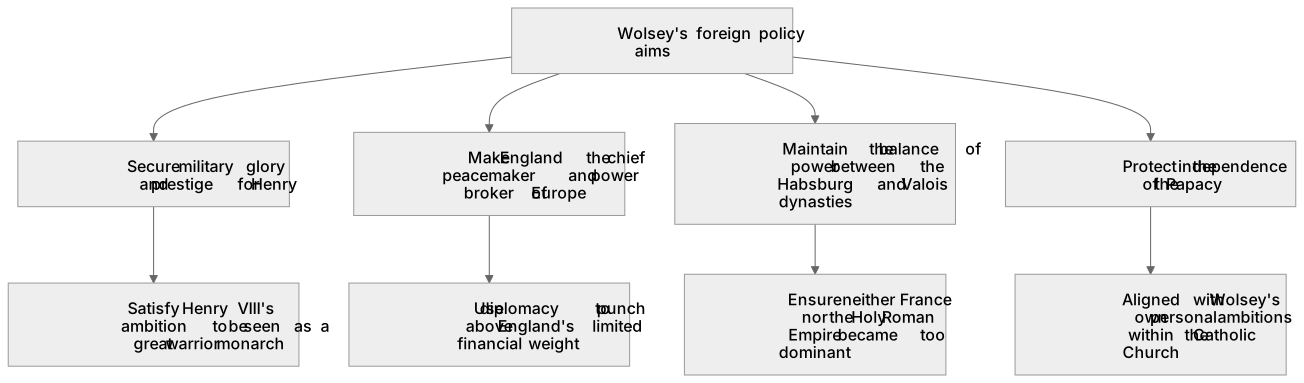
Label the diagram
Some boxes have lost their names. Pick the right name for each number.
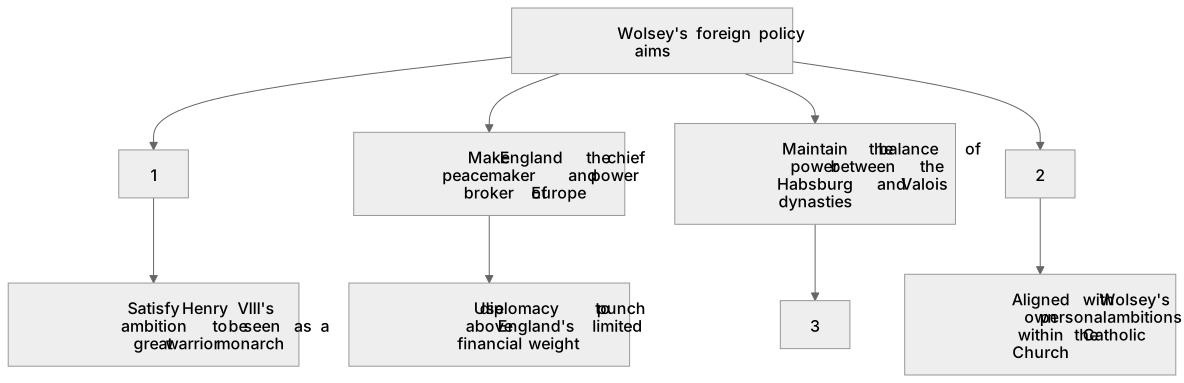
1Box 1
2Box 2
3Box 3
There is more to this lesson
The full lesson goes on to check your understanding and help you earn the marks. Create a free account to carry on, with your progress saved.
A week of Premium from your first lesson · Then the free plan continues · No card, no charge
Test your understanding of Option B3: Key topic 1: Henry VIII and Wolsey, 1509–29 - 3 Wolsey’s foreign policy: Aims of Wolsey’s foreign policy.
Active recall beats re-reading. Take an instant quiz now to test what you’ve learned and lock it into long-term memory.
A week of Premium from your first lesson · Then the free plan continues · No card, no charge