Pearson Edexcel · GCSE · History
Course version: 1HI0 · Version from Sept 2016
Key topic 1: Henry VIII and Wolsey, 1509–29 - 3 Wolsey’s foreign policy:…
Full specification wording
Option B3: Key topic 1: Henry VIII and Wolsey, 1509–29 - 3 Wolsey’s foreign policy: Successes and failures, including relations with France and the Holy Roman Empire, the Treaty of London (1518), the ‘Field of the Cloth of Gold’ (1520) and increasing difficulties in the 1520s.
Wolsey’s foreign policy saw spectacular early successes followed by severe failures.
Checked against the Pearson Edexcel 1HI0 specification (opens in a new tab) on .
- Point 2 of 2
Study notes
From the checked teaching notes for this specification point.
The idea
Wolsey’s foreign policy saw spectacular early successes followed by severe failures. The 1518 Treaty of London was a diplomatic triumph, uniting twenty European states in non-aggression and placing England at the centre of European diplomacy. This prestige was reinforced by the 1520 Field of the Cloth of Gold, a magnificent summit with France that showcased Henry’s wealth, despite achieving little politically. However, relations with France and the Holy Roman Empire became increasingly difficult in the 1520s. Wolsey's alliance with the Empire failed when Charles V abandoned England after the Battle of Pavia in 1525. Forced to ally with a weakened France, England was sidelined. By 1529, the Treaty of Cambrai between France and the Empire completely isolated England, marking the ultimate failure of Wolsey’s strategy.
What earns the marks
- Evaluate the Treaty of London (1518) as a major success that temporarily made England the diplomatic arbiter of Europe.
- Assess the Field of the Cloth of Gold (1520) as a success in terms of prestige and propaganda, but a failure in securing a lasting French alliance.
- Explain the failure of the alliance with the Holy Roman Empire, culminating in Charles V ignoring English interests after his victory at Pavia (1525).
- Analyse the increasing difficulties of the late 1520s, specifically how shifting alliances left England diplomatically isolated by the 1529 Treaty of Cambrai.
Common mistakes and how to put them right
Stating the Field of the Cloth of Gold resulted in a permanent peace with France.
Put it right: Note that despite the extravagant display, England and France were at war again by 1522.
Confusing the rulers of the rival nations.
Put it right: Ensure correct identification of Francis I as King of France and Charles V as the Holy Roman Emperor.
Claiming Wolsey's foreign policy was entirely unsuccessful.
Put it right: Balance the answer by acknowledging early triumphs like the Treaty of London before discussing the isolation of the late 1520s.
Exam tips
- Use the Treaty of London as your primary evidence for Wolsey's success in achieving his aim of making England a European peacemaker.
- Contrast the superficial success of the Field of the Cloth of Gold with the harsh political realities of the 1520s to demonstrate nuanced evaluation.
- Track the shifting alliances (from anti-French to anti-Imperial) to explain why England became isolated by 1529.
Try the lesson
The start of the Option B3: Key topic 1: Henry VIII and Wolsey, 1509–29 - 3 Wolsey’s foreign policy: Successes and failures, including relations with France and the Holy Roman Empire, the Treaty of London (1518), the ‘Field of the Cloth of Gold’ (1520) and increasing difficulties in the 1520s. lesson, made from checked teaching notes for this specification point.
Have a go first
What was the main achievement of the Treaty of London, organised by Wolsey in 1518?
Listen
Wolsey’s foreign policy saw spectacular early successes followed by severe failures. The 1518 Treaty of London was a diplomatic triumph, uniting twenty European states in non-aggression and placing England at the centre of European diplomacy. This prestige was reinforced by the 1520 Field of the Cloth of Gold, a magnificent summit with France that showcased Henry’s wealth, despite achieving little politically. However, relations with France and the Holy Roman Empire became increasingly difficult in the 1520s. Wolsey's alliance with the Empire failed when Charles V abandoned England after the Battle of Pavia in 1525. Forced to ally with a weakened France, England was sidelined. By 1529, the Treaty of Cambrai between France and the Empire completely isolated England, marking the ultimate failure of Wolsey’s strategy. A strong answer earns marks for these points. Evaluate the Treaty of London (1518) as a major success that temporarily made England the diplomatic arbiter of Europe. Assess the Field of the Cloth of Gold (1520) as a success in terms of prestige and propaganda, but a failure in securing a lasting French alliance. Explain the failure of the alliance with the Holy Roman Empire, culminating in Charles V ignoring English interests after his victory at Pavia (1525). Analyse the increasing difficulties of the late 1520s, specifically how shifting alliances left England diplomatically isolated by the 1529 Treaty of Cambrai. A common slip: Stating the Field of the Cloth of Gold resulted in a permanent peace with France. Instead, Note that despite the extravagant display, England and France were at war again by 1522. Exam tip: Use the Treaty of London as your primary evidence for Wolsey's success in achieving his aim of making England a European peacemaker.
See it
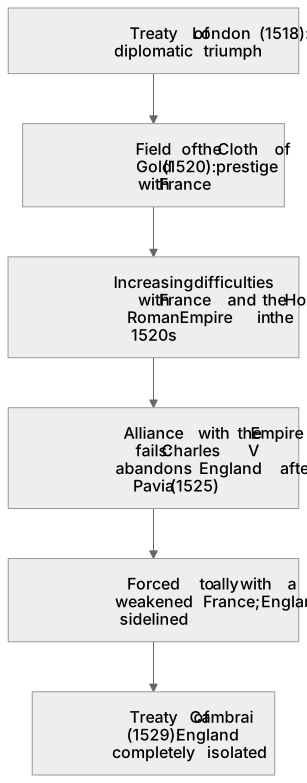
Put it in order
Put these steps in the order they happen.
- 1. Increasing difficulties with France and the Holy Roman Empire in the 1520s
- 2. Field of the Cloth of Gold (1520): prestige with France
- 3. Treaty of London (1518): diplomatic triumph
- 4. Treaty of Cambrai (1529): England completely isolated
- 5. Forced to ally with a weakened France; England sidelined
- 6. Alliance with the Empire fails: Charles V abandons England after Pavia (1525)
Put the events in order
Put these events in the order they happened, earliest first.
- 1. Treaty of Cambrai isolates England
- 2. Treaty of London unites European states in non-aggression
- 3. Charles V abandons England after victory at Pavia
- 4. Field of the Cloth of Gold summit with France
Label the diagram
Some boxes have lost their names. Pick the right name for each number.
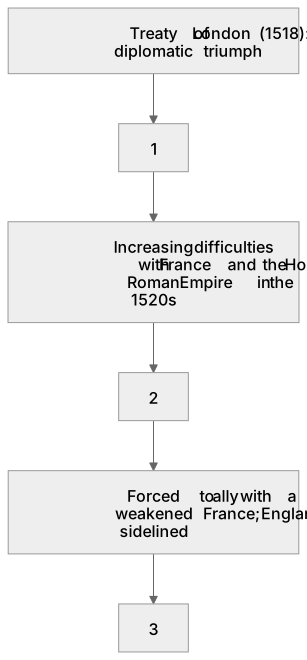
1Box 1
2Box 2
3Box 3
There is more to this lesson
The full lesson goes on to check your understanding and help you earn the marks. Create a free account to carry on, with your progress saved.
A week of Premium from your first lesson · Then the free plan continues · No card, no charge
Test your understanding of Option B3: Key topic 1: Henry VIII and Wolsey, 1509–29 - 3 Wolsey’s foreign policy: Successes and failures, including relations with France and the Holy Roman Empire, the Treaty of London (1518), the ‘Field of the Cloth of Gold’ (1520) and increasing difficulties in the 1520s.
Active recall beats re-reading. Take an instant quiz now to test what you’ve learned and lock it into long-term memory.
A week of Premium from your first lesson · Then the free plan continues · No card, no charge