Pearson Edexcel · GCSE · History
Course version: 1HI0 · Version from Sept 2016
Key topic 2: Henry VIII and Cromwell, 1529–40 - 2 The king’s marriages:…
Full specification wording
Option B3: Key topic 2: Henry VIII and Cromwell, 1529–40 - 2 The king’s marriages: Reasons for marriage to Jane Seymour; her influence, heir and death.
Henry VIII married Jane Seymour in 1536 primarily to secure a legitimate male heir, following the failures of his previous marriages.
Checked against the Pearson Edexcel 1HI0 specification (opens in a new tab) on .
- Point 2 of 3
- 4 key terms
Study notes
From the checked teaching notes for this specification point.
The idea
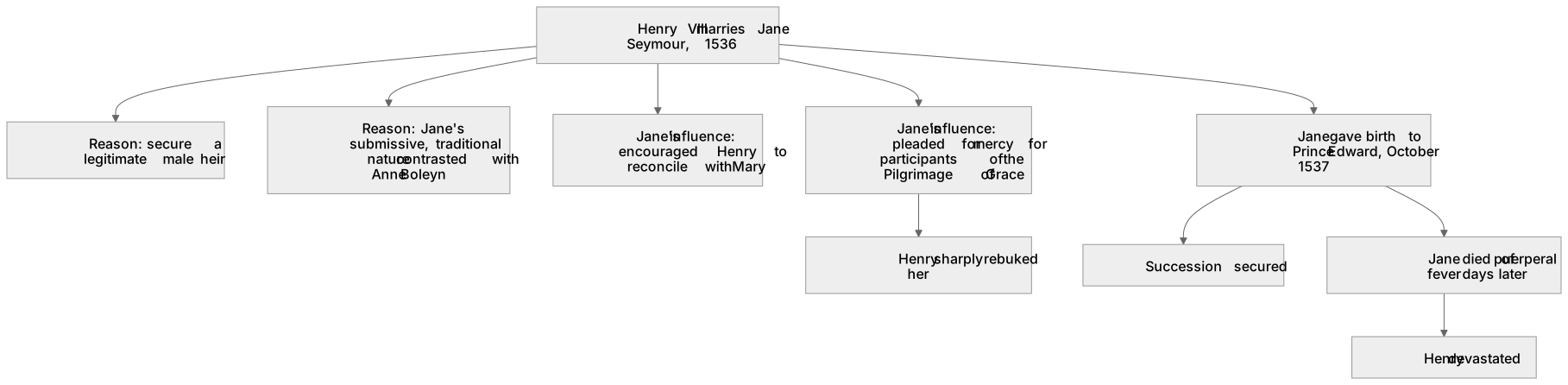
Henry VIII married Jane Seymour in 1536 primarily to secure a legitimate male heir, following the failures of his previous marriages. Jane's submissive and traditional nature contrasted sharply with Anne Boleyn's assertiveness, appealing to Henry. Her influence was subtle but significant; she encouraged Henry to reconcile with his daughter Mary and pleaded for mercy for the participants of the Pilgrimage of Grace, though Henry sharply rebuked her. Jane fulfilled her primary royal duty by giving birth to the long-desired male heir, Prince Edward, in October 1537. Tragically, she died of puerperal fever just days later, leaving Henry devastated but with a secured succession.
What earns the marks
- Explain Henry's need for a male heir as the main reason for marrying Jane Seymour.
- Describe Jane's character and how it contrasted with Anne Boleyn, making her attractive to Henry.
- Detail Jane's limited but notable influence, such as her attempts to reconcile Henry with Mary and her pleas during the Pilgrimage of Grace.
- State the significance of the birth of Prince Edward and the impact of Jane's subsequent death on Henry.
Common mistakes and how to put them right
Overstating Jane's political power.
Put it right: Jane had very little political power and was publicly rebuked by Henry when she tried to intervene in the Pilgrimage of Grace.
Confusing the mothers of Henry's children.
Put it right: Ensure you correctly attribute Edward to Jane Seymour, Mary to Catherine of Aragon, and Elizabeth to Anne Boleyn.
Assuming Jane was executed or divorced.
Put it right: Jane Seymour died of complications following childbirth (puerperal fever).
Exam tips
- Emphasise the contrast between Jane Seymour's traditional, submissive behaviour and Anne Boleyn's political involvement.
- Use Jane's intervention during the Pilgrimage of Grace to demonstrate the limits of a queen's influence over Henry.
- Highlight the birth of Prince Edward as the ultimate fulfilment of Henry's primary goal, securing the Tudor dynasty.
Try the lesson
The start of the Option B3: Key topic 2: Henry VIII and Cromwell, 1529–40 - 2 The king’s marriages: Reasons for marriage to Jane Seymour; her influence, heir and death. lesson, made from checked teaching notes for this specification point.
Have a go first
What was Henry VIII's primary motivation for marrying Jane Seymour so soon after the execution of Anne Boleyn?
Listen
Henry VIII married Jane Seymour in 1536 primarily to secure a legitimate male heir, following the failures of his previous marriages. Jane's submissive and traditional nature contrasted sharply with Anne Boleyn's assertiveness, appealing to Henry. Her influence was subtle but significant; she encouraged Henry to reconcile with his daughter Mary and pleaded for mercy for the participants of the Pilgrimage of Grace, though Henry sharply rebuked her. Jane fulfilled her primary royal duty by giving birth to the long-desired male heir, Prince Edward, in October 1537. Tragically, she died of puerperal fever just days later, leaving Henry devastated but with a secured succession. A strong answer earns marks for these points. Explain Henry's need for a male heir as the main reason for marrying Jane Seymour. Describe Jane's character and how it contrasted with Anne Boleyn, making her attractive to Henry. Detail Jane's limited but notable influence, such as her attempts to reconcile Henry with Mary and her pleas during the Pilgrimage of Grace. State the significance of the birth of Prince Edward and the impact of Jane's subsequent death on Henry. A common slip: Overstating Jane's political power. Instead, Jane had very little political power and was publicly rebuked by Henry when she tried to intervene in the Pilgrimage of Grace. Exam tip: Emphasise the contrast between Jane Seymour's traditional, submissive behaviour and Anne Boleyn's political involvement.
See it
Key words
Say what each word means before you turn the card.
Succession and the Tudor dynasty
Try answering aloud or in your head before turning the card.
The role of the Queen Consort
Try answering aloud or in your head before turning the card.
Court politics and influence
Try answering aloud or in your head before turning the card.
Marriage and diplomacy
Try answering aloud or in your head before turning the card.
See every definition
- Succession and the Tudor dynasty
- Henry's need for a legitimate male heir, secured by the birth of Prince Edward, fulfilled his primary goal of securing the Tudor dynasty.
- The role of the Queen Consort
- Jane's influence was subtle but significant, though she had very little political power and was publicly rebuked by Henry when she tried to intervene.
- Court politics and influence
- Jane's limited but notable influence included attempts to reconcile Henry with Mary and pleas for mercy during the Pilgrimage of Grace.
- Marriage and diplomacy
- Henry married Jane Seymour in 1536 primarily to secure a legitimate male heir, following the failures of his previous marriages.
Label the diagram
Some boxes have lost their names. Pick the right name for each number.
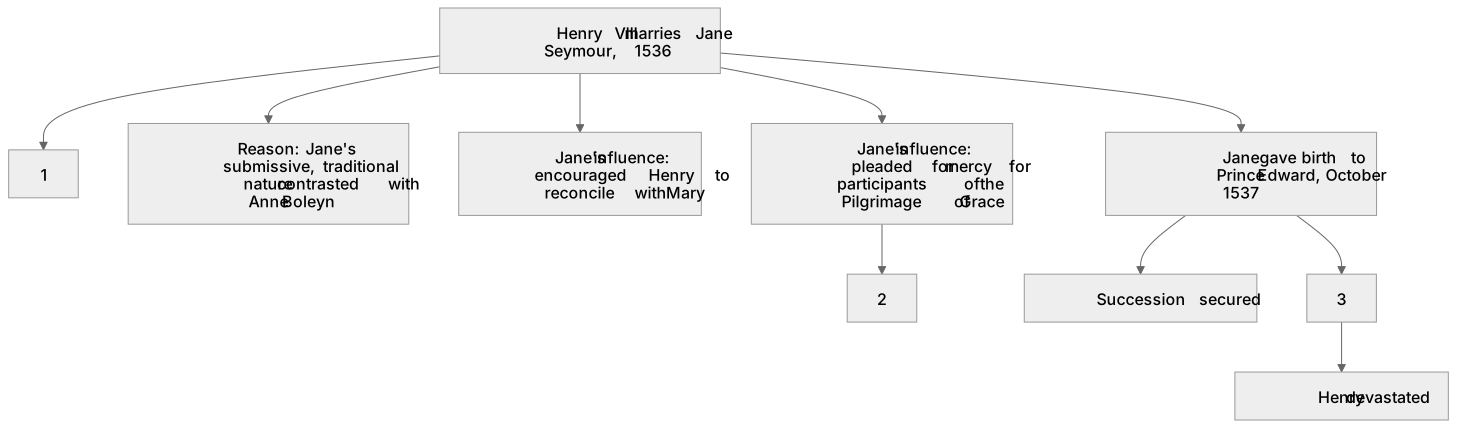
1Box 1
2Box 2
3Box 3
There is more to this lesson
The full lesson goes on to check your understanding and help you earn the marks. Create a free account to carry on, with your progress saved.
A week of Premium from your first lesson · Then the free plan continues · No card, no charge
Test your understanding of Option B3: Key topic 2: Henry VIII and Cromwell, 1529–40 - 2 The king’s marriages: Reasons for marriage to Jane Seymour; her influence, heir and death.
Active recall beats re-reading. Take an instant quiz now to test what you’ve learned and lock it into long-term memory.
A week of Premium from your first lesson · Then the free plan continues · No card, no charge