Pearson Edexcel · GCSE · History
Course version: 1HI0 · Version from Sept 2016
Key topic 2: Henry VIII and Cromwell, 1529–40 - 2 The king’s marriages:…
Full specification wording
Option B3: Key topic 2: Henry VIII and Cromwell, 1529–40 - 2 The king’s marriages: Reasons for the fall of Anne Boleyn, including the role of Cromwell.
Anne Boleyn's fall in 1536 was driven by her failure to provide a male heir, having only given birth to Princess Elizabeth and suffering miscarriages.
Checked against the Pearson Edexcel 1HI0 specification (opens in a new tab) on .
- Point 1 of 3
- 4 key terms
Study notes
From the checked teaching notes for this specification point.
The idea
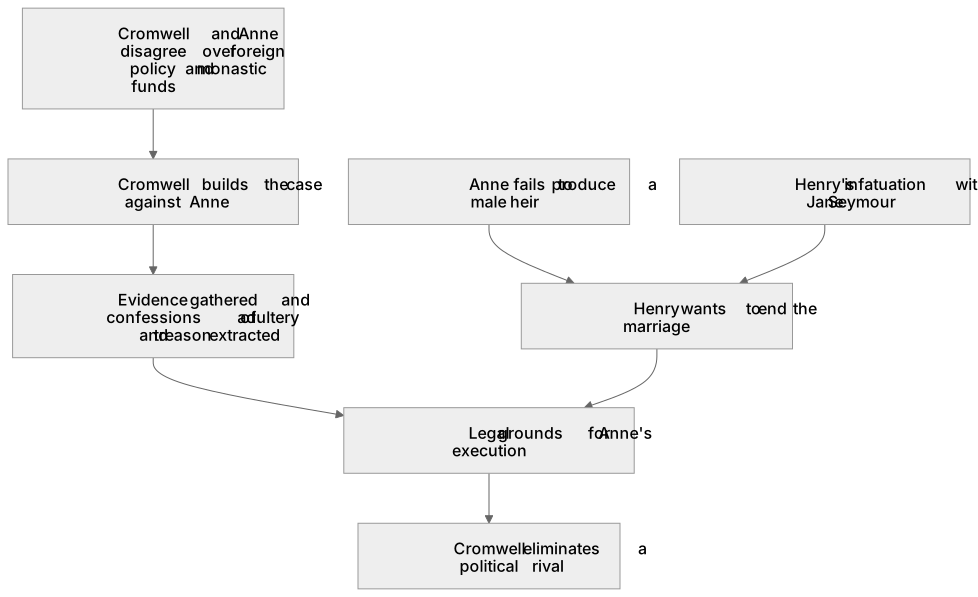
Anne Boleyn's fall in 1536 was driven by her failure to provide a male heir, having only given birth to Princess Elizabeth and suffering miscarriages. Henry VIII's infatuation with Jane Seymour further motivated his desire to end the marriage. Thomas Cromwell played a crucial role in Anne's downfall; their relationship had deteriorated over disagreements regarding foreign policy and the use of funds from dissolved monasteries. Cromwell actively built the case against Anne, gathering evidence and extracting confessions of adultery and treason, which provided Henry with the legal grounds for her execution and allowed Cromwell to eliminate a powerful political rival.
What earns the marks
- Identify Anne's failure to produce a male heir as a primary personal reason for her fall.
- Explain Henry's growing attraction to Jane Seymour as a catalyst for removing Anne.
- Detail Cromwell's role in orchestrating the plot and gathering evidence of treason and adultery against Anne.
- Analyse the political rivalry between Cromwell and the Boleyn faction over foreign policy and monastic wealth.
Common mistakes and how to put them right
Believing Anne was genuinely guilty of all charges.
Put it right: Most historians agree the charges of adultery and treason were fabricated by Cromwell to secure her removal.
Ignoring the political rivalry between Anne and Cromwell.
Put it right: Acknowledge that their disagreements over policy and finances made her a dangerous enemy to Cromwell.
Stating Henry divorced Anne.
Put it right: The marriage was annulled just before her execution for treason.
Exam tips
- When explaining Anne's fall, balance personal reasons (lack of a male heir, Jane Seymour) with political reasons (Cromwell's plotting).
- Highlight Cromwell's motivation for removing Anne, specifically their clashes over the dissolution of the monasteries.
- Use the term 'faction' to describe the rival groups at court, such as the Boleyn faction versus Cromwell's supporters.
Try the lesson
The start of the Option B3: Key topic 2: Henry VIII and Cromwell, 1529–40 - 2 The king’s marriages: Reasons for the fall of Anne Boleyn, including the role of Cromwell. lesson, made from checked teaching notes for this specification point.
Have a go first
Which of the following was a primary official charge used to justify the execution of Anne Boleyn in 1536?
Listen
Anne Boleyn's fall in 1536 was driven by her failure to provide a male heir, having only given birth to Princess Elizabeth and suffering miscarriages. Henry VIII's infatuation with Jane Seymour further motivated his desire to end the marriage. Thomas Cromwell played a crucial role in Anne's downfall; their relationship had deteriorated over disagreements regarding foreign policy and the use of funds from dissolved monasteries. Cromwell actively built the case against Anne, gathering evidence and extracting confessions of adultery and treason, which provided Henry with the legal grounds for her execution and allowed Cromwell to eliminate a powerful political rival. A strong answer earns marks for these points. Identify Anne's failure to produce a male heir as a primary personal reason for her fall. Explain Henry's growing attraction to Jane Seymour as a catalyst for removing Anne. Detail Cromwell's role in orchestrating the plot and gathering evidence of treason and adultery against Anne. Analyse the political rivalry between Cromwell and the Boleyn faction over foreign policy and monastic wealth. A common slip: Believing Anne was genuinely guilty of all charges. Instead, Most historians agree the charges of adultery and treason were fabricated by Cromwell to secure her removal. Exam tip: When explaining Anne's fall, balance personal reasons (lack of a male heir, Jane Seymour) with political reasons (Cromwell's plotting).
See it
Key words
Say what each word means before you turn the card.
Succession and heirs
Try answering aloud or in your head before turning the card.
Court factions and politics
Try answering aloud or in your head before turning the card.
Treason and execution
Try answering aloud or in your head before turning the card.
The role of the Chief Minister
Try answering aloud or in your head before turning the card.
See every definition
- Succession and heirs
- Anne Boleyn's failure to provide a male heir was a primary personal reason for her fall, having only given birth to Princess Elizabeth and suffering miscarriages.
- Court factions and politics
- Rival groups at court, such as the Boleyn faction versus Cromwell's supporters, clashed over foreign policy and monastic wealth.
- Treason and execution
- Cromwell gathered evidence and extracted confessions of adultery and treason, providing Henry with legal grounds for Anne's execution.
- The role of the Chief Minister
- Thomas Cromwell actively built the case against Anne, gathering evidence and extracting confessions, allowing him to eliminate a powerful political rival.
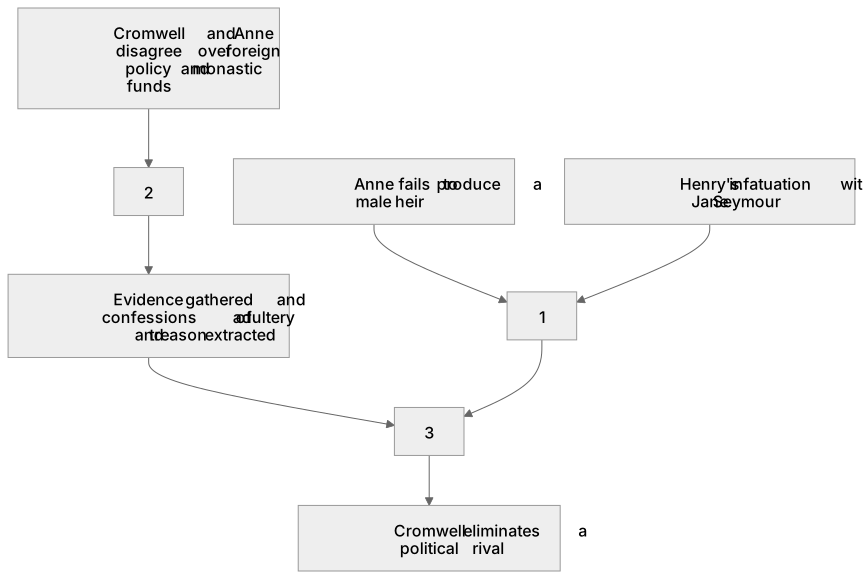
Label the diagram
Some boxes have lost their names. Pick the right name for each number.
1Box 1
2Box 2
3Box 3
There is more to this lesson
The full lesson goes on to check your understanding and help you earn the marks. Create a free account to carry on, with your progress saved.
A week of Premium from your first lesson · Then the free plan continues · No card, no charge
Test your understanding of Option B3: Key topic 2: Henry VIII and Cromwell, 1529–40 - 2 The king’s marriages: Reasons for the fall of Anne Boleyn, including the role of Cromwell.
Active recall beats re-reading. Take an instant quiz now to test what you’ve learned and lock it into long-term memory.
A week of Premium from your first lesson · Then the free plan continues · No card, no charge