Pearson Edexcel · GCSE · History
Course version: 1HI0 · Version from Sept 2016
Key topic 2: Henry VIII and Cromwell, 1529–40 - 3 Cromwell and government,…
Full specification wording
Option B3: Key topic 2: Henry VIII and Cromwell, 1529–40 - 3 Cromwell and government, 1534–40: Reform of government and royal finance.
Thomas Cromwell revolutionised Tudor government by shifting power from the royal household to bureaucratic departments.
Checked against the Pearson Edexcel 1HI0 specification (opens in a new tab) on .
- Point 1 of 2
- 4 key terms
Study notes
From the checked teaching notes for this specification point.
The idea
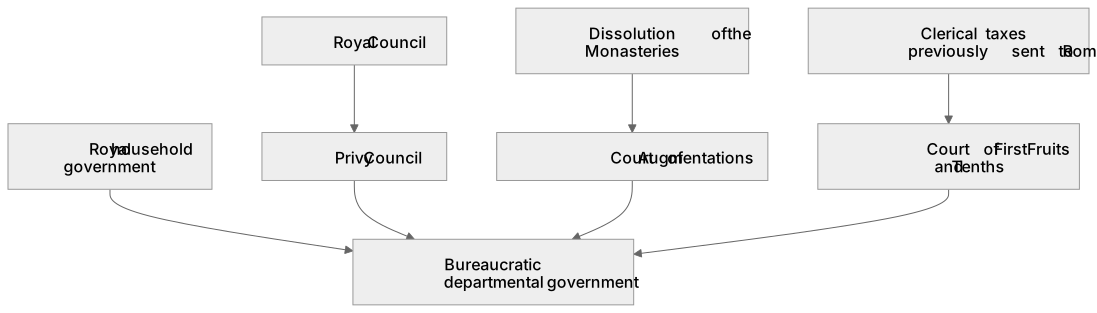
Thomas Cromwell revolutionised Tudor government by shifting power from the royal household to bureaucratic departments. He reformed the Royal Council into a smaller, more professional Privy Council comprising around 20 trained lawyers and administrators, rather than just nobles. In royal finance, Cromwell created new specialised financial courts to manage the massive influx of wealth from the Dissolution of the Monasteries. The Court of Augmentations (1536) handled monastic lands and revenues, while the Court of First Fruits and Tenths collected taxes previously sent to Rome. These reforms modernised administration, making it more efficient and less reliant on the monarch's personal household, fundamentally changing how England was governed.
What earns the marks
- Identify Cromwell's creation of the Privy Council as a smaller, professional body replacing the larger Royal Council.
- Explain the shift from personal household government to bureaucratic departmental government.
- Describe the establishment of the Court of Augmentations to manage income from dissolved monasteries.
- Describe the establishment of the Court of First Fruits and Tenths to manage clerical taxes.
- Evaluate how these reforms increased the efficiency and wealth of the Crown.
Common mistakes and how to put them right
Confusing the Privy Council with Parliament.
Put it right: The Privy Council was the monarch's group of close advisors and administrators, whereas Parliament was the legislative body that passed laws.
Stating Cromwell created the Star Chamber.
Put it right: The Star Chamber was developed earlier by Henry VII and Wolsey; Cromwell focused on the Privy Council and financial courts.
Claiming the Court of Augmentations dealt with taxes from the general public.
Put it right: The Court of Augmentations specifically managed the lands and revenues gained from the Dissolution of the Monasteries.
Exam tips
- Use the phrase 'bureaucratic government' to describe Cromwell's changes, contrasting it with 'household government'.
- When discussing finance, explicitly name the Court of Augmentations and link it directly to the Dissolution of the Monasteries.
- Explain the consequence of these reforms: they made the government more efficient and capable of handling increased royal wealth.
Try the lesson
The start of the Option B3: Key topic 2: Henry VIII and Cromwell, 1529–40 - 3 Cromwell and government, 1534–40: Reform of government and royal finance. lesson, made from checked teaching notes for this specification point.
Have a go first
What new financial court did Thomas Cromwell create in 1536 to manage the income from the dissolution of the monasteries?
Listen
Thomas Cromwell revolutionised Tudor government by shifting power from the royal household to bureaucratic departments. He reformed the Royal Council into a smaller, more professional Privy Council comprising around 20 trained lawyers and administrators, rather than just nobles. In royal finance, Cromwell created new specialised financial courts to manage the massive influx of wealth from the Dissolution of the Monasteries. The Court of Augmentations (1536) handled monastic lands and revenues, while the Court of First Fruits and Tenths collected taxes previously sent to Rome. These reforms modernised administration, making it more efficient and less reliant on the monarch's personal household, fundamentally changing how England was governed. A strong answer earns marks for these points. Identify Cromwell's creation of the Privy Council as a smaller, professional body replacing the larger Royal Council. Explain the shift from personal household government to bureaucratic departmental government. Describe the establishment of the Court of Augmentations to manage income from dissolved monasteries. Describe the establishment of the Court of First Fruits and Tenths to manage clerical taxes. A common slip: Confusing the Privy Council with Parliament. Instead, The Privy Council was the monarch's group of close advisors and administrators, whereas Parliament was the legislative body that passed laws. Exam tip: Use the phrase 'bureaucratic government' to describe Cromwell's changes, contrasting it with 'household government'.
See it
Key words
Say what each word means before you turn the card.
Privy Council
Try answering aloud or in your head before turning the card.
Court of Augmentations
Try answering aloud or in your head before turning the card.
Court of First Fruits and Tenths
Try answering aloud or in your head before turning the card.
Bureaucratic government
Try answering aloud or in your head before turning the card.
See every definition
- Privy Council
- A smaller, more professional body of around 20 trained lawyers and administrators that replaced the larger Royal Council.
- Court of Augmentations
- A new specialised financial court created in 1536 to handle monastic lands and revenues from the Dissolution of the Monasteries.
- Court of First Fruits and Tenths
- A new specialised financial court that collected taxes previously sent to Rome.
- Bureaucratic government
- A system of departmental administration that was more efficient and less reliant on the monarch's personal household.
Label the diagram
Some boxes have lost their names. Pick the right name for each number.
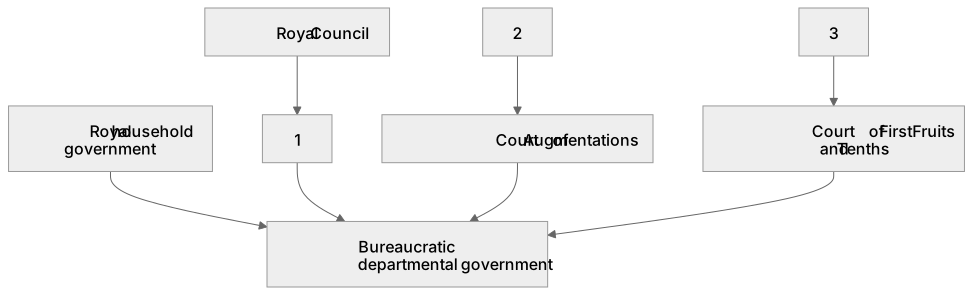
1Box 1
2Box 2
3Box 3
There is more to this lesson
The full lesson goes on to check your understanding and help you earn the marks. Create a free account to carry on, with your progress saved.
A week of Premium from your first lesson · Then the free plan continues · No card, no charge
Test your understanding of Option B3: Key topic 2: Henry VIII and Cromwell, 1529–40 - 3 Cromwell and government, 1534–40: Reform of government and royal finance.
Active recall beats re-reading. Take an instant quiz now to test what you’ve learned and lock it into long-term memory.
A week of Premium from your first lesson · Then the free plan continues · No card, no charge