Pearson Edexcel · GCSE · History
Course version: 1HI0 · Version from Sept 2016
Key topic 2: Henry VIII and Cromwell, 1529–40 - 3 Cromwell and government,…
Full specification wording
Option B3: Key topic 2: Henry VIII and Cromwell, 1529–40 - 3 Cromwell and government, 1534–40: The management and use of parliament.
Thomas Cromwell fundamentally changed the role of Parliament in English government.
Checked against the Pearson Edexcel 1HI0 specification (opens in a new tab) on .
- Point 2 of 2
- 4 key terms
Study notes
From the checked teaching notes for this specification point.
The idea
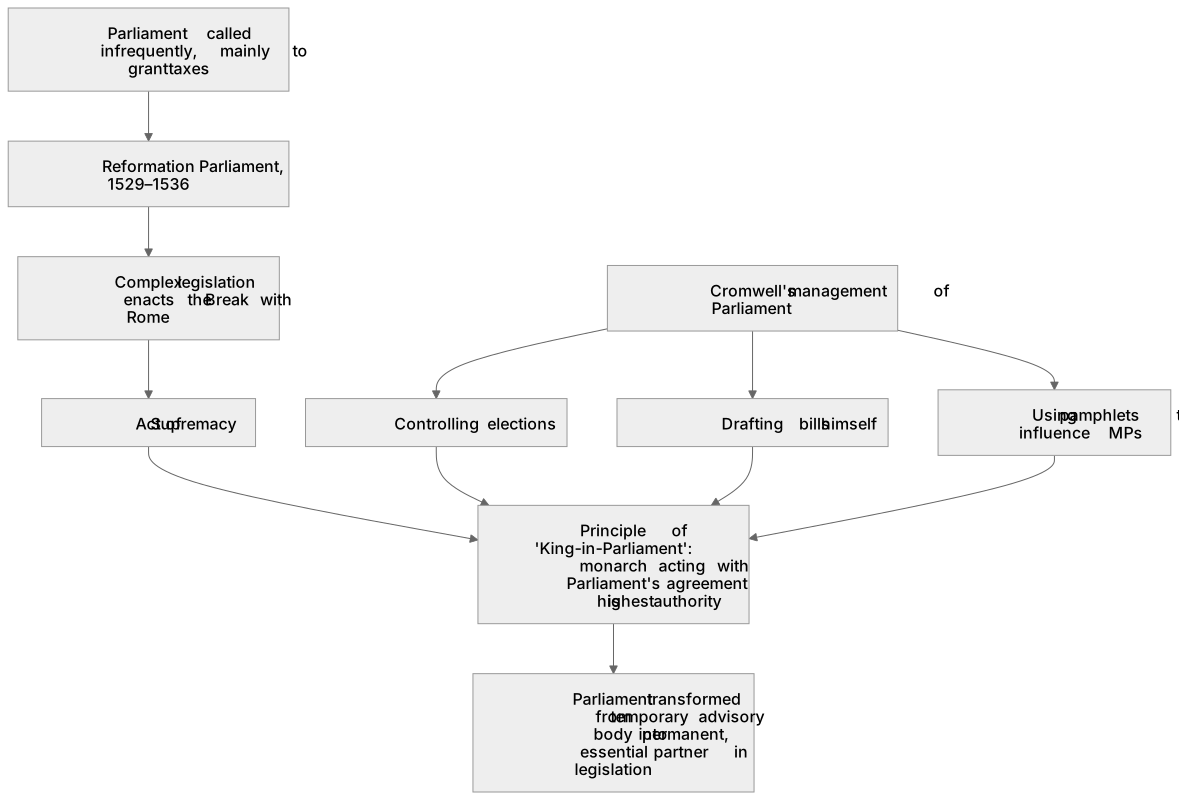
Thomas Cromwell fundamentally changed the role of Parliament in English government. Previously, Parliament was called infrequently, primarily to grant taxes. Cromwell used the 'Reformation Parliament' (1529–1536) to pass complex legislation that enacted the Break with Rome, such as the Act of Supremacy. This established the principle of 'King-in-Parliament', meaning the highest authority in England was the monarch acting with the agreement of Parliament. Cromwell managed Parliament carefully by controlling elections, drafting bills himself, and using pamphlets to influence MPs. This transformed Parliament from a temporary advisory body into a permanent, essential partner in the legislative process, significantly increasing its power and importance.
What earns the marks
- Explain the traditional role of Parliament as a body primarily for granting taxation.
- Describe how Cromwell used Parliament to pass major religious and political changes, such as the Act of Supremacy.
- Define the concept of 'King-in-Parliament' and its significance for legislative authority.
- Identify methods Cromwell used to manage Parliament, including drafting legislation and influencing elections.
- Evaluate the long-term impact of Cromwell's use of Parliament on its power and status.
Common mistakes and how to put them right
Believing Parliament had the power to defy Henry VIII during this period.
Put it right: Parliament was largely compliant and managed by Cromwell to legalise the King's wishes, not to oppose him.
Confusing the Reformation Parliament with the Privy Council.
Put it right: Parliament was the legislative body of MPs and Lords, while the Privy Council was the executive body of royal advisors.
Stating that Cromwell reduced the power of Parliament.
Put it right: Cromwell actually increased Parliament's importance by using it to enact unprecedented religious and constitutional changes.
Exam tips
- Use the term 'King-in-Parliament' to demonstrate a high-level understanding of how legislative authority evolved.
- Give specific examples of legislation passed by Parliament under Cromwell, such as the Act of Supremacy or the Treason Act.
- Discuss Cromwell's management tactics, like drafting bills, to show how he ensured Parliament did what the King wanted.
Try the lesson
The start of the Option B3: Key topic 2: Henry VIII and Cromwell, 1529–40 - 3 Cromwell and government, 1534–40: The management and use of parliament. lesson, made from checked teaching notes for this specification point.
Have a go first
How did Thomas Cromwell change the way Parliament was used during the 1530s?
Listen
Thomas Cromwell fundamentally changed the role of Parliament in English government. Previously, Parliament was called infrequently, primarily to grant taxes. Cromwell used the 'Reformation Parliament' (1529–1536) to pass complex legislation that enacted the Break with Rome, such as the Act of Supremacy. This established the principle of 'King-in-Parliament', meaning the highest authority in England was the monarch acting with the agreement of Parliament. Cromwell managed Parliament carefully by controlling elections, drafting bills himself, and using pamphlets to influence MPs. This transformed Parliament from a temporary advisory body into a permanent, essential partner in the legislative process, significantly increasing its power and importance. A strong answer earns marks for these points. Explain the traditional role of Parliament as a body primarily for granting taxation. Describe how Cromwell used Parliament to pass major religious and political changes, such as the Act of Supremacy. Define the concept of 'King-in-Parliament' and its significance for legislative authority. Identify methods Cromwell used to manage Parliament, including drafting legislation and influencing elections. A common slip: Believing Parliament had the power to defy Henry VIII during this period. Instead, Parliament was largely compliant and managed by Cromwell to legalise the King's wishes, not to oppose him. Exam tip: Use the term 'King-in-Parliament' to demonstrate a high-level understanding of how legislative authority evolved.
See it
Key words
Say what each word means before you turn the card.
Power and authority
Try answering aloud or in your head before turning the card.
Law and legislation
Try answering aloud or in your head before turning the card.
The role of Parliament
Try answering aloud or in your head before turning the card.
Constitutional change
Try answering aloud or in your head before turning the card.
See every definition
- Power and authority
- The highest authority in England was the monarch acting with the agreement of Parliament, a principle known as 'King-in-Parliament'.
- Law and legislation
- Cromwell used the Reformation Parliament to pass complex legislation that enacted the Break with Rome, such as the Act of Supremacy.
- The role of Parliament
- Previously called infrequently and primarily to grant taxes, it was transformed from a temporary advisory body into a permanent, essential partner in the legislative process.
- Constitutional change
- Cromwell used Parliament to enact unprecedented religious and constitutional changes, increasing its power and importance.
Label the diagram
Some boxes have lost their names. Pick the right name for each number.
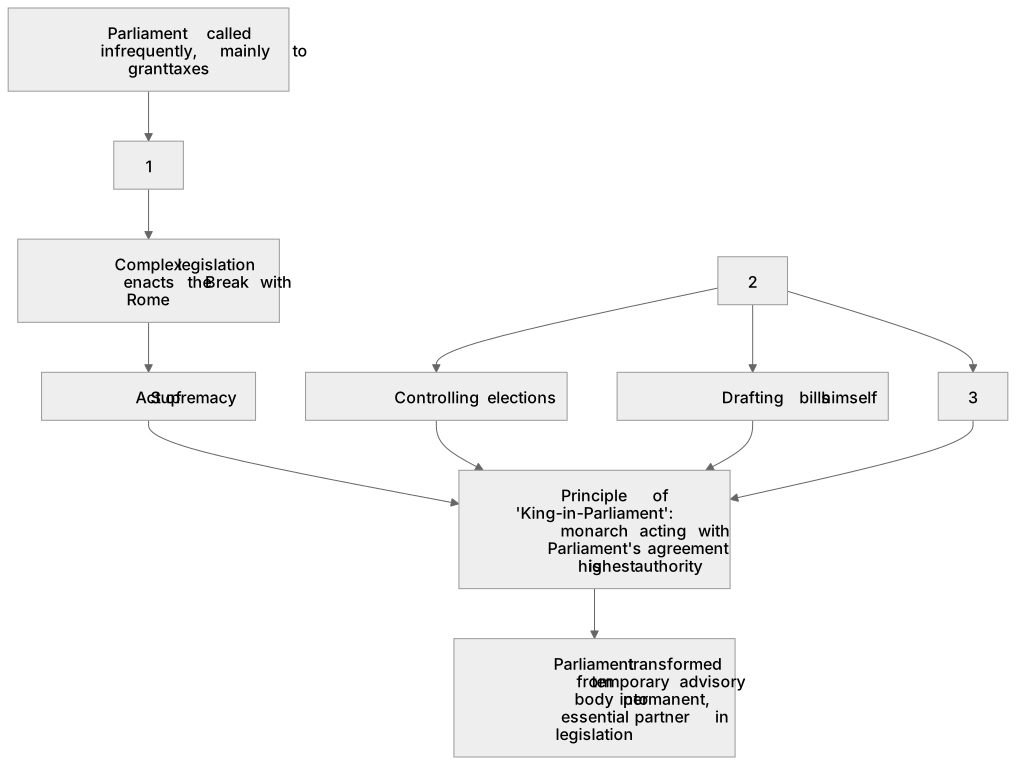
1Box 1
2Box 2
3Box 3
There is more to this lesson
The full lesson goes on to check your understanding and help you earn the marks. Create a free account to carry on, with your progress saved.
A week of Premium from your first lesson · Then the free plan continues · No card, no charge
Test your understanding of Option B3: Key topic 2: Henry VIII and Cromwell, 1529–40 - 3 Cromwell and government, 1534–40: The management and use of parliament.
Active recall beats re-reading. Take an instant quiz now to test what you’ve learned and lock it into long-term memory.
A week of Premium from your first lesson · Then the free plan continues · No card, no charge