Pearson Edexcel · GCSE · History
Course version: 1HI0 · Version from Sept 2016
Key topic 3: The Reformation and its impact, 1529–40 - 2 Opposition to,…
Full specification wording
Option B3: Key topic 3: The Reformation and its impact, 1529–40 - 2 Opposition to, and impact of, Reformation, 1534–40: Elizabeth Barton (the Nun of Kent) and John Fisher.
Elizabeth Barton, the Nun of Kent, and Bishop John Fisher were prominent opponents of Henry VIII's religious changes.
Checked against the Pearson Edexcel 1HI0 specification (opens in a new tab) on .
- Point 1 of 3
- 3 key terms
Study notes
From the checked teaching notes for this specification point.
The idea
Elizabeth Barton, the Nun of Kent, and Bishop John Fisher were prominent opponents of Henry VIII's religious changes. Barton publicly prophesied that Henry would die if he married Anne Boleyn, making her a dangerous focal point for opposition. She was arrested, forced to confess to fraud, and executed in 1534 via an Act of Attainder. John Fisher, Bishop of Rochester, steadfastly refused to accept the annulment of Henry's marriage to Catherine of Aragon and refused to swear the Oath of Succession. His refusal to acknowledge Henry as Supreme Head of the Church led to his trial and execution for treason in 1535. Both figures highlight the severe consequences of resisting the Henrician Reformation and the Crown's absolute intolerance of religious and political dissent.
What earns the marks
- Elizabeth Barton prophesied against Henry VIII's marriage to Anne Boleyn, claiming he would lose his throne and die.
- Barton's prophecies were widely circulated and used by opponents of the Reformation, leading to her execution by Act of Attainder in 1534.
- John Fisher, Bishop of Rochester, actively opposed the annulment of Henry's marriage to Catherine of Aragon.
- Fisher was executed for treason in 1535 after refusing to take the Oath of Succession and denying Henry's supremacy over the Church.
Common mistakes and how to put them right
Claiming Elizabeth Barton led an armed rebellion.
Put it right: Barton led a spiritual and prophetic opposition, not a military uprising; her threat was ideological and popular.
Stating John Fisher was executed solely for supporting Catherine of Aragon.
Put it right: While he supported Catherine, his execution was legally based on his refusal to accept the Act of Supremacy under the new Treason Act.
Confusing the fates of Barton and Fisher.
Put it right: Barton was executed via an Act of Attainder without a formal trial, whereas Fisher was tried and convicted of treason.
Exam tips
- Use Elizabeth Barton as an example of popular, grassroots opposition to the break with Rome.
- Use John Fisher as an example of high-profile, clerical opposition and the Crown's willingness to execute senior churchmen.
- Connect their executions to Cromwell's use of the Treason Act and Acts of Attainder to eliminate threats.
Try the lesson
The start of the Option B3: Key topic 3: The Reformation and its impact, 1529–40 - 2 Opposition to, and impact of, Reformation, 1534–40: Elizabeth Barton (the Nun of Kent) and John Fisher. lesson, made from checked teaching notes for this specification point.
Have a go first
What was Elizabeth Barton, the Nun of Kent, famous for during the early 1530s?
Listen
Elizabeth Barton, the Nun of Kent, and Bishop John Fisher were prominent opponents of Henry VIII's religious changes. Barton publicly prophesied that Henry would die if he married Anne Boleyn, making her a dangerous focal point for opposition. She was arrested, forced to confess to fraud, and executed in 1534 via an Act of Attainder. John Fisher, Bishop of Rochester, steadfastly refused to accept the annulment of Henry's marriage to Catherine of Aragon and refused to swear the Oath of Succession. His refusal to acknowledge Henry as Supreme Head of the Church led to his trial and execution for treason in 1535. Both figures highlight the severe consequences of resisting the Henrician Reformation and the Crown's absolute intolerance of religious and political dissent. A strong answer earns marks for these points. Elizabeth Barton prophesied against Henry VIII's marriage to Anne Boleyn, claiming he would lose his throne and die. Barton's prophecies were widely circulated and used by opponents of the Reformation, leading to her execution by Act of Attainder in 1534. John Fisher, Bishop of Rochester, actively opposed the annulment of Henry's marriage to Catherine of Aragon. Fisher was executed for treason in 1535 after refusing to take the Oath of Succession and denying Henry's supremacy over the Church. A common slip: Claiming Elizabeth Barton led an armed rebellion. Instead, Barton led a spiritual and prophetic opposition, not a military uprising; her threat was ideological and popular. Exam tip: Use Elizabeth Barton as an example of popular, grassroots opposition to the break with Rome.
See it
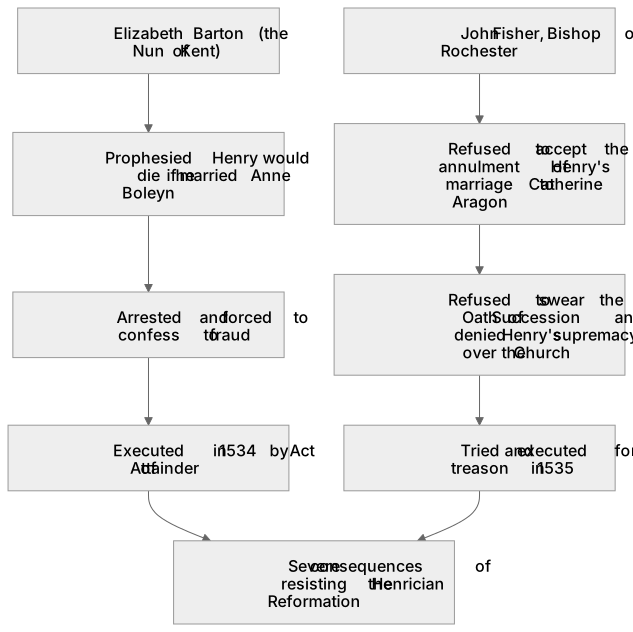
Key words
Say what each word means before you turn the card.
Opposition and resistance
Try answering aloud or in your head before turning the card.
Religion and the Church
Try answering aloud or in your head before turning the card.
Punishment and control
Try answering aloud or in your head before turning the card.
See every definition
- Opposition and resistance
- Prominent opponents of Henry VIII's religious changes included Elizabeth Barton and Bishop John Fisher, whose resistance showed the severe consequences of defying the Henrician Reformation.
- Religion and the Church
- John Fisher refused to acknowledge Henry as Supreme Head of the Church, and his refusal led to his trial and execution for treason in 1535.
- Punishment and control
- Barton was arrested, forced to confess to fraud, and executed in 1534 via an Act of Attainder, while Fisher was tried and executed for treason in 1535.
Label the diagram
Some boxes have lost their names. Pick the right name for each number.
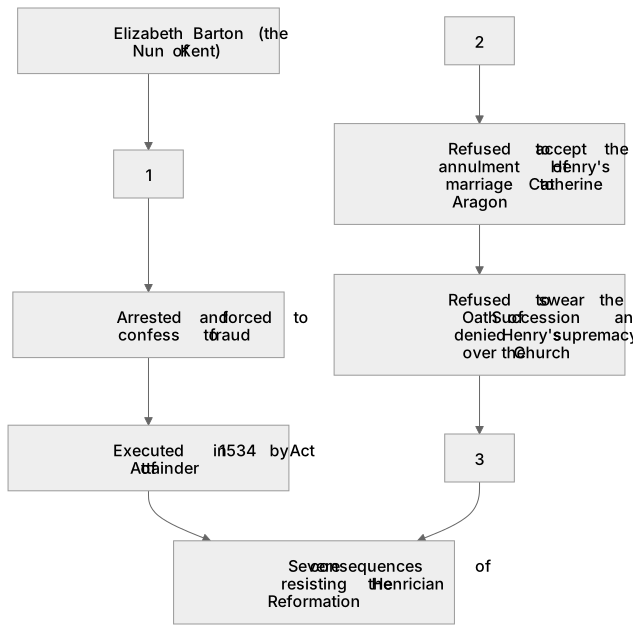
1Box 1
2Box 2
3Box 3
There is more to this lesson
The full lesson goes on to check your understanding and help you earn the marks. Create a free account to carry on, with your progress saved.
A week of Premium from your first lesson · Then the free plan continues · No card, no charge
Test your understanding of Option B3: Key topic 3: The Reformation and its impact, 1529–40 - 2 Opposition to, and impact of, Reformation, 1534–40: Elizabeth Barton (the Nun of Kent) and John Fisher.
Active recall beats re-reading. Take an instant quiz now to test what you’ve learned and lock it into long-term memory.
A week of Premium from your first lesson · Then the free plan continues · No card, no charge