Pearson Edexcel · GCSE · History
Course version: 1HI0 · Version from Sept 2016
Key topic 3: The Reformation and its impact, 1529–40 - 3 The dissolution…
Full specification wording
Option B3: Key topic 3: The Reformation and its impact, 1529–40 - 3 The dissolution of the monasteries: The impact of the dissolutions. Beneficiaries and losers.
The dissolution of the monasteries profoundly impacted English society, creating distinct beneficiaries and losers.
Checked against the Pearson Edexcel 1HI0 specification (opens in a new tab) on .
- Point 3 of 3
- 4 key terms
Study notes
From the checked teaching notes for this specification point.
The idea
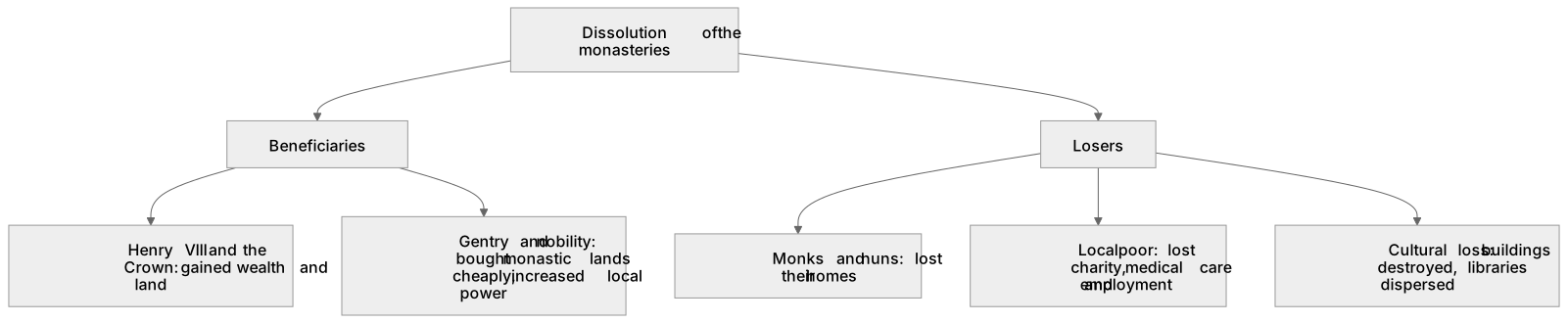
The dissolution of the monasteries profoundly impacted English society, creating distinct beneficiaries and losers. The primary beneficiary was Henry VIII, who gained vast wealth and land, though he quickly sold much to fund wars. The gentry and nobility also benefited, purchasing monastic lands cheaply, increasing their local power and tying them to the Royal Supremacy. Conversely, losers included monks and nuns who lost their homes; while some monks received pensions, nuns faced severe hardship. The local poor were major losers, deprived of charity, medical care, and employment previously provided by monasteries. Additionally, the cultural loss was immense, with magnificent buildings destroyed and irreplaceable libraries dispersed.
What earns the marks
- Identify Henry VIII and the Crown as major beneficiaries through the acquisition of wealth and property.
- Explain how the nobility and gentry benefited by purchasing land, thereby increasing their social status and wealth.
- Describe the negative impact on monks and nuns, noting the disparity in pensions and future prospects.
- Discuss the severe consequences for the local poor, who lost vital sources of charity, healthcare, and employment.
- Note the cultural and architectural destruction, including the ruin of abbey buildings and loss of manuscripts.
Common mistakes and how to put them right
Assuming all monks and nuns were left completely destitute.
Put it right: Clarify that many monks and priors received state pensions or became parish priests, whereas nuns received very little and could not marry or work in the church.
Stating that the Crown kept all the monastic land.
Put it right: Explain that Henry sold off a large portion of the land relatively quickly to fund his military campaigns.
Ignoring the cultural impact of the dissolution.
Put it right: Include the destruction of buildings, art, and libraries as a significant negative consequence.
Exam tips
- Structure answers by clearly contrasting the groups who gained (Crown, gentry) with those who suffered (religious orders, the poor).
- Link the sale of monastic lands to the gentry to the long-term strengthening of the Tudor state, as it created a class invested in the Reformation.
- Use specific examples of lost community services to illustrate the impact on the poor.
Try the lesson
The start of the Option B3: Key topic 3: The Reformation and its impact, 1529–40 - 3 The dissolution of the monasteries: The impact of the dissolutions. Beneficiaries and losers. lesson, made from checked teaching notes for this specification point.
Have a go first
Which group of people suffered the most immediate negative impact from the dissolution of the monasteries?
Listen
The dissolution of the monasteries profoundly impacted English society, creating distinct beneficiaries and losers. The primary beneficiary was Henry VIII, who gained vast wealth and land, though he quickly sold much to fund wars. The gentry and nobility also benefited, purchasing monastic lands cheaply, increasing their local power and tying them to the Royal Supremacy. Conversely, losers included monks and nuns who lost their homes; while some monks received pensions, nuns faced severe hardship. The local poor were major losers, deprived of charity, medical care, and employment previously provided by monasteries. Additionally, the cultural loss was immense, with magnificent buildings destroyed and irreplaceable libraries dispersed. A strong answer earns marks for these points. Identify Henry VIII and the Crown as major beneficiaries through the acquisition of wealth and property. Explain how the nobility and gentry benefited by purchasing land, thereby increasing their social status and wealth. Describe the negative impact on monks and nuns, noting the disparity in pensions and future prospects. Discuss the severe consequences for the local poor, who lost vital sources of charity, healthcare, and employment. A common slip: Assuming all monks and nuns were left completely destitute. Instead, Clarify that many monks and priors received state pensions or became parish priests, whereas nuns received very little and could not marry or work in the church. Exam tip: Structure answers by clearly contrasting the groups who gained (Crown, gentry) with those who suffered (religious orders, the poor).
See it
Key words
Say what each word means before you turn the card.
Social and economic change
Try answering aloud or in your head before turning the card.
Wealth and land ownership
Try answering aloud or in your head before turning the card.
Poverty and social welfare
Try answering aloud or in your head before turning the card.
Cultural destruction
Try answering aloud or in your head before turning the card.
See every definition
- Social and economic change
- The impact of the dissolutions, which created distinct beneficiaries and losers in English society.
- Wealth and land ownership
- Henry VIII gained vast wealth and land, though he quickly sold much to fund wars, and the gentry and nobility purchased monastic lands cheaply.
- Poverty and social welfare
- The local poor were major losers, deprived of charity, medical care and employment previously provided by monasteries.
- Cultural destruction
- The cultural loss was immense, with magnificent buildings destroyed and irreplaceable libraries dispersed.
Label the diagram
Some boxes have lost their names. Pick the right name for each number.
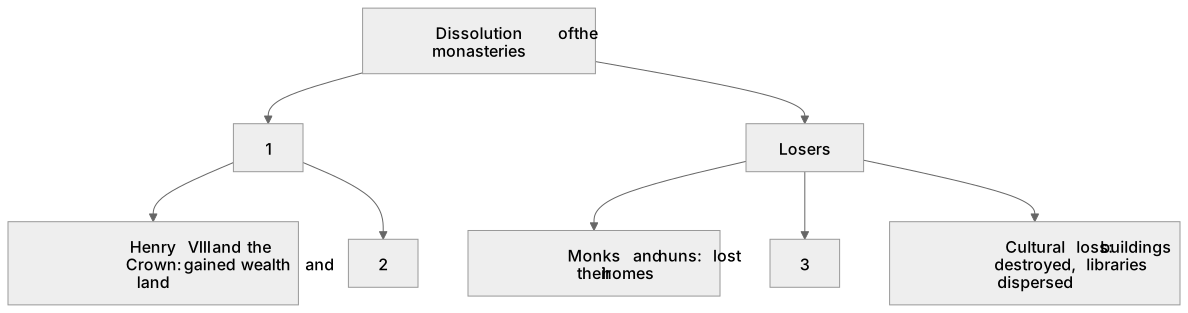
1Box 1
2Box 2
3Box 3
There is more to this lesson
The full lesson goes on to check your understanding and help you earn the marks. Create a free account to carry on, with your progress saved.
A week of Premium from your first lesson · Then the free plan continues · No card, no charge
Test your understanding of Option B3: Key topic 3: The Reformation and its impact, 1529–40 - 3 The dissolution of the monasteries: The impact of the dissolutions. Beneficiaries and losers.
Active recall beats re-reading. Take an instant quiz now to test what you’ve learned and lock it into long-term memory.
A week of Premium from your first lesson · Then the free plan continues · No card, no charge