Pearson Edexcel · GCSE · History
Course version: 1HI0 · Version from Sept 2016
Key topic 3: The Reformation and its impact, 1529–40 - 3 The dissolution…
Full specification wording
Option B3: Key topic 3: The Reformation and its impact, 1529–40 - 3 The dissolution of the monasteries: Reasons for the dissolutions, including the findings of Cromwell’s commissions of 1535.
The dissolution of the monasteries was driven by financial, political, and religious motives.
Checked against the Pearson Edexcel 1HI0 specification (opens in a new tab) on .
- Point 2 of 3
Study notes
From the checked teaching notes for this specification point.
The idea
The dissolution of the monasteries was driven by financial, political, and religious motives. Financially, Henry VIII needed wealth to fund foreign policy and coastal defences; the monasteries held immense riches. Politically, Henry sought to eliminate opposition to his Royal Supremacy, as monks owed allegiance to the Pope. Religiously, reformers like Thomas Cromwell viewed monasteries as outdated relics promoting superstitious practices. To justify closures, Cromwell launched commissions in 1535. The Valor Ecclesiasticus assessed their wealth, while a second commission investigated moral standards. This produced the Comperta Monastica, which exaggerated claims of corruption and immorality to provide a pretext for dissolution.
What earns the marks
- Explain Henry VIII's financial need to acquire monastic wealth and land for defence and patronage.
- Discuss the political motive of removing institutions loyal to the Pope to secure the Royal Supremacy.
- Identify the religious motives of reformers who opposed monasticism and superstitious practices.
- Describe the purpose and findings of the Valor Ecclesiasticus in assessing monastic wealth.
- Explain how Cromwell's commissioners fabricated or exaggerated moral failings in the Comperta Monastica to justify closure.
Common mistakes and how to put them right
Stating that the only reason for dissolution was Henry's desire for money.
Put it right: Acknowledge the financial motive but also include political (Royal Supremacy) and religious (reformist ideas) reasons.
Accepting the findings of Cromwell's commissions as entirely factual.
Put it right: Explain that the commissions were heavily biased and designed to find evidence of corruption to justify a predetermined policy.
Confusing the Valor Ecclesiasticus with the moral visitations.
Put it right: Distinguish between the Valor (which assessed wealth) and the visitations (which investigated moral conduct).
Exam tips
- Categorise the reasons for dissolution into financial, political, and religious factors to structure your answer clearly.
- Mention Thomas Cromwell's specific role and his use of the 1535 commissions to manufacture a case against the monasteries.
- Use the term 'Royal Supremacy' when discussing the political need to remove papal influence.
Try the lesson
The start of the Option B3: Key topic 3: The Reformation and its impact, 1529–40 - 3 The dissolution of the monasteries: Reasons for the dissolutions, including the findings of Cromwell’s commissions of 1535. lesson, made from checked teaching notes for this specification point.
Have a go first
What was the primary purpose of the commissions sent out by Thomas Cromwell in 1535, known as the Valor Ecclesiasticus?
Listen
The dissolution of the monasteries was driven by financial, political, and religious motives. Financially, Henry VIII needed wealth to fund foreign policy and coastal defences; the monasteries held immense riches. Politically, Henry sought to eliminate opposition to his Royal Supremacy, as monks owed allegiance to the Pope. Religiously, reformers like Thomas Cromwell viewed monasteries as outdated relics promoting superstitious practices. To justify closures, Cromwell launched commissions in 1535. The Valor Ecclesiasticus assessed their wealth, while a second commission investigated moral standards. This produced the Comperta Monastica, which exaggerated claims of corruption and immorality to provide a pretext for dissolution. A strong answer earns marks for these points. Explain Henry VIII's financial need to acquire monastic wealth and land for defence and patronage. Discuss the political motive of removing institutions loyal to the Pope to secure the Royal Supremacy. Identify the religious motives of reformers who opposed monasticism and superstitious practices. Describe the purpose and findings of the Valor Ecclesiasticus in assessing monastic wealth. A common slip: Stating that the only reason for dissolution was Henry's desire for money. Instead, Acknowledge the financial motive but also include political (Royal Supremacy) and religious (reformist ideas) reasons. Exam tip: Categorise the reasons for dissolution into financial, political, and religious factors to structure your answer clearly.
See it
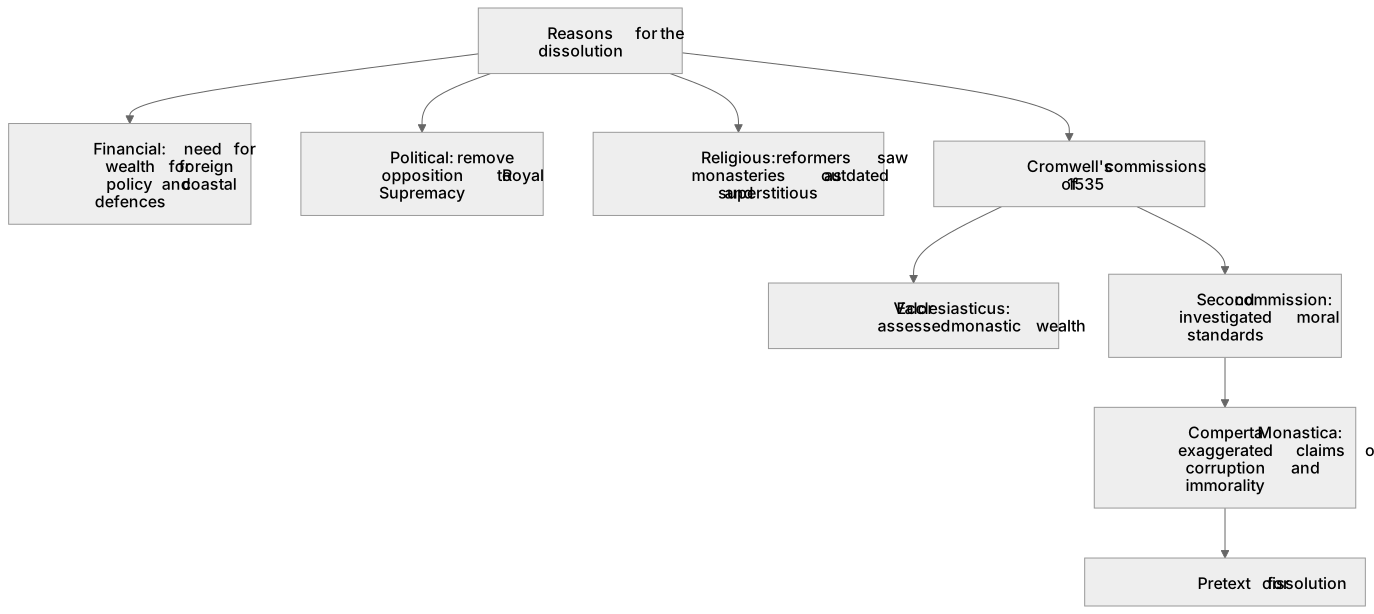
Label the diagram
Some boxes have lost their names. Pick the right name for each number.
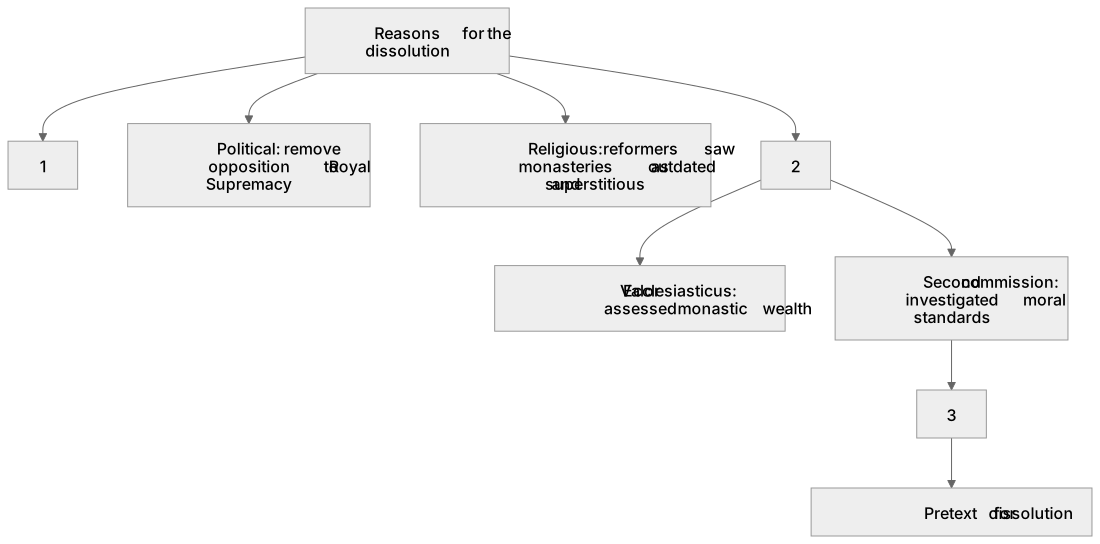
1Box 1
2Box 2
3Box 3
There is more to this lesson
The full lesson goes on to check your understanding and help you earn the marks. Create a free account to carry on, with your progress saved.
A week of Premium from your first lesson · Then the free plan continues · No card, no charge
Test your understanding of Option B3: Key topic 3: The Reformation and its impact, 1529–40 - 3 The dissolution of the monasteries: Reasons for the dissolutions, including the findings of Cromwell’s commissions of 1535.
Active recall beats re-reading. Take an instant quiz now to test what you’ve learned and lock it into long-term memory.
A week of Premium from your first lesson · Then the free plan continues · No card, no charge