Pearson Edexcel · GCSE · History
Course version: 1HI0 · Version from Sept 2016
Key topic 3: The Reformation and its impact, 1529–40 - 3 The dissolution…
Full specification wording
Option B3: Key topic 3: The Reformation and its impact, 1529–40 - 3 The dissolution of the monasteries: The role of religious houses in local communities.
Religious houses, including monasteries, nunneries, and friaries, were central to local communities in early Tudor England.
Checked against the Pearson Edexcel 1HI0 specification (opens in a new tab) on .
- Point 1 of 3
- 4 key terms
Study notes
From the checked teaching notes for this specification point.
The idea
Religious houses, including monasteries, nunneries, and friaries, were central to local communities in early Tudor England. They provided essential social services, acting as hospitals for the sick, almshouses for the elderly and destitute, and orphanages. Monasteries were significant local employers and landlords, managing vast agricultural estates and providing work for labourers and craftsmen. They also served as educational centres, offering schooling for local children and preserving knowledge through libraries. Furthermore, they offered hospitality to travellers and pilgrims, acting as safe havens. Spiritually, monks and nuns prayed for the souls of the dead (chantries), which was a vital comfort to the community.
What earns the marks
- Identify the social welfare functions of religious houses, such as providing medical care and alms to the poor.
- Explain their economic importance as major landowners, employers, and purchasers of local goods.
- Describe their role in education and preserving manuscripts.
- Discuss their spiritual role, including praying for the souls of the dead to reduce time in purgatory.
- Recognise their function as providers of hospitality for travellers and pilgrims.
Common mistakes and how to put them right
Believing monasteries only served a religious function.
Put it right: Emphasise their crucial social and economic roles, such as providing healthcare, charity, and employment.
Assuming all religious houses were wealthy and corrupt.
Put it right: Note that while some were wealthy, many smaller houses struggled financially but still provided vital local services.
Confusing the roles of monks and parish priests.
Put it right: Clarify that monks lived in enclosed communities focused on prayer and charity, whereas parish priests ministered directly to the local congregation's daily spiritual needs.
Exam tips
- Use specific examples of the services provided, such as alms-giving or medical care, to support points about their community importance.
- When evaluating the impact of the dissolution, contrast the community before and after the loss of these specific services.
- Link the economic role of monasteries as landlords to the social stability of the local area.
Try the lesson
The start of the Option B3: Key topic 3: The Reformation and its impact, 1529–40 - 3 The dissolution of the monasteries: The role of religious houses in local communities. lesson, made from checked teaching notes for this specification point.
Have a go first
Which of the following was a key social function provided by monasteries in local communities before their dissolution?
Listen
Religious houses, including monasteries, nunneries, and friaries, were central to local communities in early Tudor England. They provided essential social services, acting as hospitals for the sick, almshouses for the elderly and destitute, and orphanages. Monasteries were significant local employers and landlords, managing vast agricultural estates and providing work for labourers and craftsmen. They also served as educational centres, offering schooling for local children and preserving knowledge through libraries. Furthermore, they offered hospitality to travellers and pilgrims, acting as safe havens. Spiritually, monks and nuns prayed for the souls of the dead (chantries), which was a vital comfort to the community. A strong answer earns marks for these points. Identify the social welfare functions of religious houses, such as providing medical care and alms to the poor. Explain their economic importance as major landowners, employers, and purchasers of local goods. Describe their role in education and preserving manuscripts. Discuss their spiritual role, including praying for the souls of the dead to reduce time in purgatory. A common slip: Believing monasteries only served a religious function. Instead, Emphasise their crucial social and economic roles, such as providing healthcare, charity, and employment. Exam tip: Use specific examples of the services provided, such as alms-giving or medical care, to support points about their community importance.
See it

Key words
Say what each word means before you turn the card.
Social welfare and charity
Try answering aloud or in your head before turning the card.
Economic power and land ownership
Try answering aloud or in your head before turning the card.
Religion and spiritual life
Try answering aloud or in your head before turning the card.
Education and literacy
Try answering aloud or in your head before turning the card.
See every definition
- Social welfare and charity
- Religious houses acted as hospitals for the sick, almshouses for the elderly and destitute, and orphanages.
- Economic power and land ownership
- Monasteries were significant local employers and landlords, managing vast agricultural estates and providing work for labourers and craftsmen.
- Religion and spiritual life
- Monks and nuns prayed for the souls of the dead, which was a vital comfort to the community.
- Education and literacy
- Religious houses served as educational centres, offering schooling for local children and preserving knowledge through libraries.
Label the diagram
Some boxes have lost their names. Pick the right name for each number.
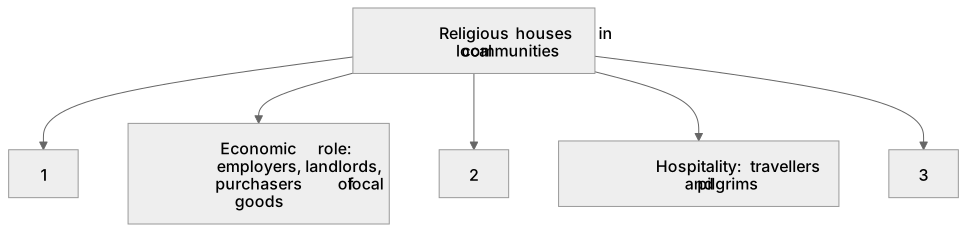
1Box 1
2Box 2
3Box 3
There is more to this lesson
The full lesson goes on to check your understanding and help you earn the marks. Create a free account to carry on, with your progress saved.
A week of Premium from your first lesson · Then the free plan continues · No card, no charge
Test your understanding of Option B3: Key topic 3: The Reformation and its impact, 1529–40 - 3 The dissolution of the monasteries: The role of religious houses in local communities.
Active recall beats re-reading. Take an instant quiz now to test what you’ve learned and lock it into long-term memory.
A week of Premium from your first lesson · Then the free plan continues · No card, no charge