Pearson Edexcel · GCSE · History
Course version: 1HI0 · Version from Sept 2016
Key topic 3: The Reformation and its impact, 1529–40 - 4 The Pilgrimage of…
Full specification wording
Option B3: Key topic 3: The Reformation and its impact, 1529–40 - 4 The Pilgrimage of Grace, 1536: Reasons for the uprising.
The Pilgrimage of Grace (1536) was a northern uprising driven by religious, economic, and political reasons.
Checked against the Pearson Edexcel 1HI0 specification (opens in a new tab) on .
- Point 1 of 2
Study notes
From the checked teaching notes for this specification point.
The idea
The Pilgrimage of Grace (1536) was a northern uprising driven by religious, economic, and political reasons. Religiously, rebels were angered by the dissolution of smaller monasteries, which provided vital services, and feared attacks on Catholic practices following the Ten Articles. Economically, the North suffered from poor harvests and resentment towards taxes like the 1534 Subsidy Act. Politically, northern nobles felt excluded from court by low-born advisors like Thomas Cromwell, whom they blamed for royal policies. The rebels' demands, articulated in the Pontefract Articles, highlighted this blend of motives, demanding the restoration of monasteries, the removal of Cromwell, and the legitimisation of Princess Mary.
What earns the marks
- Explain the religious grievances, particularly the anger over the dissolution of the smaller monasteries and the defence of Catholicism.
- Discuss the economic factors, including resentment of the 1534 Subsidy Act, poor harvests, and opposition to enclosure.
- Identify the political motives, such as the northern nobility's desire to remove Thomas Cromwell and restore their influence at court.
- Describe the social importance of the monasteries in the North and how their loss provoked rebellion.
- Reference the Pontefract Articles as evidence of the rebels' multifaceted demands.
Common mistakes and how to put them right
Viewing the Pilgrimage of Grace as solely a religious rebellion.
Put it right: Emphasise that while religion was the primary catalyst, economic hardship and political factionalism were also crucial factors.
Blaming Henry VIII directly for the rebels' grievances.
Put it right: Note that the rebels claimed to be loyal to the King, blaming his 'evil councillors' like Thomas Cromwell for the unpopular policies.
Confusing the Pilgrimage of Grace with the earlier Lincolnshire Rising.
Put it right: Ensure you focus on the Yorkshire-based Pilgrimage led by Robert Aske, though acknowledging it was sparked by the Lincolnshire events is valid.
Exam tips
- Use the Pontefract Articles to provide specific evidence of the rebels' religious, economic, and political demands.
- Emphasise the role of Thomas Cromwell as the primary target of the rebels' political anger.
- When explaining the causes, show how the different factors (e.g., religious changes and economic taxes) combined to create widespread discontent in the North.
Try the lesson
The start of the Option B3: Key topic 3: The Reformation and its impact, 1529–40 - 4 The Pilgrimage of Grace, 1536: Reasons for the uprising. lesson, made from checked teaching notes for this specification point.
Have a go first
Which of the following was a primary religious grievance that sparked the Pilgrimage of Grace in 1536?
Listen
The Pilgrimage of Grace (1536) was a northern uprising driven by religious, economic, and political reasons. Religiously, rebels were angered by the dissolution of smaller monasteries, which provided vital services, and feared attacks on Catholic practices following the Ten Articles. Economically, the North suffered from poor harvests and resentment towards taxes like the 1534 Subsidy Act. Politically, northern nobles felt excluded from court by low-born advisors like Thomas Cromwell, whom they blamed for royal policies. The rebels' demands, articulated in the Pontefract Articles, highlighted this blend of motives, demanding the restoration of monasteries, the removal of Cromwell, and the legitimisation of Princess Mary. A strong answer earns marks for these points. Explain the religious grievances, particularly the anger over the dissolution of the smaller monasteries and the defence of Catholicism. Discuss the economic factors, including resentment of the 1534 Subsidy Act, poor harvests, and opposition to enclosure. Identify the political motives, such as the northern nobility's desire to remove Thomas Cromwell and restore their influence at court. Describe the social importance of the monasteries in the North and how their loss provoked rebellion. A common slip: Viewing the Pilgrimage of Grace as solely a religious rebellion. Instead, Emphasise that while religion was the primary catalyst, economic hardship and political factionalism were also crucial factors. Exam tip: Use the Pontefract Articles to provide specific evidence of the rebels' religious, economic, and political demands.
See it

Label the diagram
Some boxes have lost their names. Pick the right name for each number.
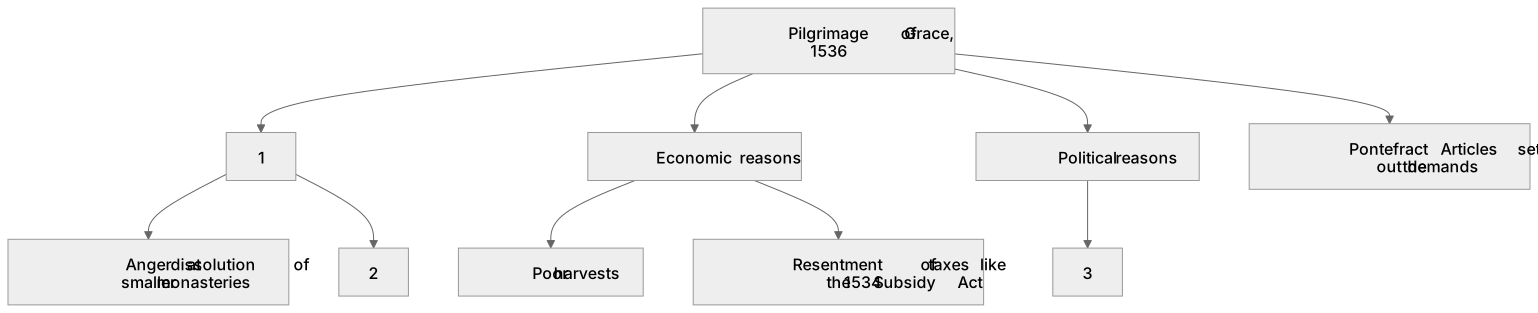
1Box 1
2Box 2
3Box 3
There is more to this lesson
The full lesson goes on to check your understanding and help you earn the marks. Create a free account to carry on, with your progress saved.
A week of Premium from your first lesson · Then the free plan continues · No card, no charge
Test your understanding of Option B3: Key topic 3: The Reformation and its impact, 1529–40 - 4 The Pilgrimage of Grace, 1536: Reasons for the uprising.
Active recall beats re-reading. Take an instant quiz now to test what you’ve learned and lock it into long-term memory.
A week of Premium from your first lesson · Then the free plan continues · No card, no charge