Pearson Edexcel · GCSE · History
Course version: 1HI0 · Version from Sept 2016
Key topic 1: Queen, government and religion, 1558–69 - 1 The situation on…
Full specification wording
Option B4: Key topic 1: Queen, government and religion, 1558–69 - 1 The situation on Elizabeth’s accession: Elizabethan England in 1558: society and government.
In 1558, Elizabethan society was strictly hierarchical, structured around the Great Chain of Being.
Checked against the Pearson Edexcel 1HI0 specification (opens in a new tab) on .
- Point 1 of 3
- 4 key terms
Study notes
From the checked teaching notes for this specification point.
The idea
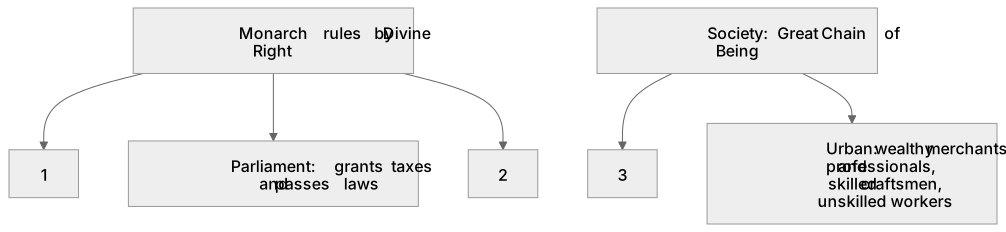
In 1558, Elizabethan society was strictly hierarchical, structured around the Great Chain of Being. In the countryside, the social ladder ranged from the nobility and gentry down to yeomen, tenant farmers, and landless labourers. Urban society was similarly stratified, dominated by wealthy merchants and professionals, followed by skilled craftsmen and unskilled workers. Government was highly centralised around the monarch, who ruled by Divine Right. Elizabeth relied on her Privy Council for daily administration and policy advice, while Parliament was called primarily to grant taxes and pass laws. At the local level, Justices of the Peace (JPs) were crucial unpaid officials who enforced the law, collected taxes, and maintained order, ensuring the Queen's authority reached across the realm.
What earns the marks
- Describe the hierarchical nature of Elizabethan society, distinguishing between rural (nobility, gentry, yeomen) and urban (merchants, craftsmen) structures.
- Explain the concept of the Great Chain of Being and how it justified the rigid social order and obedience to the monarch.
- Outline the role of the Privy Council in advising the Queen and managing the daily administration of the country.
- Detail the function of Justices of the Peace (JPs) in maintaining local law and order on behalf of the central government.
Common mistakes and how to put them right
Stating that Parliament held the most power.
Put it right: Parliament was only called by the Queen and its main role was granting taxation, not governing.
Assuming social mobility was common.
Put it right: Society was highly rigid, and people were expected to remain in the social class they were born into.
Confusing the roles of the Privy Council and Parliament.
Put it right: The Privy Council advised on daily policy, whereas Parliament passed legislation and approved taxes.
Exam tips
- Memorise the specific roles of the Privy Council, Parliament, and JPs to accurately describe the structure of Elizabethan government.
- Use the term 'hierarchy' when discussing society to demonstrate an understanding of the rigid class structure.
- Link the role of JPs to the lack of a standing police force, highlighting their importance in maintaining local control.
Try the lesson
The start of the Option B4: Key topic 1: Queen, government and religion, 1558–69 - 1 The situation on Elizabeth’s accession: Elizabethan England in 1558: society and government. lesson, made from checked teaching notes for this specification point.
Have a go first
Which institution was responsible for advising Queen Elizabeth I on a daily basis and helping to administer the realm in 1558?
Listen
In 1558, Elizabethan society was strictly hierarchical, structured around the Great Chain of Being. In the countryside, the social ladder ranged from the nobility and gentry down to yeomen, tenant farmers, and landless labourers. Urban society was similarly stratified, dominated by wealthy merchants and professionals, followed by skilled craftsmen and unskilled workers. Government was highly centralised around the monarch, who ruled by Divine Right. Elizabeth relied on her Privy Council for daily administration and policy advice, while Parliament was called primarily to grant taxes and pass laws. At the local level, Justices of the Peace (JPs) were crucial unpaid officials who enforced the law, collected taxes, and maintained order, ensuring the Queen's authority reached across the realm. A strong answer earns marks for these points. Describe the hierarchical nature of Elizabethan society, distinguishing between rural (nobility, gentry, yeomen) and urban (merchants, craftsmen) structures. Explain the concept of the Great Chain of Being and how it justified the rigid social order and obedience to the monarch. Outline the role of the Privy Council in advising the Queen and managing the daily administration of the country. Detail the function of Justices of the Peace (JPs) in maintaining local law and order on behalf of the central government. Exam tip: Memorise the specific roles of the Privy Council, Parliament, and JPs to accurately describe the structure of Elizabethan government.
See it

Key words
Say what each word means before you turn the card.
Hierarchy and order
Try answering aloud or in your head before turning the card.
Royal authority
Try answering aloud or in your head before turning the card.
Local government
Try answering aloud or in your head before turning the card.
Privy Council
Try answering aloud or in your head before turning the card.
See every definition
- Hierarchy and order
- Elizabethan society was strictly hierarchical, structured around the Great Chain of Being, and people were expected to remain in the social class they were born into.
- Royal authority
- Government was highly centralised around the monarch, who ruled by Divine Right, and the Queen's authority reached across the realm.
- Local government
- Justices of the Peace were crucial unpaid officials who enforced the law, collected taxes, and maintained order at the local level.
- Privy Council
- Elizabeth relied on it for daily administration and policy advice, advising on daily policy.
Label the diagram
Some boxes have lost their names. Pick the right name for each number.
1Box 1
2Box 2
3Box 3
There is more to this lesson
The full lesson goes on to check your understanding and help you earn the marks. Create a free account to carry on, with your progress saved.
A week of Premium from your first lesson · Then the free plan continues · No card, no charge
Test your understanding of Option B4: Key topic 1: Queen, government and religion, 1558–69 - 1 The situation on Elizabeth’s accession: Elizabethan England in 1558: society and government.
Active recall beats re-reading. Take an instant quiz now to test what you’ve learned and lock it into long-term memory.
A week of Premium from your first lesson · Then the free plan continues · No card, no charge