Pearson Edexcel · GCSE · History
Course version: 1HI0 · Version from Sept 2016
Key topic 1: Queen, government and religion, 1558–69 - 4 The problem of…
Full specification wording
Option B4: Key topic 1: Queen, government and religion, 1558–69 - 4 The problem of Mary, Queen of Scots: Mary, Queen of Scots: her claim to the English throne.
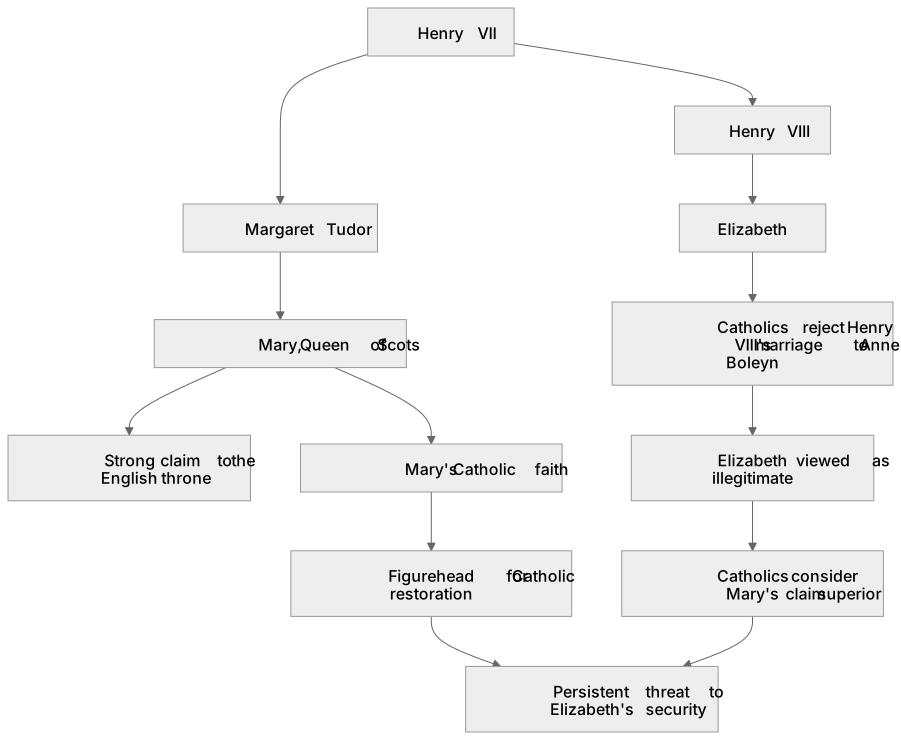
Mary, Queen of Scots, held a strong claim to the English throne as Henry VII's great-granddaughter.
Checked against the Pearson Edexcel 1HI0 specification (opens in a new tab) on .
- Point 1 of 2
- 4 key terms
Study notes
From the checked teaching notes for this specification point.
The idea
Mary, Queen of Scots, held a strong claim to the English throne as Henry VII's great-granddaughter. Many English Catholics considered Mary's claim superior to Elizabeth's, viewing Elizabeth as illegitimate because they rejected Henry VIII's marriage to Anne Boleyn. Mary's Catholic faith made her a natural figurehead for those desiring a Catholic restoration. Her status as Scottish monarch made her a powerful alternative. This legitimate, Catholic heir presumptive posed a persistent threat to Elizabeth's security. Because Elizabeth remained unmarried and childless, the unresolved succession encouraged Catholic plots centred around Mary's royal lineage, forcing Elizabeth to constantly defend her own legitimacy and throne.
What earns the marks
- Identify Mary's descent from Henry VII as the genealogical basis of her claim to the English throne.
- Explain the Catholic view of Elizabeth's illegitimacy regarding Henry VIII's marriage to Anne Boleyn.
- Link Mary's staunch Catholicism to her appeal among English Catholics seeking a religious restoration.
- Discuss the persistent threat posed by Elizabeth's lack of a direct heir and the unresolved succession.
Common mistakes and how to put them right
Stating Mary was Elizabeth's sister (Correction.
Put it right: Mary was Elizabeth's cousin, descended from Henry VIII's sister Margaret Tudor).
Claiming Mary wanted to invade England immediately upon Elizabeth's accession (Correction.
Put it right: Mary initially wanted Elizabeth to name her as heir, rather than actively seeking to depose her by force).
Confusing Mary, Queen of Scots with Mary I of England (Correction.
Put it right: Mary I was Elizabeth's half-sister who ruled before her; Mary, Queen of Scots was her cousin and a separate monarch).
Exam tips
- Use the term 'illegitimate' when explaining why many Catholics preferred Mary's claim over Elizabeth's.
- Connect Mary's dynastic claim directly to the religious divisions and tensions within England.
- Remember to mention Henry VII when tracing Mary's royal lineage to demonstrate precise historical knowledge.
Try the lesson
The start of the Option B4: Key topic 1: Queen, government and religion, 1558–69 - 4 The problem of Mary, Queen of Scots: Mary, Queen of Scots: her claim to the English throne. lesson, made from checked teaching notes for this specification point.
Have a go first
Through which English monarch did Mary, Queen of Scots, derive her direct hereditary claim to the English throne?
Listen
Mary, Queen of Scots, held a strong claim to the English throne as Henry VII's great-granddaughter. Many English Catholics considered Mary's claim superior to Elizabeth's, viewing Elizabeth as illegitimate because they rejected Henry VIII's marriage to Anne Boleyn. Mary's Catholic faith made her a natural figurehead for those desiring a Catholic restoration. Her status as Scottish monarch made her a powerful alternative. This legitimate, Catholic heir presumptive posed a persistent threat to Elizabeth's security. Because Elizabeth remained unmarried and childless, the unresolved succession encouraged Catholic plots centred around Mary's royal lineage, forcing Elizabeth to constantly defend her own legitimacy and throne. A strong answer earns marks for these points. Identify Mary's descent from Henry VII as the genealogical basis of her claim to the English throne. Explain the Catholic view of Elizabeth's illegitimacy regarding Henry VIII's marriage to Anne Boleyn. Link Mary's staunch Catholicism to her appeal among English Catholics seeking a religious restoration. Discuss the persistent threat posed by Elizabeth's lack of a direct heir and the unresolved succession. Exam tip: Use the term 'illegitimate' when explaining why many Catholics preferred Mary's claim over Elizabeth's.
See it
Key words
Say what each word means before you turn the card.
Legitimacy and succession
Try answering aloud or in your head before turning the card.
Religious conflict
Try answering aloud or in your head before turning the card.
Monarchy and power
Try answering aloud or in your head before turning the card.
Foreign relations
Try answering aloud or in your head before turning the card.
See every definition
- Legitimacy and succession
- The note links Mary's strong claim as Henry VII's great-granddaughter to the unresolved succession, since Elizabeth remained unmarried and childless.
- Religious conflict
- Mary's Catholic faith made her a natural figurehead for those desiring a Catholic restoration, while English Catholics rejected Elizabeth's legitimacy.
- Monarchy and power
- Mary's status as Scottish monarch made her a powerful alternative, and her royal lineage encouraged Catholic plots against Elizabeth's security.
- Foreign relations
- Mary was a separate Scottish monarch whose claim to the English throne made her a powerful alternative to Elizabeth.
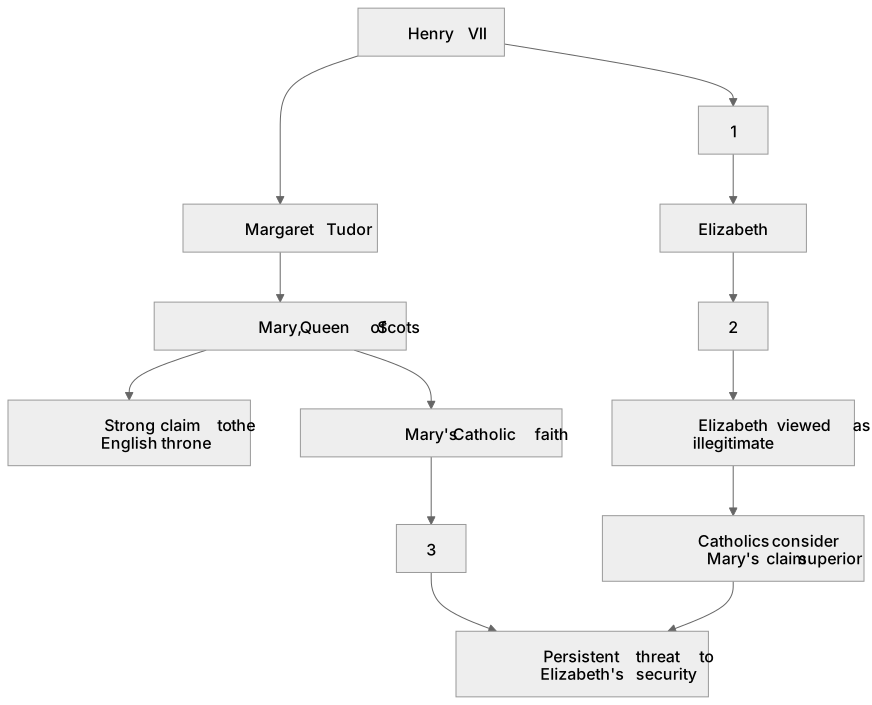
Label the diagram
Some boxes have lost their names. Pick the right name for each number.
1Box 1
2Box 2
3Box 3
There is more to this lesson
The full lesson goes on to check your understanding and help you earn the marks. Create a free account to carry on, with your progress saved.
A week of Premium from your first lesson · Then the free plan continues · No card, no charge
Test your understanding of Option B4: Key topic 1: Queen, government and religion, 1558–69 - 4 The problem of Mary, Queen of Scots: Mary, Queen of Scots: her claim to the English throne.
Active recall beats re-reading. Take an instant quiz now to test what you’ve learned and lock it into long-term memory.
A week of Premium from your first lesson · Then the free plan continues · No card, no charge