Pearson Edexcel · GCSE · History
Course version: 1HI0 · Version from Sept 2016
Key topic 1: Queen, government and religion, 1558–69 - 4 The problem of…
Full specification wording
Option B4: Key topic 1: Queen, government and religion, 1558–69 - 4 The problem of Mary, Queen of Scots: Relations between Elizabeth and Mary, 1568–69.
Relations between Elizabeth and Mary deteriorated sharply between 1568 and 1569 following Mary's flight to England.
Checked against the Pearson Edexcel 1HI0 specification (opens in a new tab) on .
- Point 2 of 2
- 4 key terms
Study notes
From the checked teaching notes for this specification point.
The idea
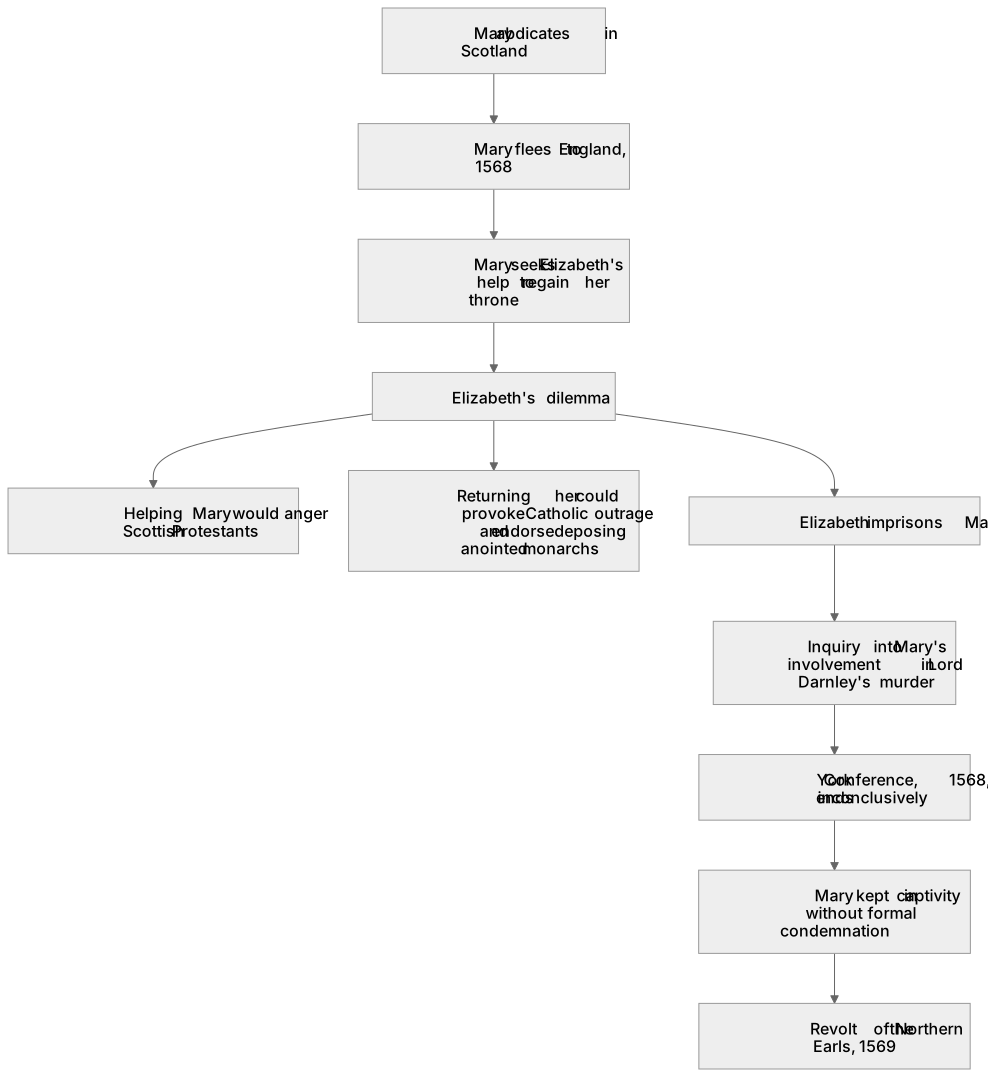
Relations between Elizabeth and Mary deteriorated sharply between 1568 and 1569 following Mary's flight to England. After abdicating in Scotland, Mary sought Elizabeth's help to regain her throne. Elizabeth faced a dilemma: helping Mary would anger Scottish Protestants, but returning her could provoke Catholic outrage and endorse deposing anointed monarchs. Instead, Elizabeth imprisoned Mary, initiating an inquiry into Mary's involvement in Lord Darnley's murder. The York Conference (1568) ended inconclusively, allowing Elizabeth to keep Mary in captivity without formally condemning her. This strained their relationship, transforming Mary from a fellow monarch seeking refuge into a captive threat, which directly catalysed the Revolt of the Northern Earls in 1569.
What earns the marks
- Explain Mary's arrival in England in 1568 seeking military and diplomatic assistance.
- Analyse Elizabeth's dilemma regarding Mary's presence and the dangerous precedent of deposing anointed monarchs.
- Describe the purpose and inconclusive outcome of the York Conference in 1568.
- Evaluate how Mary's imprisonment shifted her status from a royal guest to a focal point for Catholic rebellion.
Common mistakes and how to put them right
Stating Elizabeth immediately wanted to execute Mary in 1568 (Correction.
Put it right: Elizabeth was highly reluctant to execute an anointed monarch and initially sought a diplomatic compromise).
Claiming the York Conference found Mary guilty of murder (Correction.
Put it right: The conference reached no verdict, which perfectly suited Elizabeth's strategy of keeping Mary detained indefinitely).
Believing Mary led an invading army into England (Correction.
Put it right: Mary fled to England as a refugee after losing a battle against Scottish rebel lords).
Exam tips
- Focus on the concept of the 'anointed monarch' to explain Elizabeth's deep reluctance to punish or execute Mary.
- Use the York Conference as a specific example of Elizabeth's political delaying tactics.
- Link Mary's arrival in 1568 directly to the outbreak of the Northern Revolt in 1569 to show chronological understanding.
Try the lesson
The start of the Option B4: Key topic 1: Queen, government and religion, 1558–69 - 4 The problem of Mary, Queen of Scots: Relations between Elizabeth and Mary, 1568–69. lesson, made from checked teaching notes for this specification point.
Have a go first
What event prompted Mary, Queen of Scots, to flee to England and seek Elizabeth I's protection in 1568?
Listen
Relations between Elizabeth and Mary deteriorated sharply between 1568 and 1569 following Mary's flight to England. After abdicating in Scotland, Mary sought Elizabeth's help to regain her throne. Elizabeth faced a dilemma: helping Mary would anger Scottish Protestants, but returning her could provoke Catholic outrage and endorse deposing anointed monarchs. Instead, Elizabeth imprisoned Mary, initiating an inquiry into Mary's involvement in Lord Darnley's murder. The York Conference (1568) ended inconclusively, allowing Elizabeth to keep Mary in captivity without formally condemning her. This strained their relationship, transforming Mary from a fellow monarch seeking refuge into a captive threat, which directly catalysed the Revolt of the Northern Earls in 1569. A strong answer earns marks for these points. Explain Mary's arrival in England in 1568 seeking military and diplomatic assistance. Analyse Elizabeth's dilemma regarding Mary's presence and the dangerous precedent of deposing anointed monarchs. Describe the purpose and inconclusive outcome of the York Conference in 1568. Evaluate how Mary's imprisonment shifted her status from a royal guest to a focal point for Catholic rebellion. Exam tip: Focus on the concept of the 'anointed monarch' to explain Elizabeth's deep reluctance to punish or execute Mary.
See it
Key words
Say what each word means before you turn the card.
Diplomacy and statecraft
Try answering aloud or in your head before turning the card.
Imprisonment and captivity
Try answering aloud or in your head before turning the card.
Religious tension
Try answering aloud or in your head before turning the card.
Royal authority
Try answering aloud or in your head before turning the card.
See every definition
- Diplomacy and statecraft
- Elizabeth's handling of Mary's arrival involved seeking a diplomatic compromise rather than punishing or executing an anointed monarch.
- Imprisonment and captivity
- Elizabeth imprisoned Mary and kept her in captivity without formally condemning her, transforming her from a fellow monarch seeking refuge into a captive threat.
- Religious tension
- Helping Mary would anger Scottish Protestants, but returning her could provoke Catholic outrage, and her imprisonment made her a focal point for Catholic rebellion.
- Royal authority
- Elizabeth was highly reluctant to execute an anointed monarch and feared endorsing the deposing of anointed monarchs.
Label the diagram
Some boxes have lost their names. Pick the right name for each number.
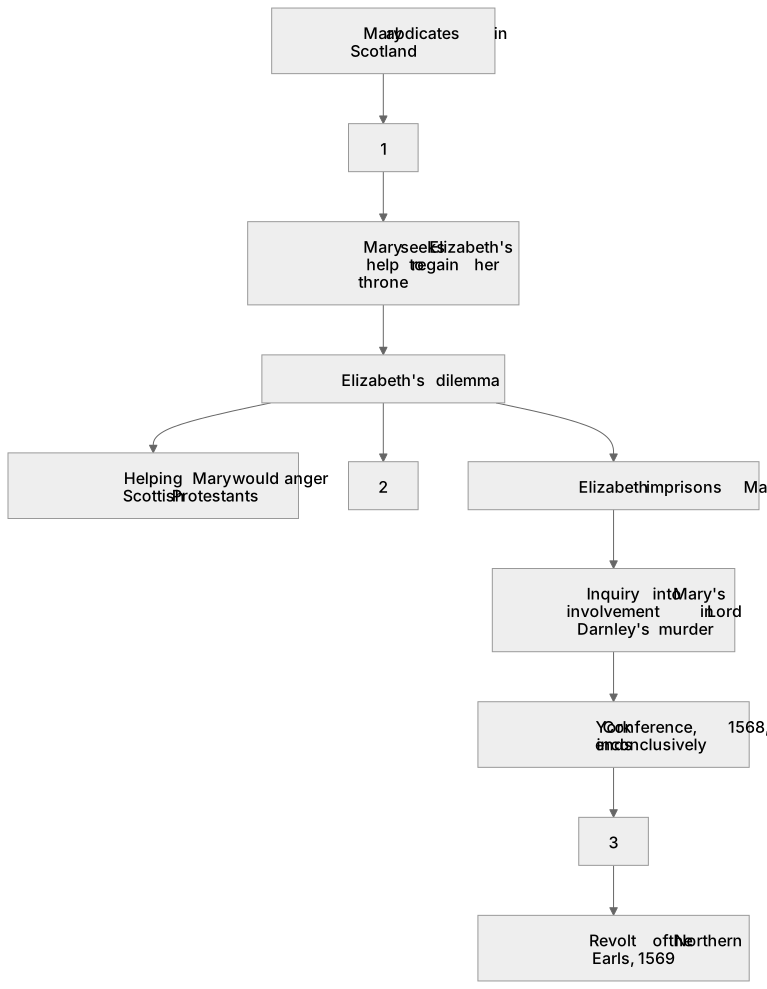
1Box 1
2Box 2
3Box 3
There is more to this lesson
The full lesson goes on to check your understanding and help you earn the marks. Create a free account to carry on, with your progress saved.
A week of Premium from your first lesson · Then the free plan continues · No card, no charge
Test your understanding of Option B4: Key topic 1: Queen, government and religion, 1558–69 - 4 The problem of Mary, Queen of Scots: Relations between Elizabeth and Mary, 1568–69.
Active recall beats re-reading. Take an instant quiz now to test what you’ve learned and lock it into long-term memory.
A week of Premium from your first lesson · Then the free plan continues · No card, no charge