Pearson Edexcel · GCSE · History
Course version: 1HI0 · Version from Sept 2016
Key topic 3: Elizabethan society in the Age of Exploration, 1558–88 - 1…
Full specification wording
Option B4: Key topic 3: Elizabethan society in the Age of Exploration, 1558–88 - 1 Education and leisure: Education in the home and schools.
Elizabethan education was highly stratified by class and gender, reflecting the era's social hierarchy.
Checked against the Pearson Edexcel 1HI0 specification (opens in a new tab) on .
- Point 1 of 2
Study notes
From the checked teaching notes for this specification point.
The idea
Elizabethan education was highly stratified by class and gender, reflecting the era's social hierarchy. For the wealthy, education often began in the home with private tutors teaching classical subjects, languages, and etiquette. Boys from the middling sorts, such as merchants, increasingly attended grammar schools, which focused heavily on Latin, Greek, and classical literature to prepare them for university. Petty schools provided basic literacy and numeracy for younger children, while dame schools offered rudimentary education for some girls. However, the vast majority of the population, particularly the labouring poor, received no formal schooling, instead learning practical agricultural or domestic skills at home to support the family.
What earns the marks
- Differentiate between the types of education available to different social classes, such as private tutors for the nobility and grammar schools for the middling sorts.
- Explain the curriculum of grammar schools, emphasising the focus on Latin, classical literature, and preparation for university.
- Describe the role of petty schools and dame schools in providing basic literacy and numeracy.
- Recognise that the majority of the lower classes received no formal education, learning practical skills at home instead.
Common mistakes and how to put them right
Assuming education was compulsory or universal.
Put it right: Education was a privilege for the wealthy and middling sorts; most children worked from a young age.
Stating girls had the same educational opportunities as boys.
Put it right: Girls were largely excluded from grammar schools and universities, receiving domestic education at home or in dame schools.
Confusing petty schools with grammar schools.
Put it right: Petty schools taught basic reading and writing to young children, whereas grammar schools taught advanced classical subjects to older boys.
Exam tips
- Emphasise how education reinforced the Elizabethan social hierarchy and gender roles.
- Use specific terms like 'petty school', 'grammar school', and 'dame school' to demonstrate precise knowledge.
- Contrast the humanist educational ideals of the elite with the practical, home-based learning of the labouring poor.
Try the lesson
The start of the Option B4: Key topic 3: Elizabethan society in the Age of Exploration, 1558–88 - 1 Education and leisure: Education in the home and schools. lesson, made from checked teaching notes for this specification point.
Have a go first
In Elizabethan England, what was the primary focus of education for girls from wealthy families?
Listen
Elizabethan education was highly stratified by class and gender, reflecting the era's social hierarchy. For the wealthy, education often began in the home with private tutors teaching classical subjects, languages, and etiquette. Boys from the middling sorts, such as merchants, increasingly attended grammar schools, which focused heavily on Latin, Greek, and classical literature to prepare them for university. Petty schools provided basic literacy and numeracy for younger children, while dame schools offered rudimentary education for some girls. However, the vast majority of the population, particularly the labouring poor, received no formal schooling, instead learning practical agricultural or domestic skills at home to support the family. A strong answer earns marks for these points. Differentiate between the types of education available to different social classes, such as private tutors for the nobility and grammar schools for the middling sorts. Explain the curriculum of grammar schools, emphasising the focus on Latin, classical literature, and preparation for university. Describe the role of petty schools and dame schools in providing basic literacy and numeracy. Recognise that the majority of the lower classes received no formal education, learning practical skills at home instead. A common slip: Assuming education was compulsory or universal. Instead, Education was a privilege for the wealthy and middling sorts; most children worked from a young age. Exam tip: Emphasise how education reinforced the Elizabethan social hierarchy and gender roles.
See it
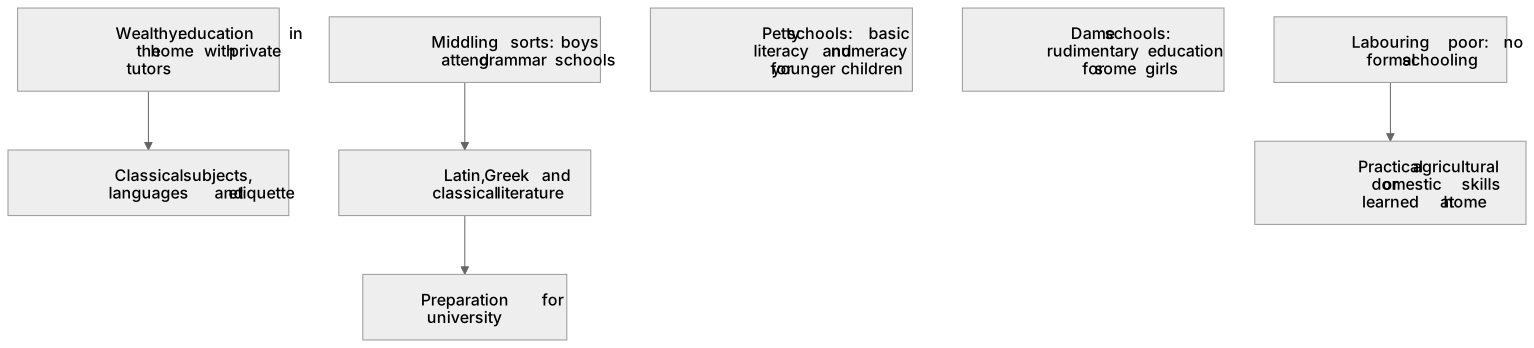
Label the diagram
Some boxes have lost their names. Pick the right name for each number.
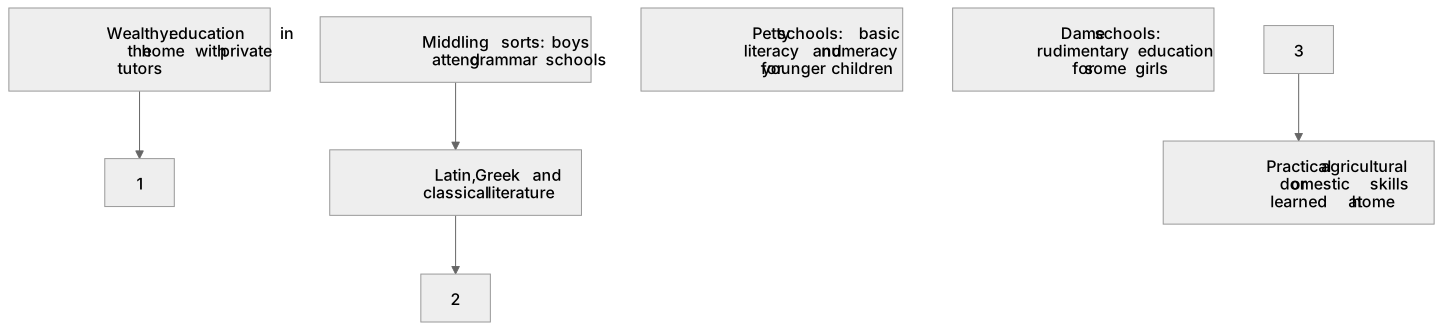
1Box 1
2Box 2
3Box 3
There is more to this lesson
The full lesson goes on to check your understanding and help you earn the marks. Create a free account to carry on, with your progress saved.
A week of Premium from your first lesson · Then the free plan continues · No card, no charge
Test your understanding of Option B4: Key topic 3: Elizabethan society in the Age of Exploration, 1558–88 - 1 Education and leisure: Education in the home and schools.
Active recall beats re-reading. Take an instant quiz now to test what you’ve learned and lock it into long-term memory.
A week of Premium from your first lesson · Then the free plan continues · No card, no charge