Pearson Edexcel · GCSE · History
Course version: 1HI0 · Version from Sept 2016
Key topic 3: Elizabethan society in the Age of Exploration, 1558–88 - 1…
Full specification wording
Option B4: Key topic 3: Elizabethan society in the Age of Exploration, 1558–88 - 1 Education and leisure: Sport, pastimes and the theatre.
Elizabethan leisure varied significantly across social classes.
Checked against the Pearson Edexcel 1HI0 specification (opens in a new tab) on .
- Point 2 of 2
- 3 key terms
Study notes
From the checked teaching notes for this specification point.
The idea
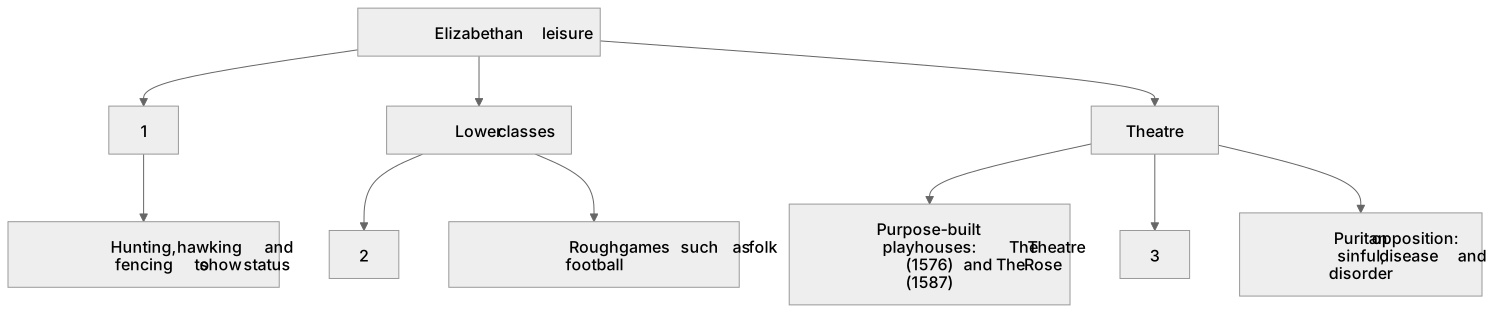
Elizabethan leisure varied significantly across social classes. The nobility engaged in exclusive sports like hunting, hawking, and fencing to demonstrate their status. The lower classes participated in brutal blood sports such as bear-baiting and cockfighting, alongside rough games like folk football. The era also witnessed the early development of the theatre, with purpose-built playhouses like The Theatre (1576) and The Rose (1587). Theatre became a unifying pastime, attracting diverse audiences from groundlings in the pit to nobles in the galleries. However, the theatre faced fierce opposition from Puritans, who viewed it as sinful and a breeding ground for disease and disorder, highlighting the cultural tensions within Elizabethan society.
What earns the marks
- Identify sports exclusive to the nobility, such as hunting, hawking, and fencing.
- Describe popular pastimes of the lower classes, including folk football and blood sports like bear-baiting.
- Explain the development and social significance of the Elizabethan theatre, noting its appeal to all social classes and citing early playhouses like The Theatre (1576).
- Analyse the reasons for Puritan opposition to the theatre, including concerns about morality, disease, and social disorder.
Common mistakes and how to put them right
Claiming that only the rich went to the theatre.
Put it right: The theatre was affordable for many, with 'groundlings' paying just one penny to stand in the pit.
Assuming blood sports were only for the poor.
Put it right: Blood sports like bear-baiting were popular across all classes, and Elizabeth I herself enjoyed them.
Using The Globe (1599) as an example for this period.
Put it right: Use period-correct examples like The Theatre (1576) or The Rose (1587) for the 1558–1588 timeframe.
Exam tips
- Contrast the leisure activities of the rich and poor to highlight the rigid social structure of Elizabethan England.
- Use the theatre as a prime example of a cross-class pastime that brought different social groups together in one venue.
Try the lesson
The start of the Option B4: Key topic 3: Elizabethan society in the Age of Exploration, 1558–88 - 1 Education and leisure: Sport, pastimes and the theatre. lesson, made from checked teaching notes for this specification point.
Have a go first
Which of the following was a popular, albeit violent, spectator sport in Elizabethan England?
Listen
Elizabethan leisure varied significantly across social classes. The nobility engaged in exclusive sports like hunting, hawking, and fencing to demonstrate their status. The lower classes participated in brutal blood sports such as bear-baiting and cockfighting, alongside rough games like folk football. The era also witnessed the early development of the theatre, with purpose-built playhouses like The Theatre (1576) and The Rose (1587). Theatre became a unifying pastime, attracting diverse audiences from groundlings in the pit to nobles in the galleries. However, the theatre faced fierce opposition from Puritans, who viewed it as sinful and a breeding ground for disease and disorder, highlighting the cultural tensions within Elizabethan society. A strong answer earns marks for these points. Identify sports exclusive to the nobility, such as hunting, hawking, and fencing. Describe popular pastimes of the lower classes, including folk football and blood sports like bear-baiting. Explain the development and social significance of the Elizabethan theatre, noting its appeal to all social classes and citing early playhouses like The Theatre (1576). Analyse the reasons for Puritan opposition to the theatre, including concerns about morality, disease, and social disorder. A common slip: Claiming that only the rich went to the theatre. Instead, The theatre was affordable for many, with 'groundlings' paying just one penny to stand in the pit. Exam tip: Contrast the leisure activities of the rich and poor to highlight the rigid social structure of Elizabethan England.
See it

Key words
Say what each word means before you turn the card.
Social class and leisure
Try answering aloud or in your head before turning the card.
Cultural development and the Renaissance
Try answering aloud or in your head before turning the card.
Religious opposition and Puritanism
Try answering aloud or in your head before turning the card.
See every definition
- Social class and leisure
- Leisure varied significantly across social classes, with the nobility engaging in exclusive sports to demonstrate their status while the lower classes took part in brutal blood sports and rough games.
- Cultural development and the Renaissance
- The era witnessed the early development of the theatre, with purpose-built playhouses like The Theatre and The Rose attracting diverse audiences.
- Religious opposition and Puritanism
- The theatre faced fierce opposition from Puritans, who viewed it as sinful and a breeding ground for disease and disorder.
Label the diagram
Some boxes have lost their names. Pick the right name for each number.
1Box 1
2Box 2
3Box 3
There is more to this lesson
The full lesson goes on to check your understanding and help you earn the marks. Create a free account to carry on, with your progress saved.
A week of Premium from your first lesson · Then the free plan continues · No card, no charge
Test your understanding of Option B4: Key topic 3: Elizabethan society in the Age of Exploration, 1558–88 - 1 Education and leisure: Sport, pastimes and the theatre.
Active recall beats re-reading. Take an instant quiz now to test what you’ve learned and lock it into long-term memory.
A week of Premium from your first lesson · Then the free plan continues · No card, no charge