Pearson Edexcel · GCSE · History
Course version: 1HI0 · Version from Sept 2016
Key topic 3: Elizabethan society in the Age of Exploration, 1558–88 - 2…
Full specification wording
Option B4: Key topic 3: Elizabethan society in the Age of Exploration, 1558–88 - 2 The ‘problem’ of the poor: The changing attitudes and policies towards the poor.
Elizabethan attitudes towards the poor shifted from viewing all poverty as a result of idleness to distinguishing between the 'deserving' poor (unable to work due to age or illness) and the…
Checked against the Pearson Edexcel 1HI0 specification (opens in a new tab) on .
- Point 2 of 2
- 4 key terms
Study notes
From the checked teaching notes for this specification point.
The idea
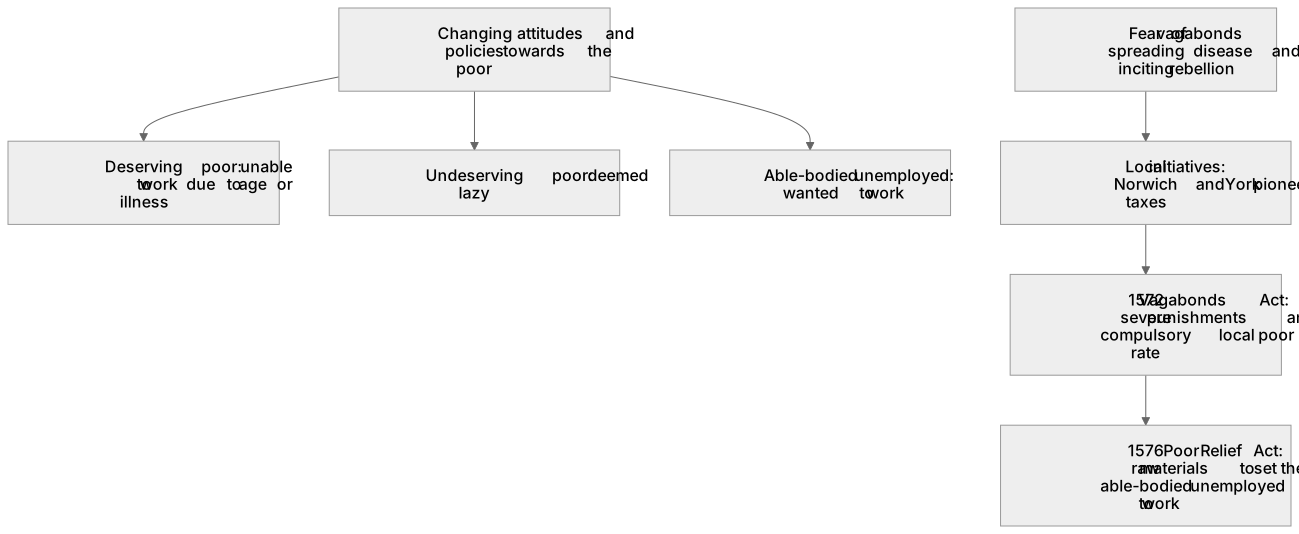
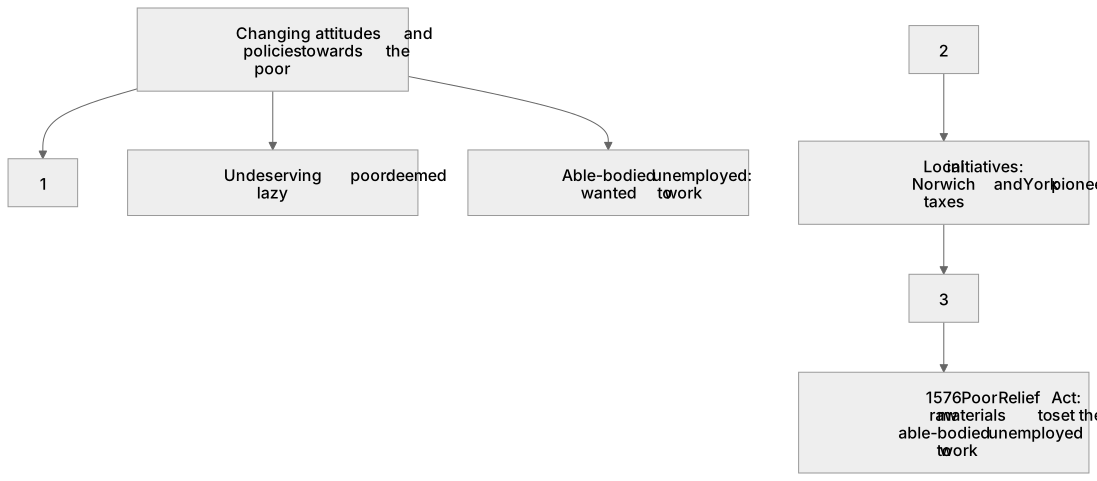
Elizabethan attitudes towards the poor shifted from viewing all poverty as a result of idleness to distinguishing between the 'deserving' poor (unable to work due to age or illness) and the 'undeserving' poor (deemed lazy). A third category, the able-bodied unemployed who wanted to work, also emerged. Fear of vagabonds spreading disease and inciting rebellion drove policy changes. Initially, poor relief was left to local authorities, with cities like Norwich and York pioneering taxes to help the vulnerable. These local initiatives influenced national policies, such as the 1572 Vagabonds Act, which introduced severe punishments for vagrancy while establishing a compulsory local poor rate. The 1576 Poor Relief Act furthered this by requiring towns to provide raw materials to set the able-bodied unemployed to work.
What earns the marks
- Differentiate between the Elizabethan classifications of the 'deserving' poor, the 'undeserving' poor, and the able-bodied unemployed.
- Explain the motivations behind changing attitudes, including the fear of disease, crime, and social rebellion.
- Describe the role of local initiatives, such as those in Norwich, in shaping national poor relief policies.
- Outline the key provisions of the 1572 Vagabonds Act, including punishments for vagrancy and the introduction of a local poor rate.
- Detail the impact of the 1576 Poor Relief Act in providing raw materials to set the able-bodied unemployed to work.
Common mistakes and how to put them right
Claiming that the Elizabethan government provided welfare for all poor people.
Put it right by specifying that help was strictly limited to the 'deserving' poor and able-bodied unemployed, while the 'undeserving' were punished.
Confusing the 1572 and 1576 Acts.
Put it right by remembering 1572 introduced the poor rate and severe punishments, whereas 1576 focused on providing work materials for the able-bodied unemployed.
Stating that the 1576 Act provided work for the 'deserving' poor.
Put it right by noting that the deserving poor were unable to work, and the materials were for the able-bodied unemployed.
Exam tips
- Use the specific terms 'deserving poor', 'undeserving poor', and 'able-bodied unemployed' to demonstrate an understanding of Elizabethan social attitudes.
- When discussing policies, explicitly mention the 1572 Vagabonds Act and the 1576 Poor Relief Act to support your points.
Try the lesson
The start of the Option B4: Key topic 3: Elizabethan society in the Age of Exploration, 1558–88 - 2 The ‘problem’ of the poor: The changing attitudes and policies towards the poor. lesson, made from checked teaching notes for this specification point.
Have a go first
How did Elizabethan authorities typically categorise the poor?
Listen
Elizabethan attitudes towards the poor shifted from viewing all poverty as a result of idleness to distinguishing between the 'deserving' poor (unable to work due to age or illness) and the 'undeserving' poor (deemed lazy). A third category, the able-bodied unemployed who wanted to work, also emerged. Fear of vagabonds spreading disease and inciting rebellion drove policy changes. Initially, poor relief was left to local authorities, with cities like Norwich and York pioneering taxes to help the vulnerable. These local initiatives influenced national policies, such as the 1572 Vagabonds Act, which introduced severe punishments for vagrancy while establishing a compulsory local poor rate. The 1576 Poor Relief Act furthered this by requiring towns to provide raw materials to set the able-bodied unemployed to work. A strong answer earns marks for these points. Differentiate between the Elizabethan classifications of the 'deserving' poor, the 'undeserving' poor, and the able-bodied unemployed. Explain the motivations behind changing attitudes, including the fear of disease, crime, and social rebellion. Describe the role of local initiatives, such as those in Norwich, in shaping national poor relief policies. Outline the key provisions of the 1572 Vagabonds Act, including punishments for vagrancy and the introduction of a local poor rate. A common slip: Claiming that the Elizabethan government provided welfare for all poor people. Instead, specifying that help was strictly limited to the 'deserving' poor and able-bodied unemployed, while the 'undeserving' were punished. Exam tip: Use the specific terms 'deserving poor', 'undeserving poor', and 'able-bodied unemployed' to demonstrate an understanding of Elizabethan social attitudes.
See it
Key words
Say what each word means before you turn the card.
Deserving poor
Try answering aloud or in your head before turning the card.
Undeserving poor
Try answering aloud or in your head before turning the card.
Able-bodied unemployed
Try answering aloud or in your head before turning the card.
Vagabonds
Try answering aloud or in your head before turning the card.
See every definition
- Deserving poor
- Those unable to work due to age or illness, distinguished from others in Elizabethan attitudes towards the poor.
- Undeserving poor
- Those deemed lazy, as opposed to the deserving poor and the able-bodied unemployed.
- Able-bodied unemployed
- A third category that emerged alongside the deserving and undeserving poor: people who wanted to work.
- Vagabonds
- A group whose spreading of disease and inciting of rebellion drove policy changes through fear.
Label the diagram
Some boxes have lost their names. Pick the right name for each number.
1Box 1
2Box 2
3Box 3
There is more to this lesson
The full lesson goes on to check your understanding and help you earn the marks. Create a free account to carry on, with your progress saved.
A week of Premium from your first lesson · Then the free plan continues · No card, no charge
Test your understanding of Option B4: Key topic 3: Elizabethan society in the Age of Exploration, 1558–88 - 2 The ‘problem’ of the poor: The changing attitudes and policies towards the poor.
Active recall beats re-reading. Take an instant quiz now to test what you’ve learned and lock it into long-term memory.
A week of Premium from your first lesson · Then the free plan continues · No card, no charge