Pearson Edexcel · GCSE · History
Course version: 1HI0 · Version from Sept 2016
Key topic 3: Elizabethan society in the Age of Exploration, 1558–88 - 2…
Full specification wording
Option B4: Key topic 3: Elizabethan society in the Age of Exploration, 1558–88 - 2 The ‘problem’ of the poor: The reasons for the increase in poverty and vagabondage during these years.
During the Elizabethan era, poverty and vagabondage increased significantly due to a combination of economic and social factors.
Checked against the Pearson Edexcel 1HI0 specification (opens in a new tab) on .
- Point 1 of 2
- 3 key terms
Study notes
From the checked teaching notes for this specification point.
The idea
During the Elizabethan era, poverty and vagabondage increased significantly due to a combination of economic and social factors. The population grew from roughly three million to four million, increasing demand for food and driving up prices. This inflation was worsened by poor harvests and the debasement of the coinage. Changes in agriculture, particularly the enclosure of land and the shift from arable to sheep farming, required fewer labourers, leading to widespread rural unemployment. Consequently, many people migrated to towns seeking work, becoming vagabonds. Furthermore, the earlier dissolution of the monasteries had removed a traditional source of charity, leaving the vulnerable without support and exacerbating the crisis.
What earns the marks
- Identify population growth as a key driver of inflation and increased demand for resources.
- Explain how the enclosure of land and the shift to sheep farming reduced the need for agricultural labourers.
- Describe the impact of bad harvests on food prices and the resulting economic hardship for the lower classes.
- Link the dissolution of the monasteries to the removal of traditional charitable support for the vulnerable.
- Connect rural unemployment to the rise in vagabondage as people migrated to towns in search of work.
Common mistakes and how to put them right
Stating that the monasteries were closed by Elizabeth I.
Put it right by noting they were dissolved earlier by Henry VIII, but the long-term effects were felt in Elizabeth's reign.
Confusing enclosure with the physical destruction of villages.
Put it right by explaining enclosure meant fencing off common land, which deprived poor farmers of grazing rights.
Assuming vagabonds were simply lazy people.
Put it right by explaining that many were desperate, unemployed labourers forced to travel to find work.
Exam tips
- When explaining the increase in poverty, ensure you link multiple causes together, such as how population growth worsened the impact of bad harvests.
- Use specific examples of agricultural changes, like the shift from arable to sheep farming, to demonstrate subject knowledge.
- Clearly distinguish between the general increase in poverty and the specific rise in vagabondage, which refers to the movement of the poor.
Try the lesson
The start of the Option B4: Key topic 3: Elizabethan society in the Age of Exploration, 1558–88 - 2 The ‘problem’ of the poor: The reasons for the increase in poverty and vagabondage during these years. lesson, made from checked teaching notes for this specification point.
Have a go first
Which of the following was a major underlying cause of the increase in poverty in Elizabethan England?
Listen
During the Elizabethan era, poverty and vagabondage increased significantly due to a combination of economic and social factors. The population grew from roughly three million to four million, increasing demand for food and driving up prices. This inflation was worsened by poor harvests and the debasement of the coinage. Changes in agriculture, particularly the enclosure of land and the shift from arable to sheep farming, required fewer labourers, leading to widespread rural unemployment. Consequently, many people migrated to towns seeking work, becoming vagabonds. Furthermore, the earlier dissolution of the monasteries had removed a traditional source of charity, leaving the vulnerable without support and exacerbating the crisis. A strong answer earns marks for these points. Identify population growth as a key driver of inflation and increased demand for resources. Explain how the enclosure of land and the shift to sheep farming reduced the need for agricultural labourers. Describe the impact of bad harvests on food prices and the resulting economic hardship for the lower classes. Link the dissolution of the monasteries to the removal of traditional charitable support for the vulnerable. A common slip: Stating that the monasteries were closed by Elizabeth I. Instead, noting they were dissolved earlier by Henry VIII, but the long-term effects were felt in Elizabeth's reign. Exam tip: When explaining the increase in poverty, ensure you link multiple causes together, such as how population growth worsened the impact of bad harvests.
See it
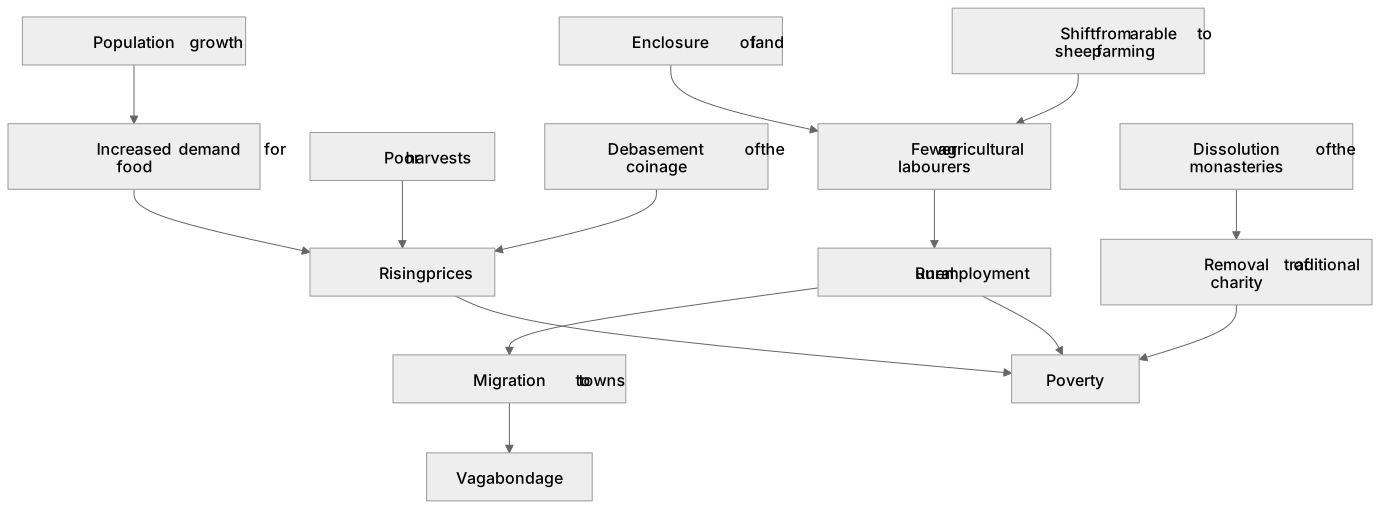
Key words
Say what each word means before you turn the card.
Economic hardship
Try answering aloud or in your head before turning the card.
Demographic changes
Try answering aloud or in your head before turning the card.
Agricultural transformation
Try answering aloud or in your head before turning the card.
See every definition
- Economic hardship
- The difficulty caused by inflation worsened by poor harvests and the debasement of the coinage, which increased prices and hit the lower classes.
- Demographic changes
- Population growth from roughly three million to four million, which increased demand for food and drove up prices.
- Agricultural transformation
- Changes such as the enclosure of land and the shift from arable to sheep farming, which required fewer labourers and led to rural unemployment.
Label the diagram
Some boxes have lost their names. Pick the right name for each number.
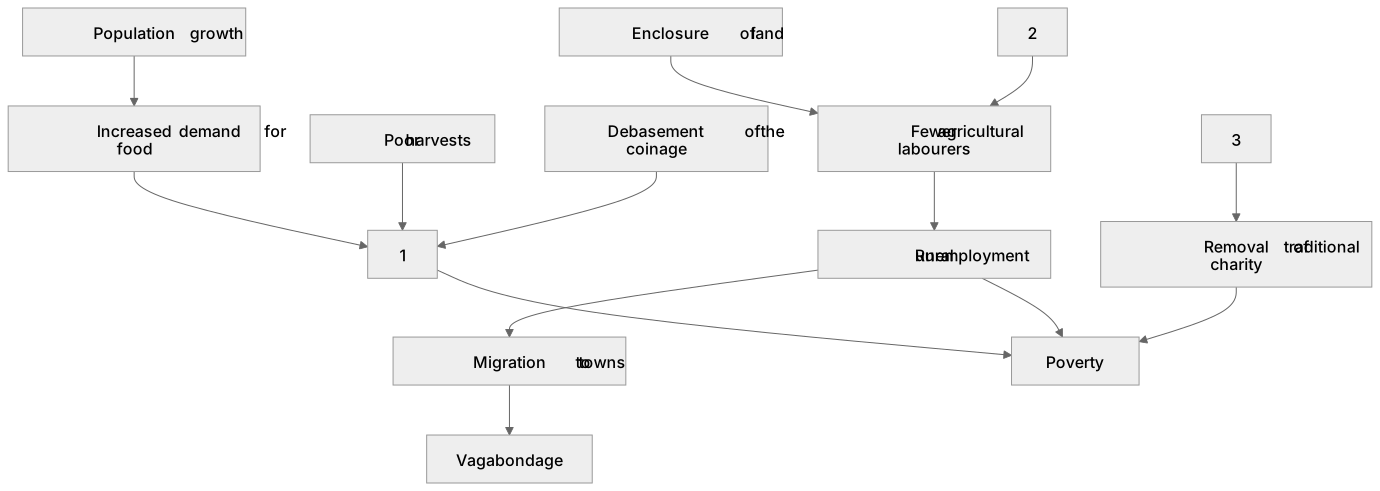
1Box 1
2Box 2
3Box 3
There is more to this lesson
The full lesson goes on to check your understanding and help you earn the marks. Create a free account to carry on, with your progress saved.
A week of Premium from your first lesson · Then the free plan continues · No card, no charge
Test your understanding of Option B4: Key topic 3: Elizabethan society in the Age of Exploration, 1558–88 - 2 The ‘problem’ of the poor: The reasons for the increase in poverty and vagabondage during these years.
Active recall beats re-reading. Take an instant quiz now to test what you’ve learned and lock it into long-term memory.
A week of Premium from your first lesson · Then the free plan continues · No card, no charge