Pearson Edexcel · GCSE · History
Course version: 1HI0 · Version from Sept 2016
Key topic 1: Spain reaches the Americas, c1490–1512 - 1 Spanish…
Full specification wording
Option P1: Key topic 1: Spain reaches the Americas, c1490–1512 - 1 Spanish exploration: Columbus’s attempts to gain sponsorship. The role of Queen Isabella: her desire to spread Christianity and sponsorship of Columbus.
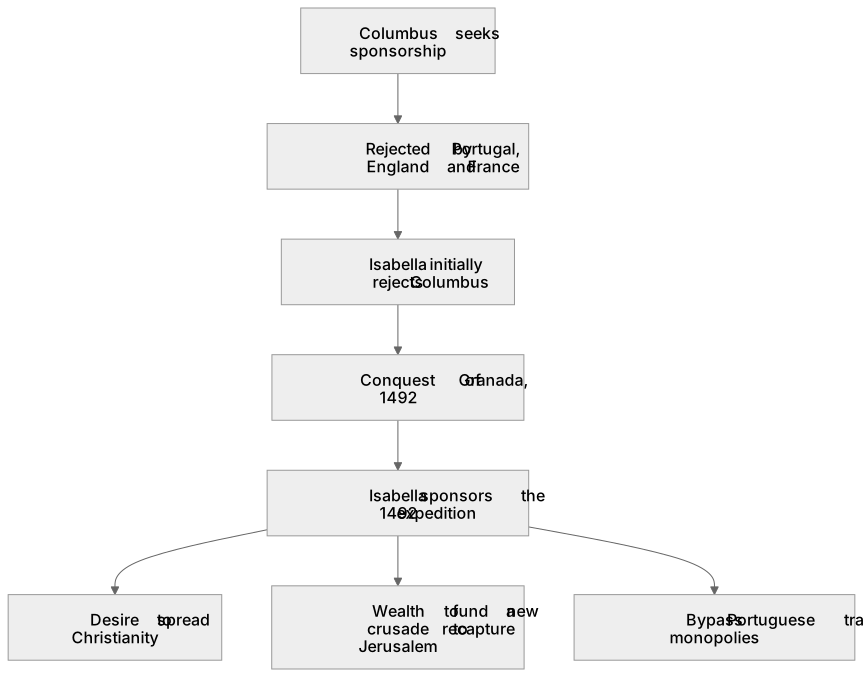
Christopher Columbus spent years seeking sponsorship for his proposed western route to Asia, facing rejections from Portugal, England, and France before securing Spanish backing.
Checked against the Pearson Edexcel 1HI0 specification (opens in a new tab) on .
- Point 2 of 3
- 2 key terms
Study notes
From the checked teaching notes for this specification point.
The idea
Christopher Columbus spent years seeking sponsorship for his proposed western route to Asia, facing rejections from Portugal, England, and France before securing Spanish backing. He argued that sailing west was a faster route to the Indies, though experts correctly doubted his underestimation of the Earth's circumference. Queen Isabella of Castile played a pivotal role in his eventual success. Following the conquest of Granada in 1492, Isabella was driven by a profound desire to spread Christianity to undiscovered lands and to fund a new crusade to recapture Jerusalem. She recognised that Columbus's voyage, if successful, could provide the immense wealth needed for these religious goals, while also allowing Spain to bypass Portuguese trade monopolies, leading her to sponsor the 1492 expedition.
What earns the marks
- Detail Columbus's repeated attempts to gain funding from various European monarchs before succeeding in Spain.
- Explain Isabella's religious motivations, specifically her desire to evangelise new populations and fund further crusades.
- Describe the economic and political benefits Isabella hoped to gain, such as bypassing Portuguese trade routes.
- Identify the significance of the timing, noting that sponsorship was granted only after the fall of Granada in 1492.
Common mistakes and how to put them right
Stating that Columbus was trying to prove the Earth was round.
Put it right by explaining that educated people knew it was round, but disagreed on its size.
Claiming Isabella sponsored Columbus immediately.
Put it right by noting she initially rejected him and only agreed after the Reconquista concluded.
Ignoring the religious motives of Isabella.
Put it right: Explicitly linking her sponsorship to the desire to spread Christianity.
Exam tips
- Emphasise the dual nature of Isabella's sponsorship: the intertwining of religious zeal (spreading Christianity) and economic pragmatism (gaining wealth).
- Mention the Capitulations of Santa Fe to show precise knowledge of the agreement between Columbus and the Spanish monarchs.
- Explain why other monarchs rejected Columbus to highlight the risk Isabella was taking.
Try the lesson
The start of the Option P1: Key topic 1: Spain reaches the Americas, c1490–1512 - 1 Spanish exploration: Columbus’s attempts to gain sponsorship. The role of Queen Isabella: her desire to spread Christianity and sponsorship of Columbus. lesson, made from checked teaching notes for this specification point.
Have a go first
What was one of Queen Isabella's primary personal motivations for sponsoring Christopher Columbus's voyage?
Listen
Christopher Columbus spent years seeking sponsorship for his proposed western route to Asia, facing rejections from Portugal, England, and France before securing Spanish backing. He argued that sailing west was a faster route to the Indies, though experts correctly doubted his underestimation of the Earth's circumference. Queen Isabella of Castile played a pivotal role in his eventual success. Following the conquest of Granada in 1492, Isabella was driven by a profound desire to spread Christianity to undiscovered lands and to fund a new crusade to recapture Jerusalem. She recognised that Columbus's voyage, if successful, could provide the immense wealth needed for these religious goals, while also allowing Spain to bypass Portuguese trade monopolies, leading her to sponsor the 1492 expedition. A strong answer earns marks for these points. Detail Columbus's repeated attempts to gain funding from various European monarchs before succeeding in Spain. Explain Isabella's religious motivations, specifically her desire to evangelise new populations and fund further crusades. Describe the economic and political benefits Isabella hoped to gain, such as bypassing Portuguese trade routes. Identify the significance of the timing, noting that sponsorship was granted only after the fall of Granada in 1492. A common slip: Stating that Columbus was trying to prove the Earth was round. Instead, explaining that educated people knew it was round, but disagreed on its size. Exam tip: Emphasise the dual nature of Isabella's sponsorship: the intertwining of religious zeal (spreading Christianity) and economic pragmatism (gaining wealth).
See it
Key words
Say what each word means before you turn the card.
Royal patronage
Try answering aloud or in your head before turning the card.
Religious motivation
Try answering aloud or in your head before turning the card.
See every definition
- Royal patronage
- Sponsorship from a monarch, which Columbus sought for years before securing Spanish backing.
- Religious motivation
- Isabella's profound desire to spread Christianity to undiscovered lands and to fund a new crusade to recapture Jerusalem.
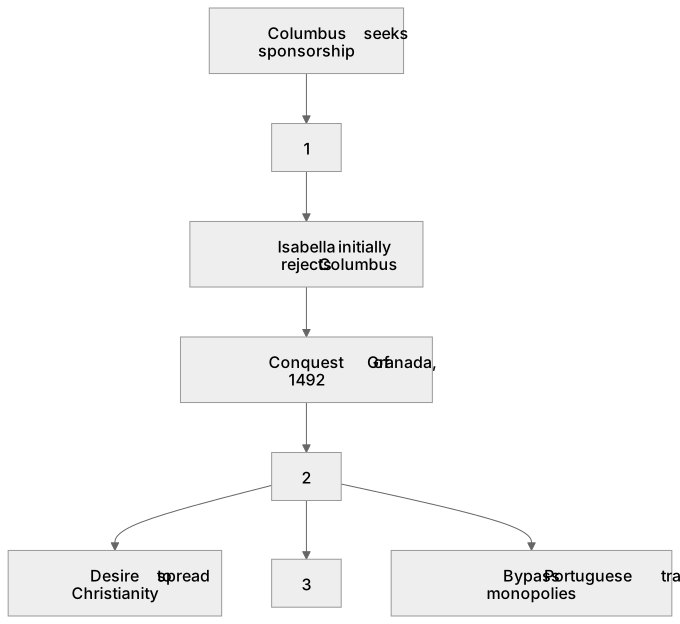
Label the diagram
Some boxes have lost their names. Pick the right name for each number.
1Box 1
2Box 2
3Box 3
There is more to this lesson
The full lesson goes on to check your understanding and help you earn the marks. Create a free account to carry on, with your progress saved.
A week of Premium from your first lesson · Then the free plan continues · No card, no charge
Test your understanding of Option P1: Key topic 1: Spain reaches the Americas, c1490–1512 - 1 Spanish exploration: Columbus’s attempts to gain sponsorship. The role of Queen Isabella: her desire to spread Christianity and sponsorship of Columbus.
Active recall beats re-reading. Take an instant quiz now to test what you’ve learned and lock it into long-term memory.
A week of Premium from your first lesson · Then the free plan continues · No card, no charge