Pearson Edexcel · GCSE · History
Course version: 1HI0 · Version from Sept 2016
Key topic 1: Spain reaches the Americas, c1490–1512 - 1 Spanish…
Full specification wording
Option P1: Key topic 1: Spain reaches the Americas, c1490–1512 - 1 Spanish exploration: Columbus’s first voyage of 1492 and the problems encountered.
Columbus's 1492 voyage, sponsored by Spain, aimed to find a western sea route to Asia.
Checked against the Pearson Edexcel 1HI0 specification (opens in a new tab) on .
- Point 3 of 3
Study notes
From the checked teaching notes for this specification point.
The idea
Columbus's 1492 voyage, sponsored by Spain, aimed to find a western sea route to Asia. Departing with the Niña, Pinta, and Santa María, the expedition faced significant problems. The crew experienced intense fear of the unknown, worsened by the unprecedented time out of sight of land. Navigational challenges, including compass variations and false land sightings, severely damaged morale. As provisions dwindled, Columbus faced the threat of mutiny from terrified sailors. He managed these problems by keeping two logbooks to deceive the crew about the distance travelled and by promising to turn back if land was not sighted within days, eventually reaching the Bahamas in October 1492.
What earns the marks
- Identify the main aim of the 1492 voyage: finding a western route to Asia.
- Describe the logistical problems encountered, such as dwindling food and water supplies.
- Explain the psychological problems faced by the crew, including fear of the unknown and the threat of mutiny.
- Detail Columbus's methods for managing problems, such as keeping a fake logbook to hide the true distance travelled.
Common mistakes and how to put them right
Stating that Columbus set out to discover America.
Put it right: Columbus was attempting to find a new trade route to Asia (the Indies), not a new continent.
Claiming the crew mutinied and took over the ship.
Put it right: The crew threatened mutiny, but Columbus successfully negotiated a delay, preventing a full rebellion.
Believing the ships ran out of food completely.
Put it right: Provisions were running low and spoiling, causing anxiety, but they did not completely run out before reaching land.
Exam tips
- When discussing problems, categorise them into logistical (supplies), navigational, and psychological (fear, mutiny) issues.
- Use specific details, such as the names of the ships or the dual logbook strategy, to support your explanation of the voyage.
- Link the problems encountered directly to the length of the journey and the limitations of 15th-century maritime technology.
Try the lesson
The start of the Option P1: Key topic 1: Spain reaches the Americas, c1490–1512 - 1 Spanish exploration: Columbus’s first voyage of 1492 and the problems encountered. lesson, made from checked teaching notes for this specification point.
Have a go first
Which of the following was a significant problem encountered by Christopher Columbus and his crew during their first voyage across the Atlantic in 1492?
Listen
Columbus's 1492 voyage, sponsored by Spain, aimed to find a western sea route to Asia. Departing with the Niña, Pinta, and Santa María, the expedition faced significant problems. The crew experienced intense fear of the unknown, worsened by the unprecedented time out of sight of land. Navigational challenges, including compass variations and false land sightings, severely damaged morale. As provisions dwindled, Columbus faced the threat of mutiny from terrified sailors. He managed these problems by keeping two logbooks to deceive the crew about the distance travelled and by promising to turn back if land was not sighted within days, eventually reaching the Bahamas in October 1492. A strong answer earns marks for these points. Identify the main aim of the 1492 voyage: finding a western route to Asia. Describe the logistical problems encountered, such as dwindling food and water supplies. Explain the psychological problems faced by the crew, including fear of the unknown and the threat of mutiny. Detail Columbus's methods for managing problems, such as keeping a fake logbook to hide the true distance travelled. A common slip: Stating that Columbus set out to discover America. Instead, Columbus was attempting to find a new trade route to Asia (the Indies), not a new continent. Exam tip: When discussing problems, categorise them into logistical (supplies), navigational, and psychological (fear, mutiny) issues.
See it
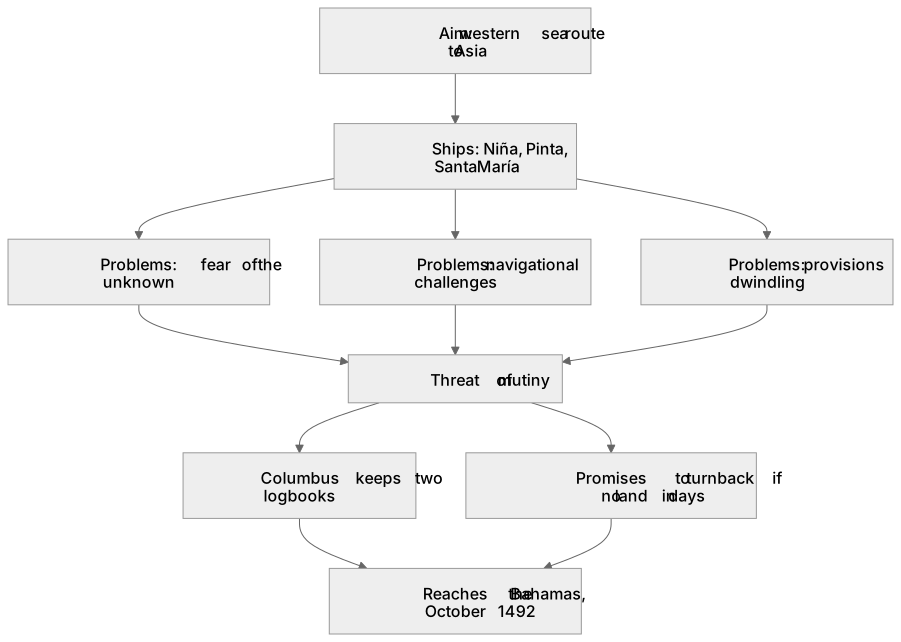
Label the diagram
Some boxes have lost their names. Pick the right name for each number.
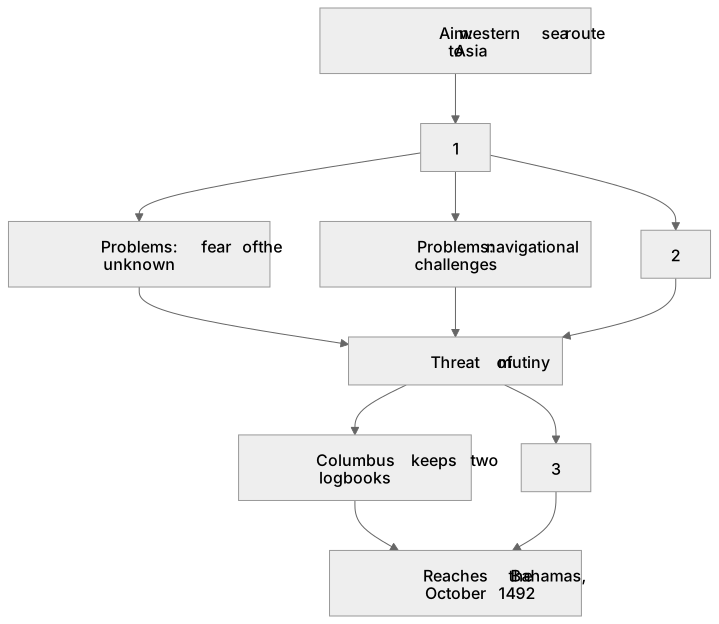
1Box 1
2Box 2
3Box 3
There is more to this lesson
The full lesson goes on to check your understanding and help you earn the marks. Create a free account to carry on, with your progress saved.
A week of Premium from your first lesson · Then the free plan continues · No card, no charge
Test your understanding of Option P1: Key topic 1: Spain reaches the Americas, c1490–1512 - 1 Spanish exploration: Columbus’s first voyage of 1492 and the problems encountered.
Active recall beats re-reading. Take an instant quiz now to test what you’ve learned and lock it into long-term memory.
A week of Premium from your first lesson · Then the free plan continues · No card, no charge