Pearson Edexcel · GCSE · History
Course version: 1HI0 · Version from Sept 2016
Key topic 1: Spain reaches the Americas, c1490–1512 - 3 Spanish claims in…
Full specification wording
Option P1: Key topic 1: Spain reaches the Americas, c1490–1512 - 3 Spanish claims in the Caribbean: Columbus’s later voyages and his role as governor in the Spanish settlement. The significance of the establishment of the Spanish colony at Santo Domingo (1496).
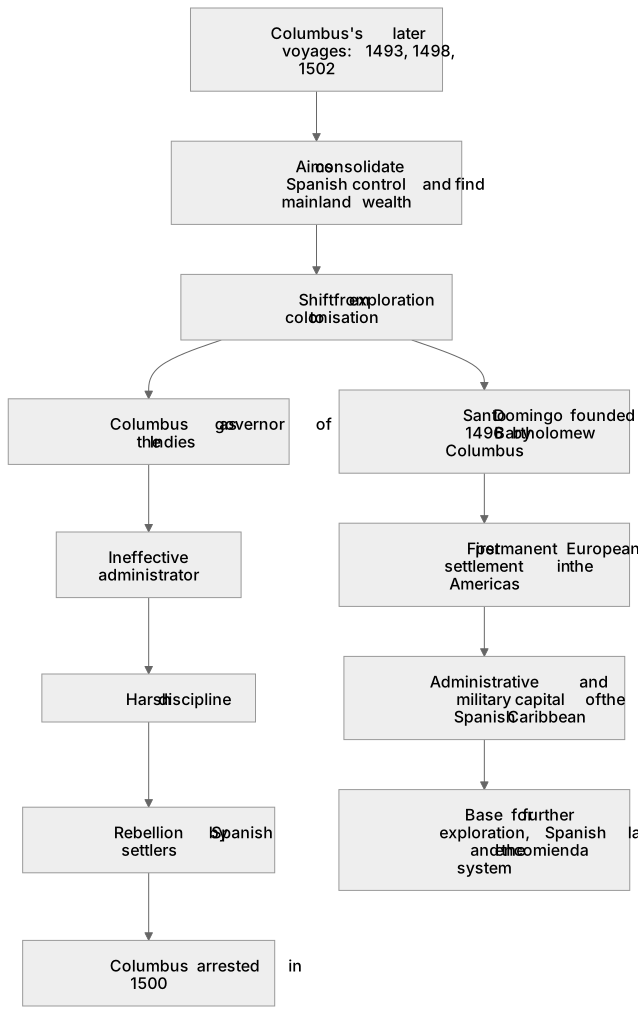
Columbus's later voyages (1493, 1498, 1502) aimed to consolidate Spanish control and find mainland wealth, shifting from exploration to colonisation.
Checked against the Pearson Edexcel 1HI0 specification (opens in a new tab) on .
- Point 1 of 3
- 4 key terms
Study notes
From the checked teaching notes for this specification point.
The idea
Columbus's later voyages (1493, 1498, 1502) aimed to consolidate Spanish control and find mainland wealth, shifting from exploration to colonisation. As governor of the Indies, Columbus proved an ineffective administrator, leading to rebellion by Spanish settlers and his eventual arrest in 1500. The establishment of Santo Domingo in 1496 by his brother Bartholomew was highly significant; it became the first permanent European settlement in the Americas, serving as the administrative and military capital of the Spanish Caribbean. It acted as a crucial base for further exploration, the enforcement of Spanish law, and the initial implementation of the encomienda system, cementing Spain's imperial foothold.
What earns the marks
- Identify the aims of Columbus's later voyages, such as colonisation and finding gold.
- Describe Columbus's failures as governor, including his harsh discipline and the resulting settler revolts.
- Explain the significance of Santo Domingo as the first permanent Spanish administrative centre in the New World.
- Analyse how Santo Domingo facilitated further Spanish expansion and the control of the Caribbean.
Common mistakes and how to put them right
Believing Columbus was a successful and popular governor.
Put it right: Columbus was a poor administrator whose harsh rule led to rebellion and his removal in chains in 1500.
Confusing La Navidad or Isabella with Santo Domingo as the permanent capital.
Put it right: While La Navidad and Isabella were earlier, Santo Domingo (1496) became the first permanent and successful administrative capital.
Thinking Columbus founded Santo Domingo himself.
Put it right: It was founded by his brother, Bartholomew Columbus, while Christopher was back in Spain.
Exam tips
- When discussing Columbus's role as governor, focus on the contrast between his navigational skills and his administrative failures.
- Use Santo Domingo as a specific example of how Spain transitioned from exploration to permanent imperial settlement.
- Link the establishment of Santo Domingo to the broader theme of Spanish control and the base for future conquistadors.
Try the lesson
The start of the Option P1: Key topic 1: Spain reaches the Americas, c1490–1512 - 3 Spanish claims in the Caribbean: Columbus’s later voyages and his role as governor in the Spanish settlement. The significance of the establishment of the Spanish colony at Santo Domingo (1496). lesson, made from checked teaching notes for this specification point.
Have a go first
Which settlement was established in 1496 and became the capital of the Spanish colony in the Caribbean?
Listen
Columbus's later voyages (1493, 1498, 1502) aimed to consolidate Spanish control and find mainland wealth, shifting from exploration to colonisation. As governor of the Indies, Columbus proved an ineffective administrator, leading to rebellion by Spanish settlers and his eventual arrest in 1500. The establishment of Santo Domingo in 1496 by his brother Bartholomew was highly significant; it became the first permanent European settlement in the Americas, serving as the administrative and military capital of the Spanish Caribbean. It acted as a crucial base for further exploration, the enforcement of Spanish law, and the initial implementation of the encomienda system, cementing Spain's imperial foothold. A strong answer earns marks for these points. Identify the aims of Columbus's later voyages, such as colonisation and finding gold. Describe Columbus's failures as governor, including his harsh discipline and the resulting settler revolts. Explain the significance of Santo Domingo as the first permanent Spanish administrative centre in the New World. Analyse how Santo Domingo facilitated further Spanish expansion and the control of the Caribbean. A common slip: Believing Columbus was a successful and popular governor. Instead, Columbus was a poor administrator whose harsh rule led to rebellion and his removal in chains in 1500. Exam tip: When discussing Columbus's role as governor, focus on the contrast between his navigational skills and his administrative failures.
See it
Key words
Say what each word means before you turn the card.
Colonisation and settlement
Try answering aloud or in your head before turning the card.
Leadership and administration
Try answering aloud or in your head before turning the card.
Imperial expansion
Try answering aloud or in your head before turning the card.
Conflict and rebellion
Try answering aloud or in your head before turning the card.
See every definition
- Colonisation and settlement
- Columbus's later voyages shifted from exploration to colonisation, and the establishment of Santo Domingo in 1496 became the first permanent European settlement in the Americas.
- Leadership and administration
- As governor of the Indies, Columbus proved an ineffective administrator, and Santo Domingo served as the administrative and military capital of the Spanish Caribbean.
- Imperial expansion
- Santo Domingo acted as a crucial base for further exploration, the enforcement of Spanish law and the initial implementation of the encomienda system, cementing Spain's imperial foothold.
- Conflict and rebellion
- Columbus's harsh discipline as governor led to rebellion by Spanish settlers and his eventual arrest in 1500.
Label the diagram
Some boxes have lost their names. Pick the right name for each number.
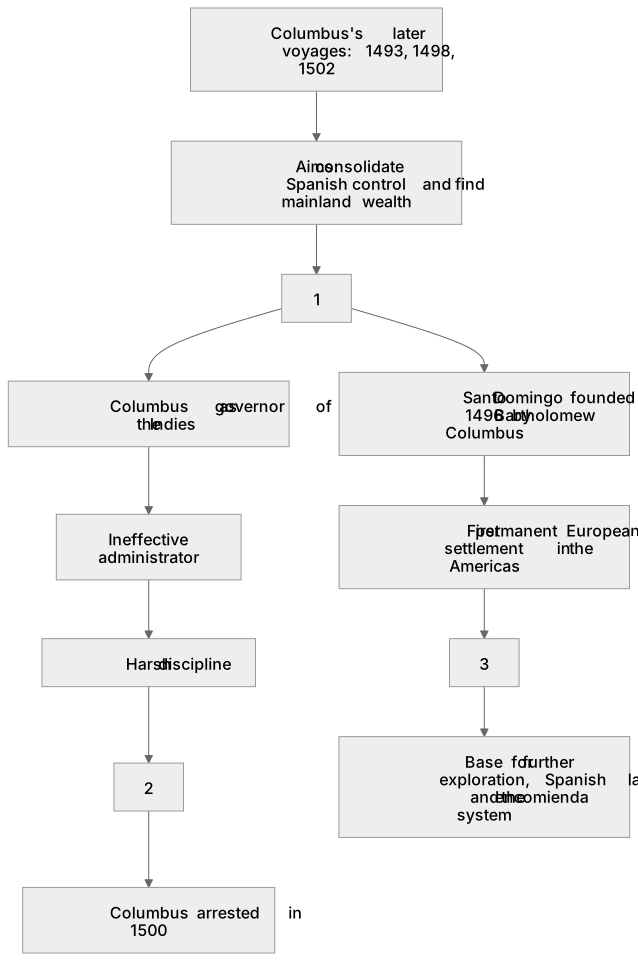
1Box 1
2Box 2
3Box 3
There is more to this lesson
The full lesson goes on to check your understanding and help you earn the marks. Create a free account to carry on, with your progress saved.
A week of Premium from your first lesson · Then the free plan continues · No card, no charge
Test your understanding of Option P1: Key topic 1: Spain reaches the Americas, c1490–1512 - 3 Spanish claims in the Caribbean: Columbus’s later voyages and his role as governor in the Spanish settlement. The significance of the establishment of the Spanish colony at Santo Domingo (1496).
Active recall beats re-reading. Take an instant quiz now to test what you’ve learned and lock it into long-term memory.
A week of Premium from your first lesson · Then the free plan continues · No card, no charge